
Credits and licences
- #1 — vueltaalhuerto illustration
- #2 — vueltaalhuerto illustration
- #3 — vueltaalhuerto illustration
- #4 — vueltaalhuerto illustration
- #5 — vueltaalhuerto illustration
- #6 — vueltaalhuerto illustration
- #7 — vueltaalhuerto illustration
- #8 — vueltaalhuerto illustration
- #9 — vueltaalhuerto illustration
- #10 — vueltaalhuerto illustration
Saskatoon berry
and 2 more names
alder-leaved serviceberry, Amelanchier alnifoliaSaskatoon berry is sown directly outdoors from October to November. It is harvested from June to July. Grow it in full sun, 150 cm apart, with moderate watering. Dates are for a mild temperate climate in the northern hemisphere; the calendar below adjusts them to your zone.
What else to sow in October and November
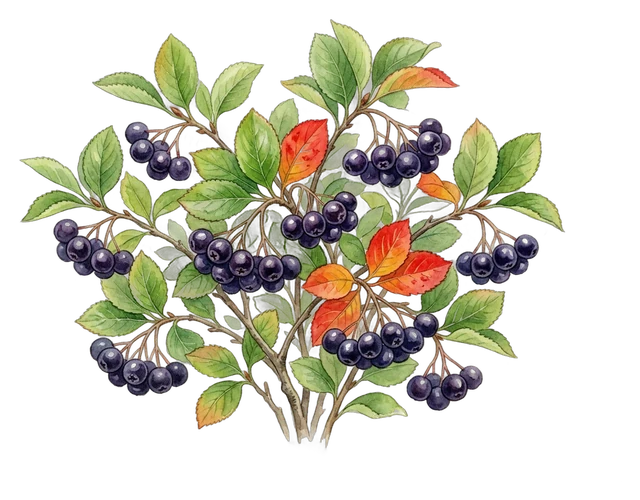
A deciduous shrub 2 to 4 m tall, with several upright stems rising from the base, oval leaves toothed towards the tip, and white star-shaped flowers in short clusters in early spring. It bears small, round, dark violet-blue fruits with a crown at the tip, with a sweet, mild flavour reminiscent of blueberry with a hint of almond. They are eaten fresh, in jam, in tarts or dried. It is very hardy, withstands extreme cold and infertile soils, and flowers early, so late frosts can damage the flowers. It belongs to the same family as the apple and the aronia. Do not confuse it with other species of the genus: snowy mespilus (Amelanchier ovalis) is native to the mountains of Spain and also bears edible, smaller fruits, and many ornamental amelanchiers are planted for their flowers and autumn colour.
Family and origin: Rose family (Rosaceae) · native to North America (Canada and the north-western United States) · More plants from North America
01In your area
How will it do in your garden?
Year calendar
| Task | J | F | M | A | M | J | J | A | S | O | N | D |
|---|---|---|---|---|---|---|---|---|---|---|---|---|
| Direct sowingOct–Nov | no | no | no | no | no | no | no | no | no | yes | yes | no |
| Plant / transplantNov–Mar | yes | yes | yes | no | no | no | no | no | no | no | yes | yes |
| HarvestJun–Jul | no | no | no | no | no | yes | yes | no | no | no | no | no |
| FloweringApr–May | no | no | no | yes | yes | no | no | no | no | no | no | no |
| PruningFeb | no | yes | no | no | no | no | no | no | no | no | no | no |
| CuttingsJun–Jul | no | no | no | no | no | yes | yes | no | no | no | no | no |
| Divide the clumpFeb, Nov | no | yes | no | no | no | no | no | no | no | no | yes | no |
Its life cycle at a glance
Swipe and tap a stage to see its details.
02Planting
Where and how to plant it
Sow the seed 3 mm deep; leave 1.5 m between plants and 3 m between rows.
1.5 m between plants · 3 m between rows
Seed at a depth of 3 mm; seedlings go in with the root ball level with the soil.
- In a square-foot bed
- 1 plant every 25 squares30 × 30 cm squares
- Transplanting
- Nov–Mar
- Direct sowing
- Oct–Nov
- Germination
- ~150 days
03Care
Care through the year
Sun and aspectFull sun · 8 h of sun · South or south-west, with nothing casting shade at midday
- Too little sun
- Ideal range
- Plenty of sun
South or south-west, with nothing casting shade at midday
Strong sun: Loves full midday sun and high temperatures.
Full sun for the best crop; it tolerates partial shade but bears less fruit. In hot areas it appreciates afternoon shade.
WateringMoist but never waterlogged · summer: every 2-3 days
- Summerevery 2-3 days8 L per tree/week
- Spring / Autumnevery 4-5 days4 L per tree/week
- Winterevery 2-3 weeks1.2 L per tree/week
Moist but never waterlogged: Water before the surface is completely dry. Never puddles. Mulch: straw or dry plant material cuts watering by 30-50 %.
Water regularly in the first year and in summer if rain is lacking, especially while the fruits ripen. Once established it tolerates some drought; it does not tolerate waterlogging and does best in well-drained soil.
When to water? Push your finger 3 cm into the soil next to the base of the plant:
- Damp: soil sticks to your finger. Do not water today. The moisture is fine.
- Cool but clean, no mud. Water early tomorrow if it stays like this, or this evening.
- Dry and dusty. Water now, and deeply. This is not where it likes to be.
- TipMulch and water in summer if rain is lacking.
Soil and feedingpH 6–7.5 · Cool, slightly acidic soil with organic matter
Cool, slightly acidic soil with organic matter.
Medium: constant moisture but no puddles.
This plant prefers a pH between 6.0 and 7.5 (slightly acidic to slightly alkaline).
- Use pine needles or pine bark as a mulch (they lower the pH little by little).
- Water with rainwater or softened water if your tap water is hard.
- Compost made from chestnut leaves or leaf litter in autumn keeps up the humus.
- Chalky or alkaline soils cause chlorosis (yellow leaves with green veins).
- Letting the roots dry out while fruiting ruins the harvest.
- TipPlant several shrubs 1.5 m apart in a row, or 0.6 or 1 m apart if you want a hedge, in sun and well-drained, slightly acid or neutral soil.
- TipMulch the base: almost all berry bushes want cool, slightly acidic soil.
PruningWhen: Feb
Pruning time for this plant: Feb.
- TipPrune at the end of winter by thinning out the oldest stems and removing any suckers you do not need, and renew old plants by cutting them down to ground level.
- Common mistakeNot pruning the canes that have already fruited leaves the clump congested.
Common mistakes and tips
- TipIt is self-fertile, although it usually bears more fruit in a group.
- TipFor quality fruit look for cultivars such as 'Smoky', 'Northline' or 'Thiessen'.
- TipIf there is a risk of late frost, protect the flowers with fleece.
- TipDo not eat the seeds in quantity: as in other members of the Rosaceae, they contain small amounts of cyanogenic compounds.
- TipRenew old canes every year to keep up production and air flow.
04Harvest
Harvesting and storing
Harvest in Jun–Jul.
- TipHarvest in June or July, when the berries turn from pink to dark blue; they ripen fairly evenly, and birds seek them out, so cover them with netting.
- Common mistakeLetting it dry out while fruiting ruins the harvest.
05Propagation
Make new plants
The most reliable method is to plant it already rooted, in a pot or bare-root in winter. It is propagated by suckers, the shoots that come up from the base and are separated with roots at the end of winter or in autumn, and by softwood cuttings in early summer. It can also be propagated by seed, which needs a cold period to germinate (sow it in autumn or stratify it), but the plants are variable and take longer to bear fruit.
Seeds: how to germinate them~150 days
06Uses and health
What it is used for, and with what care
The ripe fruit is edible. As in other members of the Rosaceae, the seeds and leaves contain small amounts of cyanogenic compounds, so do not chew them or use them in infusions; in whole fruit, the seeds are swallowed without any problem. There are few data on its effect on pets: to be on the safe side, do not give them leaves, branches or fruit in quantity. Do not confuse it with other shrubs with blue or black berries: eat only fruits you can identify with certainty.
- Properties
- Fruits with a good content of fibre, anthocyanins and other antioxidants, with vitamin C and minerals; they are being studied for their nutritional value, with no proven curative effects.
- Uses
- They are eaten fresh, in jam, compote, tarts, sponge cakes and juices, and dried like raisins. They can be frozen. Harvest only ripe, dark blue fruits.
For guidance only; this is not medical treatment and does not replace advice from a doctor or vet.
07Companions and related plants
What to plant it with
Good companions
Group it in the same bedPlants with the same watering or the same sun
They are not essential companions, but you will not have to water or position them differently.