Credits and licences
- #1 — vueltaalhuerto illustration
- #2 — vueltaalhuerto illustration
- #3 — vueltaalhuerto illustration
- #4 — vueltaalhuerto illustration
- #5 — vueltaalhuerto illustration
- #6 — vueltaalhuerto illustration
- #7 — vueltaalhuerto illustration
- #8 — vueltaalhuerto illustration
- #9 — vueltaalhuerto illustration
- #10 — vueltaalhuerto illustration
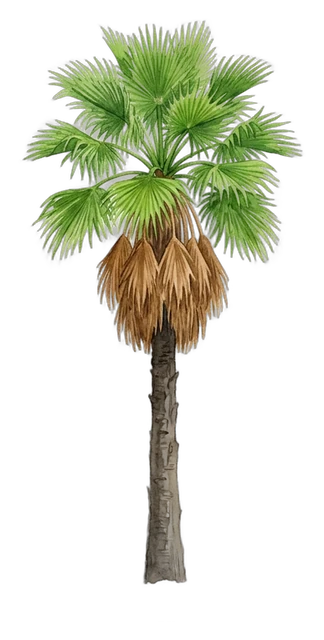
Queen palm (Syagrus romanzoffiana)
and 4 more names
Syagrus romanzoffiana, Arecastrum romanzoffianum, jerivá, palm treeQueen palm (Syagrus romanzoffiana) is sown in seed trays from March to May or directly outdoors from May to July, and planted out from April to June and in September. Grow it in full sun, 500 cm apart, with moderate watering. Dates are for a mild temperate climate in the northern hemisphere; the calendar below adjusts them to your zone.
What else to sow in March, April, May, June and July
A palm with a single smooth, grey, ringed trunk that reaches 10 or 15 m in a garden, and an elegant crown of arching, feathery fronds 3 to 4 m long, with long, drooping leaflets arranged in several planes, which gives it a light, tousled look. In summer it produces large clusters of yellowish flowers that emerge from a woody, boat-shaped spathe, followed, from late summer into autumn, by heavy clusters of oval orange fruits about 2 cm long. It grows quickly with warmth and water and is very common in gardens on the Spanish Mediterranean coast, the Balearic Islands and the Canary Islands. It copes poorly with hard frosts, especially when young. It is a large tree: give it room and do not plant it over car parks, terraces or play areas, because when the old fronds dry and the fruit clusters fall, they are very heavy and leave stains. The flesh of the fruit is edible, fibrous and sweet, but the stone is hard and is not eaten.
Family and origin: Palm family (Arecaceae) · native to Brazil, Paraguay, Uruguay and north-eastern Argentina, in forests and on riverbanks · More plants from South America
01In your area
How will it do in your garden?
Year calendar
| Task | J | F | M | A | M | J | J | A | S | O | N | D |
|---|---|---|---|---|---|---|---|---|---|---|---|---|
| Seed trayMar–May | no | no | yes | yes | yes | no | no | no | no | no | no | no |
| Direct sowingMay–Jul | no | no | no | no | yes | yes | yes | no | no | no | no | no |
| Plant / transplantApr–Jun, Sep | no | no | no | yes | yes | yes | no | no | yes | no | no | no |
| FloweringJun–Aug | no | no | no | no | no | yes | yes | yes | no | no | no | no |
Its life cycle at a glance
Swipe and tap a stage to see its details.
02Planting
Where and how to plant it
Sow the seed 2 cm deep; leave 5 m between plants and 5 m between rows.
5 m between plants · 5 m between rows
Seed at a depth of 2 cm; seedlings go in with the root ball level with the soil.
- Transplanting
- Apr–Jun, Sep
- Seed tray
- Mar–May
- Direct sowing
- May–Jul
- Germination
- ~90 days
- TipBefore planting it, bear in mind that it reaches 10 or 15 m: leave at least 5 m of clear space and do not put it next to houses, cables or pipes.
- TipWatch out for the red palm weevil (Rhynchophorus ferrugineus): it mainly attacks the date palm and the Canary Island date palm, but it can affect other palms; if you see drooping central fronds, sawdust or tunnels in the crown, notify the plant health authorities.
- TipWhen buying it, ask for a nursery-grown plant with a plant passport.
- TipDates, spacing, germination and cold-hardiness are a guide only.
03Care
Care through the year
Sun and aspectFull sun · 8 h of sun · South or south-west, with nothing casting shade at midday
- Too little sun
- Ideal range
- Plenty of sun
South or south-west, with nothing casting shade at midday
Strong sun: Loves full midday sun and high temperatures.
Full sun all day; in shade it becomes leggy and grows weakly. When young it appreciates a few days of light shade after transplanting. A hard frost scorches the fronds; a young palm can die below about -3 or -4 °C and a mature one withstands a little more, although these figures are a guide only and depend on how long the cold lasts.
WateringMoist but never waterlogged · summer: one deep watering every 5 to 7 days
- Summerone deep watering every 5 to 7 days10 L per plant/week
- Spring / Autumnevery 4-5 days5 L per plant/week
- Winterevery 2 to 3 weeks, depending on rainfall1.5 L per plant/week
Moist but never waterlogged: Water before the surface is completely dry. Never puddles. Mulch: straw or dry plant material cuts watering by 30-50 %.
Water generously in the first few years and in summer; a mature palm withstands some drought, but it grows much better with regular moisture and good feeding. It does not tolerate prolonged waterlogging or very chalky soils deficient in iron and manganese (yellowish fronds).
When to water? Push your finger 5 cm into the soil next to the base of the plant:
- Damp: soil sticks to your finger. Do not water today. The moisture is fine.
- Cool but clean, no mud. Water early tomorrow if it stays like this, or this evening.
- Dry and dusty. Water now, and deeply. This is not where it likes to be.
Soil and feedingpH 5.5–7.5 · Free-draining, somewhat gritty mix
Free-draining, somewhat gritty mix.
50 % multi-purpose compost · 30 % coarse sand · 20 % perlite or pumice.
High.
This plant prefers a pH between 5.5 and 7.5 (slightly acidic to slightly alkaline).
- Give a balanced granular fertiliser in spring and summer.
- Water generously but let the surface dry between waterings.
- Burying the trunk causes rot.
- Cutting off all the green fronds weakens the palm.
- TipPlant it in full sun, in deep, fertile, well-drained soil, and mulch the base.
- TipFeed in spring and summer with a palm fertiliser containing magnesium and trace elements.
- TipFree-draining soil and regular watering in hot weather; it does not like constant waterlogging.
Pruning
- TipDo not cut green fronds: remove only the dead ones, preferably by a professional, as over-pruning weakens it.
- Common mistakeOver-pruning weakens the palm and opens the door to pests.
Common mistakes and tips
- TipDo not cut off green fronds: the palm feeds on them.
- Common mistakeBurying the trunk causes rot.
04Propagation
Make new plants
Propagated only by seed, because it has a single trunk and does not produce offsets. Collect the fruits when ripe and orange, remove the flesh and wash them. The seed should be sown fresh, without letting it dry out. Sow about 2 cm deep in a deep container, with moist potting mix and plenty of warmth, about 25 to 30 °C; it germinates very unevenly, usually in two to six months. The first leaf is narrow, like a ribbon.
Seeds: how to germinate them~90 days
05Uses and health
What it is used for, and with what care
No toxicity of the plant to people is known. We have no reliable data for pets: the fruits are fleshy, but the stone is hard and, if a dog swallows a lot of them, it can cause digestive upset or a blockage. Fallen fruits ferment and attract wasps. The fronds have no spines, but the edges of the leaf stalks can cut when handled.
- Properties
- An ornamental palm with light shade and an elegant habit. The flesh of the fruit has traditionally been eaten in its native range.
- Uses
- The flesh of the ripe fruit is edible: sweet and fibrous, it is eaten fresh or in jam; the stone is not eaten. Do not cut out the heart (palm heart) to eat it: the palm will die.
For guidance only; this is not medical treatment and does not replace advice from a doctor or vet.
06Companions and related plants