
Credits and licences
- #1 — vueltaalhuerto illustration
- #2 — vueltaalhuerto illustration
- #3 — vueltaalhuerto illustration
- #4 — vueltaalhuerto illustration
- #5 — vueltaalhuerto illustration
- #6 — vueltaalhuerto illustration
- #7 — vueltaalhuerto illustration
- #8 — vueltaalhuerto illustration
- #9 — vueltaalhuerto illustration
- #10 — vueltaalhuerto illustration
Pink trumpet vine (Podranea ricasoliana)
and 2 more names
podranea, pink bignoniaPink trumpet vine (Podranea ricasoliana) is sown in seed trays from February to April, and planted out from March to May and from September to October. It flowers from June to October. Grow it in full sun, 300 cm apart, with moderate watering. Dates are for a mild temperate climate in the northern hemisphere; the calendar below adjusts them to your zone.
What else to sow in February, March and April
Podranea ricasoliana, also known as the pink trumpet vine, is a vigorous, semi-woody climber that can reach 5 to 8 m if it has support. It has compound leaves of seven to eleven glossy, oval leaflets, and from late spring to autumn it produces clusters of large bell-shaped flowers, pale pink with darker veins in the throat, much visited by bees and bumblebees. It is used to cover sunny walls, pergolas, fences and banks. It is a plant for sun and heat that copes well with drought once established, but it is killed back by hard frost: it resprouts from the base if the frost does not kill it. Because of its vigour it needs space and pruning, and in some warm places it naturalises (see the health warning). Do not confuse it with the trumpet vine (Campsis radicans) or with Cape honeysuckle (Tecoma capensis).
Family and origin: Trumpet vine family (Bignoniaceae) · native to Southern Africa (Zimbabwe, Mozambique and South Africa) · More plants from Africa
01In your area
How will it do in your garden?
Year calendar
| Task | J | F | M | A | M | J | J | A | S | O | N | D |
|---|---|---|---|---|---|---|---|---|---|---|---|---|
| Seed trayFeb–Apr | no | yes | yes | yes | no | no | no | no | no | no | no | no |
| Plant / transplantMar–May, Sep–Oct | no | no | yes | yes | yes | no | no | no | yes | yes | no | no |
| HarvestJun–Oct | no | no | no | no | no | yes | yes | yes | yes | yes | no | no |
| FloweringJun–Oct | no | no | no | no | no | yes | yes | yes | yes | yes | no | no |
| PruningFeb–Mar | no | yes | yes | no | no | no | no | no | no | no | no | no |
| CuttingsJun–Sep | no | no | no | no | no | yes | yes | yes | yes | no | no | no |
Its life cycle at a glance
Swipe and tap a stage to see its details.
02Planting
Where and how to plant it
Sow the seed 3 mm deep; leave 3 m between plants; give it a stake from the start.
3 m between plants
Seed at a depth of 3 mm; seedlings go in with the root ball level with the soil.
- Transplanting
- Mar–May, Sep–Oct
- Seed tray
- Feb–Apr
- Germination
- ~21 days
- Support
- Needs a stake
- TipDo not plant it right next to roofs, gutters or small trees, because it climbs up and smothers them.
- Common mistakePlanting it hard up against a wall with no gap reduces air flow.
03Care
Care through the year
Sun and aspectFull sun · 8 h of sun · South or south-west, with nothing casting shade at midday
- Too little sun
- Ideal range
- Plenty of sun
South or south-west, with nothing casting shade at midday
Strong sun: Loves full midday sun and high temperatures.
Full sun and a spot sheltered from cold winds. In areas with frost, best against a wall that stores heat; if the top growth is frosted, cut it back and it will resprout in spring.
WateringLet it dry out between waterings · summer: every 2-3 days
- Summerevery 2-3 days8 L per plant/week
- Spring / Autumnevery 4-5 days4 L per plant/week
- Winterevery 2-3 weeks1.2 L per plant/week
Let it dry out between waterings: A Mediterranean favourite: better thirsty than overwatered. Mulch: straw or dry plant material cuts watering by 30-50 %.
Water regularly in the first year until it roots and afterwards infrequently, only in long droughts. With slightly more generous watering in summer it flowers more. Waterlogging damages it.
When to water? Push your finger 3 cm into the soil next to the base of the plant:
- Damp: soil sticks to your finger. Do not water yet. It has more than enough; wait for it to dry out more.
- Cool but clean, no mud. Wait another 1-2 days before watering.
- Dry and dusty. Water now, but moderately. Do not overdo it: it prefers thirst to excess.
Soil and feedingpH 6–8 · Deep soil with good drainage
Deep soil with good drainage.
Medium/high.
This plant prefers a pH between 6.0 and 8.0 (slightly acidic to alkaline).
- Guide the first stems onto the support; after that it climbs on its own.
- A mulch at the base keeps the roots moist.
- Planting it hard against a wall reduces air flow and encourages powdery mildew.
- Pruning at the wrong time removes its flower buds.
- TipPlant it in spring or autumn, in well-drained soil, beside a sturdy support: a pergola, mesh or wires, because it is heavy and vigorous.
PruningWhen: Feb–Mar
Pruning time for this plant: Feb–Mar.
- TipPrune it at the end of winter, removing frost-damaged branches and trimming back anything tangled, and after flowering if you want to tidy it; it regrows vigorously.
- TipRemove suckers and shoots that appear away from the plant as soon as they start to grow.
- TipPrune after flowering to keep its vigour in check.
Common mistakes and tips
- TipSize, flowering and cold-tolerance details are approximate.
- TipGuide the first stems onto the support; after that it climbs on its own.
- Common mistakeLeaving it untrained turns it into a tangle that is hard to manage.
04Harvest
Harvesting and storing
Harvest in Jun–Oct.
05Propagation
Make new plants
It is easily propagated from semi-ripe cuttings 15 to 20 cm long, taken from this year's branches that have begun to harden, between June and September; they root within a few weeks in a moist, sandy potting mix, better with rooting hormone. It also produces suckers from the base that can be separated with roots, and the low branches layer themselves when they touch the ground. The seed, held in long, thin pods with winged seeds, germinates with warmth in two or three weeks, but the plant takes longer to flower and may not come true.
Seeds: how to germinate them~21 days
06Uses and health
What it is used for, and with what care
ENVIRONMENTAL WARNING: it is a vigorous African species that readily naturalises in warm climates, through winged seeds and root shoots, and has become naturalised in several regions of the world. It is not listed in the Spanish Catalogue of Invasive Alien Species or on the European Union list, but it is best not to plant it next to scrubland, watercourses or natural coastline, not to dump prunings or seeds outside the garden, and to remove the suckers. There are no reliable toxicity data for people, dogs and cats: it is thought to be low risk, but as a precaution do not eat the flowers, leaves or pods and do not let animals chew them. Do not confuse it with other garden bignonias, such as Campsis radicans or Tecoma capensis.
- Properties
- A climber with abundant pink flowers over a long season, offering nectar to bees and bumblebees from late spring to autumn.
- Uses
- It is not grown for eating. There are no reliable culinary uses.
For guidance only; this is not medical treatment and does not replace advice from a doctor or vet.
07Companions and related plants
What to plant it with
Compare with similar varieties
| Variety | Sowing | Harvest | Days | Spacing | Difficulty |
|---|---|---|---|---|---|
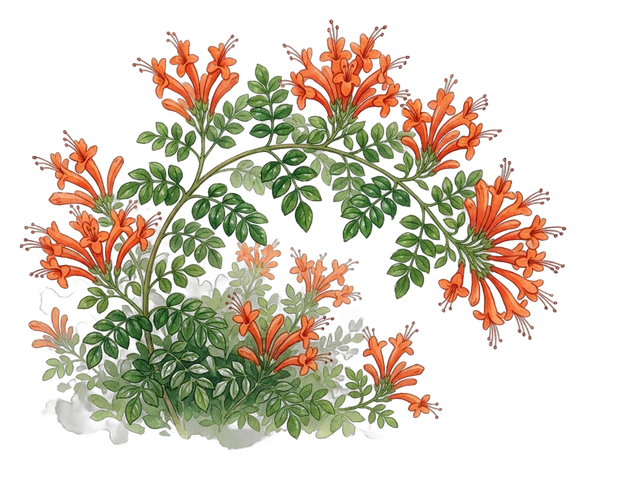
| Cape honeysuckle | Mar–May, Sep–Oct | Sep–Dec | — | 150 cm | Easy |
| Pink trumpet vine (Podranea ricasoliana) | Feb–Apr | Jun–Oct | — | 300 cm | Easy |