
Credits and licences
- #1 — vueltaalhuerto illustration
- #2 — vueltaalhuerto illustration
- #3 — vueltaalhuerto illustration
- #4 — vueltaalhuerto illustration
- #5 — vueltaalhuerto illustration
- #6 — vueltaalhuerto illustration
- #7 — vueltaalhuerto illustration
- #8 — vueltaalhuerto illustration
Needle spikerush (hair grass)
and 3 more names
slender spikerush, Eleocharis acicularis, aquarium carpet plantNeedle spikerush (hair grass) is planted from April to June and in September. It flowers from June to August. Grow it in full sun, 10 cm apart, with plenty of watering. Dates are for a mild temperate climate in the northern hemisphere; the calendar below adjusts them to your zone.
A small perennial wetland plant that forms a dense lawn of extremely fine, cylindrical, leafless stems, bright green and 5 to 20 cm tall, which sprout from slender creeping rhizomes. In summer some stems carry a tiny brownish-green spikelet at the tip, which is the flower. It lives with its roots in the mud of shorelines or in very shallow water, and is used as ground cover at the edge of ponds and as a carpeting plant in freshwater aquariums, where it can grow submerged, with longer, more flexible stems. It is a species native to the Iberian Peninsula, so it is best to buy nursery-grown plants rather than dig up plants from the wild.
Family and origin: Sedge family (Cyperaceae) · native to Temperate regions of the northern hemisphere, including the Iberian Peninsula (muddy shores of ponds, lagoons and rivers) · More plants from Temperate Europe
01In your area
How will it do in your garden?
Year calendar
| Task | J | F | M | A | M | J | J | A | S | O | N | D |
|---|---|---|---|---|---|---|---|---|---|---|---|---|
| Plant / transplantApr–Jun, Sep | no | no | no | yes | yes | yes | no | no | yes | no | no | no |
| FloweringJun–Aug | no | no | no | no | no | yes | yes | yes | no | no | no | no |
| PruningMar | no | no | yes | no | no | no | no | no | no | no | no | no |
| Divide the clumpMar–May | no | no | yes | yes | yes | no | no | no | no | no | no | no |
Its life cycle at a glance
Swipe and tap a stage to see its details.
02Planting
Where and how to plant it
The seed goes on the surface, uncovered; leave 10 cm between plants and 10 cm between rows.
10 cm between plants · 10 cm between rows
Seed at ground level; seedlings go in with the root ball level with the soil.
- Transplanting
- Apr–Jun, Sep
- Germination
- ~30 days
- TipPlant in a grid or at wide spacing: they will fill in on their own with runners.
03Care
Care through the year
Sun and aspectFull sun · 6 h of sun · South or south-west, with nothing casting shade at midday
- Too little sun
- Ideal range
- Plenty of sun
South or south-west, with nothing casting shade at midday
Moderate sun: Copes with full sun, but give it some shade during heatwaves.
Plenty of light: four to six hours of sun, or a well-lit area in the aquarium. In poor light the stems grow long, flop over and do not form a dense lawn. It copes well with cold, even frost, with the rhizome under water or in the mud.
- TipIn an aquarium, plant it in a fine sand or aquasoil substrate, in small clumps set close together, with good light; CO2 is not essential, but it speeds up growth.
WateringVery moist, tolerates waterlogging · summer: always with the roots in soaked mud or under a few centimetres of water
- Summeralways with the roots in soaked mud or under a few centimetres of water1.4 L per plant/week
- Spring / Autumnevery 3-4 days0.6 L per plant/week
- Winterkeep the mud moist0.2 L per plant/week
Very moist, tolerates waterlogging: Saturated or nearly saturated soil. Still watch out for fungal disease.
The roots must always be in waterlogged mud or under a shallow layer of water a few centimetres deep. If the mud dries out in summer, the clump thins and turns yellow. It prefers soft or medium-hard water; in an aquarium, it does wonderfully at 20 to 25 °C.
This is a plant for waterlogged soil or pond margins: the finger test does not help, because the soil must stay wet all the time. Make sure the mud never dries out and, if it grows in a pond, that the water covers the base as the profile says; in summer, top up what evaporates.
- TipDo not empty aquarium or pond waste into natural watercourses or wetlands.
- TipRegular watering at the start helps them carpet the ground sooner.
Soil and feedingpH 5.5–7.5 · Airy soil with some organic matter
Airy soil with some organic matter.
Medium.
This plant prefers a pH between 5.5 and 7.5 (slightly acidic to slightly alkaline).
- Regular watering at the start speeds up coverage by runners.
- Edging to contain it if the species tends to spread.
- Very compacted soil holds back its spread and leaves bare patches.
- Without proper spacing they do not cover well and weeds appear in between.
- TipPlant it in a pond basket or on the marginal shelf, in heavy garden soil without fertiliser or peat, topped with a thin layer of gravel so that it does not float, and with the water barely covering the base.
- Common mistakeCompacted soil holds back their spread.
PruningWhen: Mar
Pruning time for this plant: Mar.
Common mistakes and tips
- TipTrim the lawn with scissors at the end of winter or when it gets very long, and renew the clumps every few years.
- TipHeights, temperatures and timings are approximate.
- Common mistakeLeft unchecked, some become invasive: contain them with edging.
04Propagation
Make new plants
It is very easily propagated by dividing the clump: lift a piece of the lawn, split it into fragments with roots and a few stems, and plant them 5 to 10 cm apart; the creeping rhizomes fill the gaps in a few weeks. You can also cut a piece of clump with scissors and replant it. Growing from seed is possible, but slow and unusual in cultivation; timings are approximate.
05Uses and health
What it is used for, and with what care
There are no reliable data on toxicity to people, dogs and cats. To be safe, do not eat it or use it in infusions, and stop animals chewing the plant. It is native to the Iberian Peninsula: buy nursery-grown plants, do not dig up plants from the wild and do not empty aquarium waste into rivers, ponds or irrigation ditches.
- Properties
- An ornamental and functional plant: its rhizomes hold the mud of the shoreline together, it gives shelter to small aquatic animals and it helps keep the water clean in ponds and aquariums. It has no home medicinal uses.
- Uses
- It is not grown for eating and there are no culinary uses to recommend.
For guidance only; this is not medical treatment and does not replace advice from a doctor or vet.
06Companions and related plants
What to plant it with
Compare with similar varieties
| Variety | Sowing | Harvest | Days | Spacing | Difficulty |
|---|---|---|---|---|---|
| Needle spikerush (hair grass) | Apr–Jun, Sep | — | — | 10 cm | Easy |
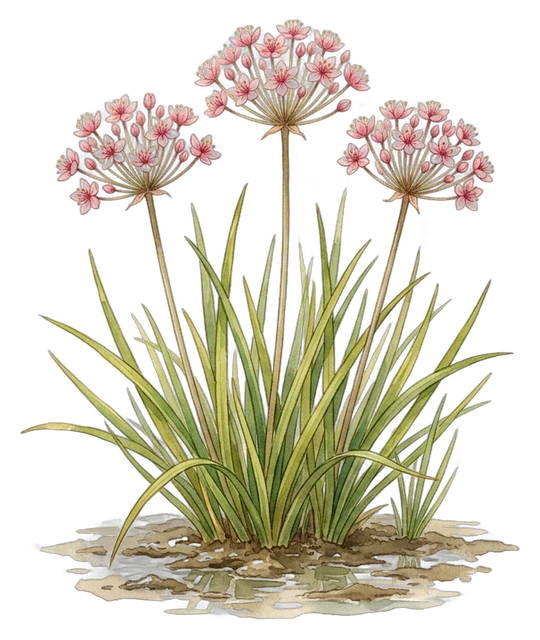
| Flowering rush | Aug–Sep | — | — | 40 cm | Easy |