Credits and licences
- #1 — vueltaalhuerto illustration
- #2 — vueltaalhuerto illustration
- #3 — vueltaalhuerto illustration
- #4 — vueltaalhuerto illustration
- #5 — vueltaalhuerto illustration
- #6 — vueltaalhuerto illustration
- #7 — vueltaalhuerto illustration
- #8 — vueltaalhuerto illustration
- #9 — vueltaalhuerto illustration
- #10 — vueltaalhuerto illustration
Pachypodium lamerei (Madagascar palm)
and 1 more names
Pachypodium lameriPachypodium lamerei (Madagascar palm) is sown in seed trays from March to May, and planted out from April to June. Grow it in full sun, 60 cm apart, with little watering. Dates are for a mild temperate climate in the northern hemisphere; the calendar below adjusts them to your zone.
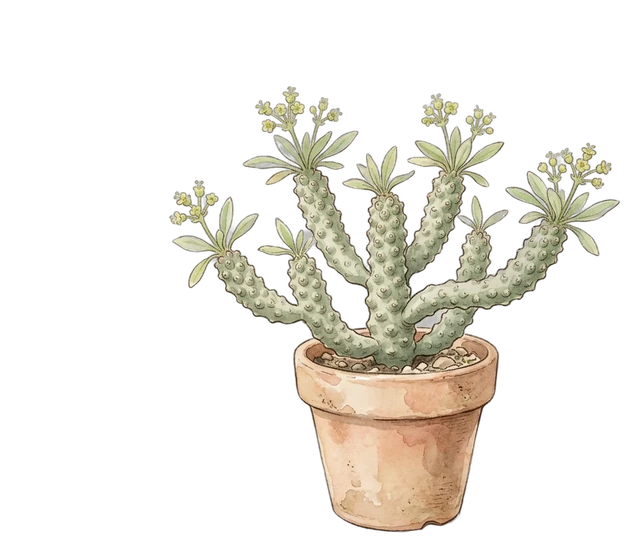
The Madagascar palm is not a palm, even though it looks like one: it is a succulent with a thick, cylindrical, silvery trunk that stores water and is covered in long spines arranged in threes. At the top it carries a tuft of long, narrow, glossy dark green leaves with a pale central vein. In cultivation it usually reaches 1 to 2 m, and in the wild several metres. Only mature specimens of 1.8 m or more flower, and rarely indoors: they do so in spring or early summer, with clusters of white five-petalled flowers with a yellow throat. In cultivation it drops its leaves in winter if it is cold or short of light and grows them back in spring, which is quite normal for the plant. It needs plenty of sun, a very free-draining potting mix and little water, and it cannot stand frost, which is why it is grown in pots on terraces and in bright rooms indoors. LEGAL AND SAFETY NOTICE: Legal: the whole genus Pachypodium is regulated by the CITES convention, and Pachypodium lamerei is listed in its Appendix II (the EU includes it in Annex B of Regulation (EC) 338/97). Live plants and their parts need paperwork for international trade, while seeds are outside that regulation. In practice, always buy plants from an authorised nursery, with a receipt, and do not buy or transport specimens taken from the wild in Madagascar; if you are going to travel outside the EU with the plant, check the convention's requirements first. Safety: the plant's milky latex irritates the skin and eyes, and, as with other members of the dogbane family, its sap is said to contain cardiac glycosides (cardenolides), so it should be treated as toxic. The trunk and branches bear long, rigid spines in groups of three that easily cause injury. What to do: do not eat it or use it in herbal teas; handle the plant with thick gloves and goggles when pruning or repotting; keep it away from children and pets, and if anyone swallows the sap or gets it on them, rinse with plenty of water and, in Spain, call the Toxicology Information Service (91 562 04 20) or the vet without waiting for symptoms. It is not listed in the Spanish Catalogue of Invasive Alien Species (Royal Decree 630/2013).
Family and origin: Dogbane family (Apocynaceae) · native to Southern Madagascar, on rocky slopes and in dry spiny forest · More plants from Africa
01In your area
How will it do in your home?
Year calendar
| Task | J | F | M | A | M | J | J | A | S | O | N | D |
|---|---|---|---|---|---|---|---|---|---|---|---|---|
| Seed trayMar–May | no | no | yes | yes | yes | no | no | no | no | no | no | no |
| Plant / transplantApr–Jun | no | no | no | yes | yes | yes | no | no | no | no | no | no |
Its life cycle at a glance
Swipe and tap a stage to see its details.
02Care
Care through the year
Sun and aspectFull sun · 8 h of sun · South or south-west, with nothing casting shade at midday
- Too little sun
- Ideal range
- Plenty of sun
South or south-west, with nothing casting shade at midday
Strong sun: Loves full midday sun and high temperatures.
Full sun and warmth, indoors too, next to the brightest window. It does not survive frost: below about 10 °C it drops its leaves and below about 5 °C it suffers damage.
- Common mistakeLack of light makes them stretch and go soft (etiolation).
WateringLet it dry out between waterings · summer: every 10 to 14 days, deeply, letting it dry out in between
- Summerevery 10 to 14 days, deeply, letting it dry out in between0.2 L per plant/week
- Spring / Autumnevery 10-14 days0.1 L per plant/week
- Winteralmost none, once a month at most if dormant0 L per plant/week
Let it dry out between waterings: A Mediterranean favourite: better thirsty than overwatered.
Water only when the potting mix is completely dry, and hardly at all in winter: too much water rots the trunk.
When to water? Push your finger 8 cm into the soil next to the base of the plant:
- Damp: soil sticks to your finger. Do not water yet. It has more than enough; wait for it to dry out more.
- Cool but clean, no mud. Wait another 1-2 days before watering.
- Dry and dusty. Water now, but moderately. Do not overdo it: it prefers thirst to excess.
- TipWater sparingly, and not at all in winter if it has dropped its leaves.
- TipWatering, temperatures and timings are only a guide.
- TipWater thoroughly and leave long gaps: better thirsty than overwatered.
- Common mistakeWatering often rots the crown and the roots.
Potting mix and feedingpH 6–7.5 · Very gritty, free-draining mix
Very gritty, free-draining mix.
30 % multi-purpose compost · 40 % coarse sand · 30 % perlite or pumice.
Very high: standing moisture rots them.
This plant prefers a pH between 6.0 and 7.5 (slightly acidic to slightly alkaline).
- Multi-purpose compost on its own with no drainage: rot sets in quickly.
- Watering the rosette or the leaves marks them and causes rot.
- TipPlant it in a heavy, deep pot with cactus compost mixed with plenty of coarse sand or pumice, and put it in the sunniest spot in the house or on the terrace.
- TipVery free-draining mix (with sand/perlite) and pots with a drainage hole.
Common mistakes and tips
- TipRepot wearing thick gloves and hold it with a cloth or folded cardboard so you do not get pricked.
- TipWatch out for mealybugs and for black patches on the trunk, a sign of rot.
03Propagation
Make new plants
It is propagated mainly from fresh seed, sown on the surface over sand and a very free-draining mix, with warmth of about 22 °C: sources give anything from a few days to three or four weeks, and seedlings keep appearing irregularly for months. The seedlings soon thicken at the base and grow slowly. Branched specimens can provide cuttings, although this is not common.
Seeds: how to germinate them~21 days
04Uses and health
What it is used for, and with what care
As with other members of the dogbane family, this plant's milky latex irritates the skin and eyes, and its sap is said to contain cardiac glycosides (cardenolides), which can disturb the heart rhythm; swallowing it can cause vomiting, diarrhoea and heart problems. There is little data specific to this species, so it is treated as highly toxic as a precaution. Handle the plant with gloves and goggles, keep it out of the reach of children and pets, and do not use it as a remedy in any form. The spines easily cause injury. In the event of any ingestion or contact with the eyes, rinse with plenty of water and, in Spain, call the Toxicology Information Service (91 562 04 20) or the vet without waiting for symptoms.
- Properties
- An ornamental plant with no safe home medicinal uses.
- Uses
- It is not edible. It has no culinary or medicinal uses; do not use it in herbal teas or eat it.
For guidance only; this is not medical treatment and does not replace advice from a doctor or vet.
05Companions and related plants