Credits and licences
- #1 — vueltaalhuerto illustration
- #2 — vueltaalhuerto illustration
- #3 — vueltaalhuerto illustration
- #4 — vueltaalhuerto illustration
- #5 — vueltaalhuerto illustration
- #6 — vueltaalhuerto illustration
- #7 — vueltaalhuerto illustration
- #8 — vueltaalhuerto illustration
- #9 — vueltaalhuerto illustration
- #10 — vueltaalhuerto illustration
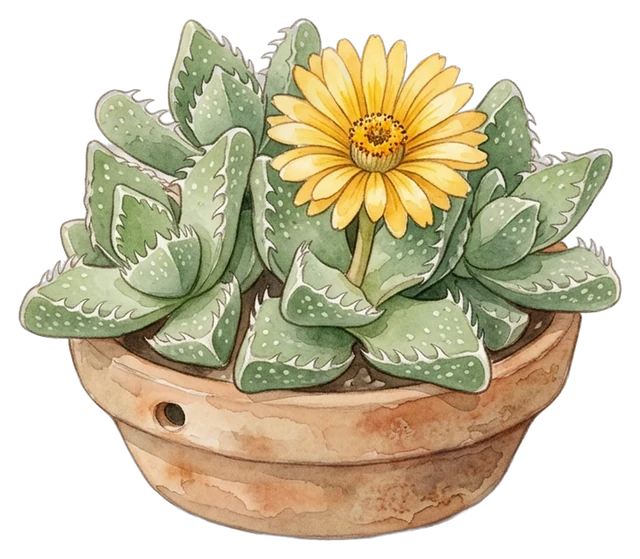
Machairophyllum brevifolium (short-leaved mesemb)
and 2 more names
ice plant, yellow ice plantMachairophyllum brevifolium (short-leaved mesemb) is sown in seed trays from September to October, and planted out from March to April and in October. Grow it in full sun, 15 cm apart, with little watering. Dates are for a mild temperate climate in the northern hemisphere; the calendar below adjusts them to your zone.
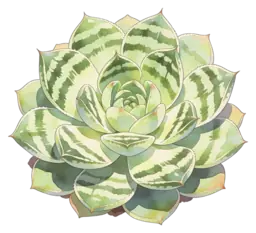
A small, almost stemless succulent that forms compact clumps or small mats 3 to 5 cm tall. The leaves, 1 to 3 cm long, are fleshy, greyish green, three-angled and shaped like a pointed sword blade, and are packed tightly together. In cultivation it flowers at the end of summer and in autumn (as a guide): each flower is solitary, bright yellow, about 3 to 4.5 cm across, with many narrow, daisy-like petals, and opens in the afternoon. Afterwards it forms a dry, star-shaped capsule that opens in the rain, with tiny seeds. It is one of the so-called ‘midday flowers’ (the mesemb family) and, unlike many indoor succulents, it grows in the cool season and rests in summer. It is not edible. There are no toxicity data for this species.
Family and origin: Ice plant family (Aizoaceae) · native to South Africa, in the Western Cape (Little Karoo, near Oudtshoorn), on slopes of reddish conglomerate among scrub, in an area with a dry climate and winter rainfall · More plants from Africa
01In your area
How will it do in your home?
Year calendar
| Task | J | F | M | A | M | J | J | A | S | O | N | D |
|---|---|---|---|---|---|---|---|---|---|---|---|---|
| Seed traySep–Oct | no | no | no | no | no | no | no | no | yes | yes | no | no |
| Plant / transplantMar–Apr, Oct | no | no | yes | yes | no | no | no | no | no | yes | no | no |
| CuttingsApr–May, Sep–Oct | no | no | no | yes | yes | no | no | no | yes | yes | no | no |
Its life cycle at a glance
Swipe and tap a stage to see its details.
02Care
Care through the year
Sun and aspectFull sun · 7 h of sun · shade in summer
- Too little sun
- Ideal range
- Plenty of sun
South or south-west, with nothing casting shade at midday
Strong sun: Loves full midday sun and high temperatures.
Plenty of light and direct sun for most of the year; shade stops it flowering. In high summer it appreciates a cool, somewhat shaded spot while it rests. It does not withstand hard frosts: protect it when temperatures drop below about 2 °C.
- Common mistakeLack of light makes them stretch and go soft (etiolation).
WateringLet it dry out between waterings · summer: almost none: just a splash if it shrivels
- Summeralmost none: just a splash if it shrivels0.2 L per plant/week
- Spring / Autumnevery 10-14 days0.1 L per plant/week
- Winterevery 10 to 14 days, sparingly, from October to March0 L per plant/week
Let it dry out between waterings: A Mediterranean favourite: better thirsty than overwatered.
It grows in autumn, winter and spring (as a guide): water moderately from September or October until March and let the potting mix dry out between waterings. In summer, during its rest, keep the potting mix almost dry and water only if the leaves shrivel. Too much water in summer or in cold weather rots the base.
When to water? Push your finger 4 cm into the soil next to the base of the plant:
- Damp: soil sticks to your finger. Do not water yet. It has more than enough; wait for it to dry out more.
- Cool but clean, no mud. Wait another 1-2 days before watering.
- Dry and dusty. Water now, but moderately. Do not overdo it: it prefers thirst to excess.
- TipThe watering, temperatures and timings are only a guide.
- TipWater thoroughly and leave long gaps: better thirsty than overwatered.
- Common mistakeWatering often rots the crown and the roots.
Potting mix and feedingpH 6–7.5 · Very gritty, free-draining mix
Very gritty, free-draining mix.
30 % multi-purpose compost · 40 % coarse sand · 30 % perlite or pumice.
Very high: standing moisture rots them.
This plant prefers a pH between 6.0 and 7.5 (slightly acidic to slightly alkaline).
- Multi-purpose compost on its own with no drainage: rot sets in quickly.
- Watering the rosette or the leaves marks them and causes rot.
- TipPlant it in a low, wide terracotta pot with a very mineral potting mix (for example, half cactus compost and half coarse sand, pumice or fine gravel) and place it in full sun.
- TipFeed sparingly: a cactus fertiliser at half strength once at the start of the growing season.
- TipIn a large pot with more water it forms denser clumps; in a small pot with drier potting mix in summer, it stays more compact.
- TipVery free-draining mix (with sand/perlite) and pots with a drainage hole.
Common mistakes and tips
- TipWatch out for mealybugs.
03Propagation
Make new plants
It is propagated by seed and by cuttings. Stem cuttings with a few leaves are taken in spring or autumn, the wound is left to dry for a few days and they are planted in an almost dry mineral potting mix; they root in a few weeks. The seed, tiny, brown and about 1 mm across, comes from the dry capsules that open in damp conditions; sow it in autumn on the surface of fine sand at 15 to 22 °C with plenty of light, watering from below.
Seeds: how to germinate them~14 days
04Uses and health
What it is used for, and with what care
We have not found any toxicity data for this species. To be on the safe side, do not eat it and stop children, dogs and cats chewing the leaves; if this happens and vomiting or other symptoms appear, consult a doctor or a vet.
- Properties
- An ornamental succulent with striking flowers. It has no home medicinal uses.
- Uses
- It is not edible. There are no culinary uses or herbal teas.
For guidance only; this is not medical treatment and does not replace advice from a doctor or vet.
05Companions and related plants