Credits and licences
- #1 — vueltaalhuerto illustration
- #2 — vueltaalhuerto illustration
- #3 — vueltaalhuerto illustration
- #4 — vueltaalhuerto illustration
- #5 — vueltaalhuerto illustration
- #6 — vueltaalhuerto illustration
- #7 — vueltaalhuerto illustration
- #8 — vueltaalhuerto illustration
- #9 — vueltaalhuerto illustration
Lippia (Phyla nodiflora)
and 4 more names
Lippia nodiflora, capeweed, lippia lawn, Phyla canescensLippia (Phyla nodiflora) is planted from April to June and in September. It flowers from May to October. Grow it in full sun, 30 cm apart, with moderate watering. Dates are for a mild temperate climate in the northern hemisphere; the calendar below adjusts them to your zone.
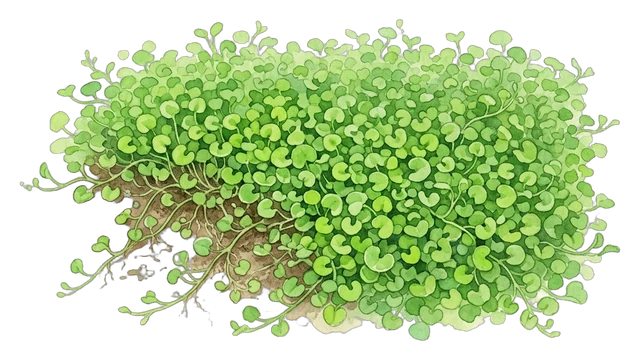
A groundcover that is evergreen in mild climates, with creeping, branching stems that root at the nodes and form a low, dense carpet only 5 to 15 cm high that spreads over several metres. The leaves are small, oval and toothed towards the tip, light green, and from spring to autumn rounded or conical heads of tiny white and lilac-pink flowers with yellow centres appear, much visited by bees and butterflies. It is used as a lawn substitute in areas with little foot traffic, on banks, between stones and at the edges of ponds. It withstands heat, drought once established, light trampling and salt; in severe cold it scorches and loses its leaves, although it regrows from the roots if the frost is light (a guide only). Be careful with its vigour: it can escape from the garden and run wild in damp, sandy soils, riverbanks and wetlands in warm climates. It is not regulated as invasive in Spain or the EU, but do not plant it next to watercourses, salt marshes or dunes and do not release it into the wild. It is not edible, and do not confuse it with lemon verbena (Aloysia), which is a different plant.
Family and origin: Verbena family (Verbenaceae) · native to Tropical and subtropical America, naturalised in warm regions all over the world · More plants from South America
01In your area
How will it do in your garden?
Year calendar
| Task | J | F | M | A | M | J | J | A | S | O | N | D |
|---|---|---|---|---|---|---|---|---|---|---|---|---|
| Plant / transplantApr–Jun, Sep | no | no | no | yes | yes | yes | no | no | yes | no | no | no |
| FloweringMay–Oct | no | no | no | no | yes | yes | yes | yes | yes | yes | no | no |
| CuttingsApr–Sep | no | no | no | yes | yes | yes | yes | yes | yes | no | no | no |
| Divide the clumpApr–Jun, Sep | no | no | no | yes | yes | yes | no | no | yes | no | no | no |
Its life cycle at a glance
Swipe and tap a stage to see its details.
02Planting
Where and how to plant it
Leave 30 cm between plants and 30 cm between rows.
30 cm between plants · 30 cm between rows
Seedlings are planted with the root ball level with the soil.
- Transplanting
- Apr–Jun, Sep
- TipPlant in a grid or at wide spacing: they will fill in on their own with runners.
03Care
Care through the year
Sun and aspectFull sun · 8 h of sun · South or south-west, with nothing casting shade at midday
- Too little sun
- Ideal range
- Plenty of sun
South or south-west, with nothing casting shade at midday
Strong sun: Loves full midday sun and high temperatures.
Full sun for a dense, free-flowering carpet; it tolerates some shade, but then becomes sparser and flowers less.
- TipAs a lawn substitute it takes light trampling, not heavy wear.
WateringMoist but never waterlogged · summer: every 3 to 5 days the first summer; after that, every 7 to 10 days
- Summerevery 3 to 5 days the first summer; after that, every 7 to 10 days0.8 L per plant/week
- Spring / Autumnevery 4-5 days0.4 L per plant/week
- Winterevery 2-3 weeks0.1 L per plant/week
Moist but never waterlogged: Water before the surface is completely dry. Never puddles. Mulch: straw or dry plant material cuts watering by 30-50 %.
Water regularly until it is established (a few weeks). Once established it tolerates drought and turns brown in an extreme heatwave, but recovers with watering. If you want a green carpet in high summer, water deeply and infrequently. Do not leave it permanently waterlogged.
When to water? Push your finger 3 cm into the soil next to the base of the plant:
- Damp: soil sticks to your finger. Do not water today. The moisture is fine.
- Cool but clean, no mud. Water early tomorrow if it stays like this, or this evening.
- Dry and dusty. Water now, and deeply. This is not where it likes to be.
- TipRegular watering at the start helps them carpet the ground sooner.
Soil and feedingpH 6–8 · Airy soil with some organic matter
Airy soil with some organic matter.
Medium.
This plant prefers a pH between 6.0 and 8.0 (slightly acidic to alkaline).
- Regular watering at the start speeds up coverage by runners.
- Edging to contain it if the species tends to spread.
- Very compacted soil holds back its spread and leaves bare patches.
- Without proper spacing they do not cover well and weeds appear in between.
- TipPlant it in full sun, 30 cm apart, in loose, free-draining soil; it covers the ground in one or two seasons.
- Common mistakeCompacted soil holds back their spread.
Common mistakes and tips
- TipCut it with the mower on its highest setting or with a strimmer a couple of times a year to keep it dense and limit its spread, and put in a deep edging or a stone path to contain it.
- TipIn cold climates it loses its leaves with frost.
- TipIt attracts bees, so do not use it where people walk barefoot if anyone is allergic to stings.
- TipThe figures are a guide only and depend on the climate.
- Common mistakeLeft unchecked, some become invasive: contain them with edging.
04Propagation
Make new plants
It is very easily propagated by cuttings: the creeping stems root by themselves at every node that touches the soil, so you only need to cut pieces 10 to 15 cm long with several nodes and lay them on moist potting mix, or plant them with one node buried, from spring to early autumn, when it is warm. They root in one or two weeks (a guide only). Rooted pieces can also be separated from the clump. It sets seed, but this is rarely used. Cut and remove surplus trimmings and do not dump them in watercourses or natural wetlands.
05Uses and health
What it is used for, and with what care
It is not edible and there are no reliable data on its toxicity in people or pets. Although it is used in folk medicine in some countries, to be safe do not eat any part of it, do not use it in infusions or home remedies, and do not let children, dogs or cats chew it. If symptoms appear after it has been swallowed, in Spain consult the Toxicology Information Service (91 562 04 20) or call 112, and the vet if it is an animal. NATURALISED SPECIES WARNING: it is very vigorous and can escape from the garden in damp soils, riverbanks and dunes in warm climates. It is not regulated as invasive in Spain or the EU, but do not plant it next to watercourses, salt marshes or wetlands and do not throw trimmings into the wild.
- Properties
- An ornamental groundcover plant: it is not grown for consumption and has no proven health uses. Its flowers are visited by bees and butterflies.
- Uses
- It is not edible. It is grown as a groundcover and lawn substitute in areas with little foot traffic.
For guidance only; this is not medical treatment and does not replace advice from a doctor or vet.
06Companions and related plants