
Credits and licences
- #1 — vueltaalhuerto illustration
- #2 — vueltaalhuerto illustration
- #3 — vueltaalhuerto illustration
- #4 — vueltaalhuerto illustration
- #5 — vueltaalhuerto illustration
- #6 — vueltaalhuerto illustration
- #7 — vueltaalhuerto illustration
- #8 — vueltaalhuerto illustration
- #9 — vueltaalhuerto illustration
- #10 — vueltaalhuerto illustration
Gymnocalycium schickendantzii (globular cactus)
and 1 more names
globe cactusGymnocalycium schickendantzii (globular cactus) is sown in seed trays from March to May, and planted out from April to June. It flowers from May to July. Grow it in sun or partial shade, 15 cm apart, with little watering. Dates are for a mild temperate climate in the northern hemisphere; the calendar below adjusts them to your zone.
A somewhat flattened globular cactus, about 6 to 12 cm across, with greyish-green or bluish-grey skin and 9 to 14 broad ribs marked by transverse grooves that form a kind of ‘chin’ beneath each areole. The spines, 3 to 7 per areole, are short and curved and lie flat against the body like a small greyish-brown spider. It grows slowly and, over the years, may produce offsets at the base. In spring and early summer it opens funnel-shaped flowers 4 to 6 cm across from the top, white or very pale pink with a darker throat, followed by fleshy greenish or pinkish fruits full of tiny black seeds. It copes well with sun, drought and moderate dry cold, but too much water and damp cold do not suit it. It is a collector's cactus, easy if the mix drains very well. It is neither edible nor toxic, but it has spines. All cacti are listed in Appendix II of the CITES convention: always buy nursery-raised plants and do not collect wild plants or seeds.
Family and origin: Cactus family (Cactaceae) · native to Central and north-western Argentina (the provinces of Córdoba, La Rioja, Catamarca, Mendoza and neighbouring ones), in dry scrub and on stony soils · More plants from South America
01In your area
How will it do in your home?
Year calendar
| Task | J | F | M | A | M | J | J | A | S | O | N | D |
|---|---|---|---|---|---|---|---|---|---|---|---|---|
| Seed trayMar–May | no | no | yes | yes | yes | no | no | no | no | no | no | no |
| Plant / transplantApr–Jun | no | no | no | yes | yes | yes | no | no | no | no | no | no |
| FloweringMay–Jul | no | no | no | no | yes | yes | yes | no | no | no | no | no |
| Divide the clumpApr–Jun | no | no | no | yes | yes | yes | no | no | no | no | no | no |
Its life cycle at a glance
Swipe and tap a stage to see its details.
02Care
Care through the year
Sun and aspectSun and shade · 6 h of sun · shade in summer
- Too little sun
- Ideal range
- Plenty of sun
East, or south with light shade during the middle of the day
Strong sun: Loves full midday sun and high temperatures.
It likes plenty of light and some direct morning or afternoon sun; in full midday sun in summer, or if put out after winter without acclimatising, the skin turns brown or scorches. In low light it stretches and does not flower. In winter the best place is a bright window or a cold greenhouse. It withstands light frosts down to about -3 °C only with dry mix, and outdoors in areas with cold, wet winters it is best protected from rain.
WateringLet it dry out between waterings · summer: every 10 to 14 days, only when the mix is completely dry
- Summerevery 10 to 14 days, only when the mix is completely dry0.2 L per plant/week
- Spring / Autumnevery 10-14 days0.1 L per plant/week
- Winterno watering from November to February (at most a drop once a month if central heating dries it out)0 L per plant/week
Let it dry out between waterings: A Mediterranean favourite: better thirsty than overwatered.
Water from April to October, sparingly and without waterlogging, when the mix is dry all the way down, and let the water drain away well. In winter keep it dry and cool (5 to 12 °C): this rest is what makes it flower in spring. A pot with drainage holes and a layer of coarse sand or gravel at the bottom prevent almost all losses.
When to water? Push your finger 5 cm into the soil next to the base of the plant:
- Damp: soil sticks to your finger. Do not water yet. It has more than enough; wait for it to dry out more.
- Cool but clean, no mud. Wait another 1-2 days before watering.
- Dry and dusty. Water now, but moderately. Do not overdo it: it prefers thirst to excess.
- TipIf the skin wrinkles and sinks in summer, it needs water; if it goes soft and black from the base, it has had too much water: take it out, cut away the rotten part and let it dry before replanting.
- TipA dry winter rest: with hardly any water they flower better in spring.
- Common mistakeWatering in cold winter weather is the fast track to rot.
Potting mix and feedingpH 6–7.5 · Mineral mix with almost no organic matter
Mineral mix with almost no organic matter.
20 % multi-purpose compost · 40 % silica sand · 40 % pumice or lava rock.
Extreme.
This plant prefers a pH between 6.0 and 7.5 (slightly acidic to slightly alkaline).
- Rich, compact mix: certain rot within a few months.
- Watering in cold winter weather: the first step towards rot.
- TipUse a cactus mix with at least half coarse sand, fine gravel or pumice, and a terracotta pot with good drainage.
- TipFeed only from April to August, once a month, with a low-nitrogen cactus fertiliser.
- TipPlenty of light and a free-draining mineral mix.
- Common mistakeA mix that holds water drowns the roots.
03Propagation
Make new plants
It is propagated by seed and, on old plants, by offsets. The tiny black seeds are sown in spring on a moist mineral mix (sand, perlite and a little peat), without covering them, in a propagator at 20-25 °C with plenty of light; they germinate in two or three weeks, and the seedlings take years to reach the size of a marble. Offsets are separated in spring or early summer with a clean blade, left to dry for five to seven days and set on dry mix until they root.
Seeds: how to germinate them~14 days
04Uses and health
What it is used for, and with what care
- Properties
- A decorative, low-maintenance cactus. It has no home medicinal uses.
- Uses
- It is not grown for food. The fruits are not eaten.
For guidance only; this is not medical treatment and does not replace advice from a doctor or vet.
05Companions and related plants
What to plant it with
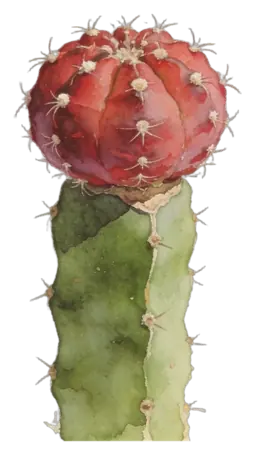
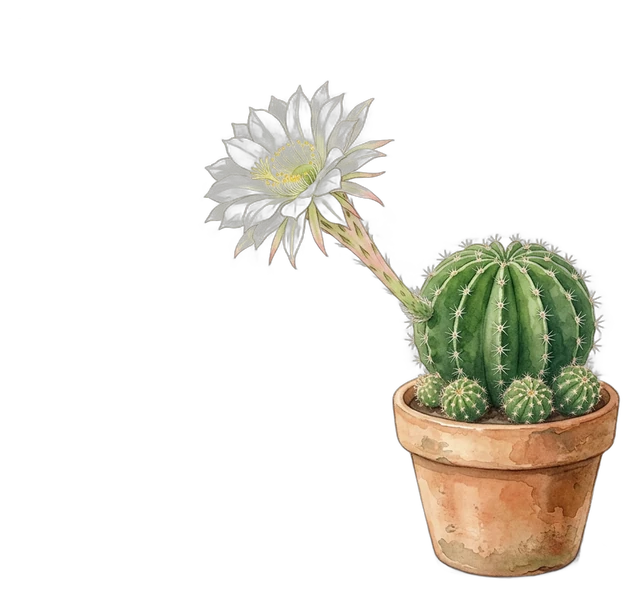
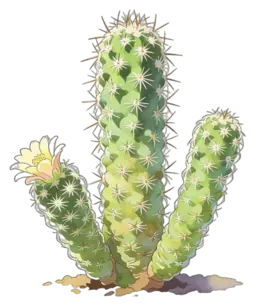
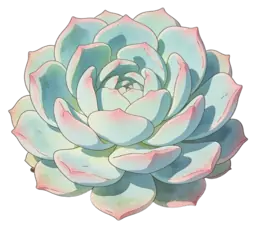
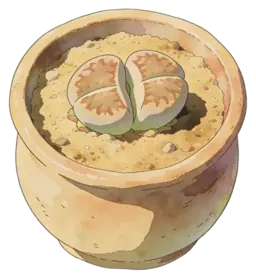
Compare with similar varieties
| Variety | Sowing | Harvest | Days | Spacing | Difficulty |
|---|---|---|---|---|---|
| Moon cactus (Gymnocalycium) | — | — | — | 12 cm | Easy |
| Gymnocalycium gibbosum (chin cactus) | Mar–May | — | ~1825 | 20 cm | Easy |
| Gymnocalycium schickendantzii (globular cactus) | Mar–May | — | — | 15 cm | Easy |
No known toxicity to people or pets
No toxic substances are known in this species. The risk is physical: the spines prick and the wound can become infected, so keep it out of reach of children and curious animals. A pet that bites the cactus may get spines in its mouth and mild digestive upset.