
Credits and licences
- #1 — vueltaalhuerto illustration
- #2 — vueltaalhuerto illustration
- #3 — vueltaalhuerto illustration
- #4 — vueltaalhuerto illustration
- #5 — vueltaalhuerto illustration
- #6 — vueltaalhuerto illustration
- #7 — vueltaalhuerto illustration
- #8 — vueltaalhuerto illustration
- #9 — vueltaalhuerto illustration
Ficus benghalensis 'Audrey' (ficus Audrey, banyan)
and 4 more names
banyan tree, Indian banyan, Bengal fig, ficusFicus benghalensis 'Audrey' (ficus Audrey, banyan) is planted from March to June. Grow it in sun or partial shade, 100 cm apart, with moderate watering. Dates are for a mild temperate climate in the northern hemisphere; the calendar below adjusts them to your zone.
An indoor tree which, in the cultivar ‘Audrey’, has an upright habit, with a single trunk of smooth, light grey bark and large, broad, oval leaves 15 to 25 cm long, matt and velvety, greyish green with very prominent pale veins. Indoors it reaches 1.5 or 2.5 m and grows quickly if it has enough light. In its native habitat, and outdoors in frost-free climates, the species becomes an enormous banyan that sends down aerial roots from its branches and forms a multiple trunk: do not plant it near walls, pipes or foundations. Indoors it does not produce figs. It is sensitive to sudden changes of position, light or watering, and drops leaves when they happen. It is not edible. LEGAL AND SAFETY WARNING: all parts of the plant release a white latex that irritates the skin and mucous membranes; it is considered a skin allergen and advises wearing gloves when handling it, and it is toxic to dogs and cats if they chew it. What to do: wear gloves when pruning it or taking cuttings, wash off any splashes with soap and water, and avoid contact with the eyes; keep it out of reach of children and pets and, if any part is swallowed, consult a doctor or a vet.
Family and origin: Mulberry family (Moraceae) · native to The Indian subcontinent (India, Pakistan and neighbouring countries), in forests and open areas; in many places it is a sacred tree and a shade tree · More plants from South Asia
01In your area
How will it do in your home?
Year calendar
| Task | J | F | M | A | M | J | J | A | S | O | N | D |
|---|---|---|---|---|---|---|---|---|---|---|---|---|
| Plant / transplantMar–Jun | no | no | yes | yes | yes | yes | no | no | no | no | no | no |
| PruningMar–May | no | no | yes | yes | yes | no | no | no | no | no | no | no |
| CuttingsApr–Jul | no | no | no | yes | yes | yes | yes | no | no | no | no | no |
Its life cycle at a glance
Swipe and tap a stage to see its details.
02Planting
Planting and transplanting
- TipWipe the dust off the leaves with a damp cloth and turn the pot now and then.
03Care
Care through the year
Sun and aspectSun and shade · 4 h of sun · shade in summer
- Too little sun
- Ideal range
- Plenty of sun
East, or south with light shade during the middle of the day
Moderate sun: Copes with full sun, but give it some shade during heatwaves.
Bright light, with a few hours of gentle morning or afternoon sun; in low light it stretches and drops leaves. Avoid strong midday sun through glass and draughts. It does not cope well below about 10 °C: it is recommended to growing it at a minimum of about 15 °C.
- TipTurn the pot every week so it grows evenly towards the light.
WateringMoist but never waterlogged · summer: every 7 to 10 days
- Summerevery 7 to 10 days0.6 L per plant/week
- Spring / Autumnevery 4-5 days0.3 L per plant/week
- Winterevery 12 to 15 days0.1 L per plant/week
Moist but never waterlogged: Water before the surface is completely dry. Never puddles.
Water thoroughly when the top 3 to 5 cm of the mix are dry, and empty the saucer. In winter water less, without letting the root ball dry out completely.
When to water? Push your finger 3 cm into the soil next to the base of the plant:
- Damp: soil sticks to your finger. Do not water today. The moisture is fine.
- Cool but clean, no mud. Water early tomorrow if it stays like this, or this evening.
- Dry and dusty. Water now, and deeply. This is not where it likes to be.
- TipYellow leaves that drop usually point to overwatering or a change of position.
- TipWatering, temperatures and timings are a rough guide.
- TipAdjust watering to the light and the season: in winter almost all of them need much less water.
- Common mistakeOverwatering is the number one killer: let it dry out as the species requires.
Potting mix and feedingpH 6–7.5 · Multi-purpose compost lightened with perlite
Multi-purpose compost lightened with perlite.
70 % multi-purpose compost · 20 % perlite · 10 % coir.
High: always a pot with a drainage hole and a shallow saucer.
This plant prefers a pH between 6.0 and 7.5 (slightly acidic to slightly alkaline).
- Repot every 2-3 years into a pot a finger's width wider, not much more.
- A handful of worm castings a year keeps the potting mix alive.
- Reusing old potting mix without refreshing it compacts and rots the roots.
- No drainage in the pot = waterlogged roots = dead plant.
- TipPlant it in a pot with drainage holes and multipurpose potting mix with perlite or bark.
- TipFeed every month from spring to summer with a foliage-plant fertiliser at half strength.
- Common mistakePots without drainage waterlog the roots and rot the plant.
Common mistakes and tips
- TipRepot every two or three years, in spring.
04Propagation
Make new plants
It is propagated from semi-ripe stem cuttings, about 10 to 15 cm long with two or three leaves, taken in spring or summer; latex flows from the cut, so wipe it off or let it dry before planting. They root best with constant warmth and humidity. Seed is impractical at home.
Seeds: how to germinate them~30 days
05Uses and health
What it is used for, and with what care
WARNING: all parts release a white latex that irritates the skin and mouth; it is considered a skin allergen and recommends gloves, and it is toxic to dogs and cats if they chew it (drooling, vomiting, dermatitis). Wear gloves when pruning it, wash off any splashes with soap and water, keep it out of reach of children and pets, and consult a doctor or a vet if any part is swallowed.
- Properties
- A large-leaved ornamental houseplant. It has no home medicinal uses.
- Uses
- It is not edible. Indoors it does not produce figs, and the plant is not used in cooking or in infusions; in its native region it has traditional uses that we do not recommend.
For guidance only; this is not medical treatment and does not replace advice from a doctor or vet.
06Companions and related plants
What to plant it with
Compare with similar varieties
| Variety | Sowing | Harvest | Days | Spacing | Difficulty |
|---|---|---|---|---|---|
| Ficus benghalensis 'Audrey' (ficus Audrey, banyan) | Mar–Jun | — | — | 100 cm | Moderate |
| Weeping fig (Ficus benjamina) | — | — | — | 100 cm | Moderate |
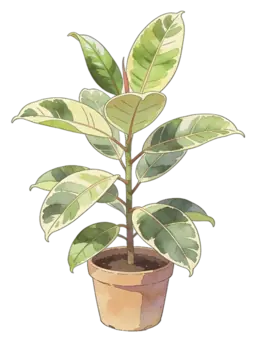
| Rubber plant (Ficus elastica) | — | — | — | 80 cm | Easy |
| Ficus ginseng | — | — | — | 30 cm | Easy |
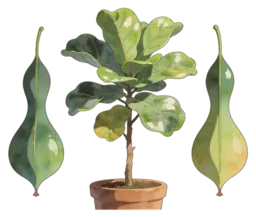
| Fiddle-leaf fig (Ficus lyrata) | — | — | — | 100 cm | Moderate |
| Ficus maclellandii (ficus 'Alii', ficus 'Amstel King') | Mar–Jun | — | — | 80 cm | Easy |
| Creeping fig (Ficus pumila) | — | — | — | 30 cm | Easy |