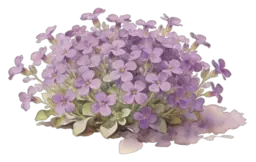
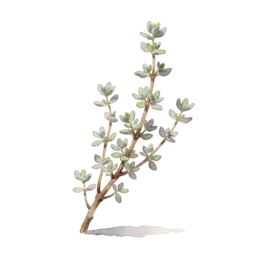
Credits and licences
- #1 — vueltaalhuerto illustration
- #2 — vueltaalhuerto illustration
- #3 — vueltaalhuerto illustration
- #4 — vueltaalhuerto illustration
- #5 — vueltaalhuerto illustration
- #6 — vueltaalhuerto illustration
- #7 — vueltaalhuerto illustration
- #8 — vueltaalhuerto illustration
- #9 — vueltaalhuerto illustration
- #10 — vueltaalhuerto illustration
Evergreen candytuft
and 1 more names
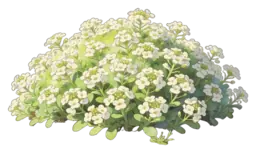
Iberis 'Snowflake'Evergreen candytuft is sown in seed trays from February to March or directly outdoors from April to May and from September to October, and planted out from April to May and in October. It flowers from March to May. Grow it in full sun, 30 cm apart, with little watering. Dates are for a mild temperate climate in the northern hemisphere; the calendar below adjusts them to your zone.
What else to sow in February, March, April, May, September and October
An evergreen perennial, almost a low subshrub 15 to 30 cm tall, that forms a rounded mound of narrow, dark green, rather leathery leaves. From March to May it is covered in flat clusters of white four-petalled flowers, the two outer petals larger than the others, which open from pink-tinged buds to pure white; afterwards it leaves small, flat, rounded seed pods (silicles). It is a hardy rock-garden and edging plant that tolerates sun, drought once established and hard frosts, and is happy in poor, chalky soils. Watch out for name mix-ups: many shops sell the annual Iberis umbellata, a different short-lived plant, simply as ‘iberis’; the perennial is Iberis sempervirens (sometimes misspelt ‘sempervivum’).
Family and origin: Cabbage family (Brassicaceae) · native to Southern Europe and western Asia (central and eastern Mediterranean) · More plants from Mediterranean basin
01In your area
How will it do in your garden?
Year calendar
| Task | J | F | M | A | M | J | J | A | S | O | N | D |
|---|---|---|---|---|---|---|---|---|---|---|---|---|
| Seed trayFeb–Mar | no | yes | yes | no | no | no | no | no | no | no | no | no |
| Direct sowingApr–May, Sep–Oct | no | no | no | yes | yes | no | no | no | yes | yes | no | no |
| Plant / transplantApr–May, Oct | no | no | no | yes | yes | no | no | no | no | yes | no | no |
| FloweringMar–May | no | no | yes | yes | yes | no | no | no | no | no | no | no |
| PruningMay–Jun | no | no | no | no | yes | yes | no | no | no | no | no | no |
| CuttingsJun–Jul | no | no | no | no | no | yes | yes | no | no | no | no | no |
| Divide the clumpSep–Oct | no | no | no | no | no | no | no | no | yes | yes | no | no |
Its life cycle at a glance
Swipe and tap a stage to see its details.
02Planting
Where and how to plant it
The seed goes on the surface, uncovered; leave 30 cm between plants and 40 cm between rows.
30 cm between plants · 40 cm between rows
Seed at ground level; seedlings go in with the root ball level with the soil.
- Transplanting
- Apr–May, Oct
- Seed tray
- Feb–Mar
- Direct sowing
- Apr–May, Sep–Oct
- Germination
- ~18 days
- Common mistakeSowing out of season: many need warmth or a cold spell beforehand to sprout.
03Care
Care through the year
Sun and aspectFull sun · 8 h of sun · South or south-west, with nothing casting shade at midday
- Too little sun
- Ideal range
- Plenty of sun
South or south-west, with nothing casting shade at midday
Strong sun: Loves full midday sun and high temperatures.
Full sun for a more compact mound covered in flowers; it tolerates light partial shade, with fewer flowers. In the intense heat of inland areas it appreciates afternoon shade.
- TipPlant it in spring or autumn along a sunny edge, in a rock garden, on a wall or at the front of a border, about 30 cm apart.
WateringLet it dry out between waterings · summer: every 5-7 days
- Summerevery 5-7 days0.6 L per plant/week
- Spring / Autumnevery 10-14 days0.2 L per plant/week
- Winteronly in extreme drought (once a month)0.1 L per plant/week
Let it dry out between waterings: A Mediterranean favourite: better thirsty than overwatered.
Water sparingly: a few well-spaced waterings in the first year and after that almost only rainwater, except in very dry summers. It needs well-drained soil, even poor or chalky; what it copes with worst is waterlogging, which rots the base.
When to water? Push your finger 5 cm into the soil next to the base of the plant:
- Damp: soil sticks to your finger. Do not water yet. It has more than enough; wait for it to dry out more.
- Cool but clean, no mud. Wait another 1-2 days before watering.
- Dry and dusty. Water now, but moderately. Do not overdo it: it prefers thirst to excess.
Soil and feedingpH 6.5–8 · Loose soil with organic matter and good drainage
Loose soil with organic matter and good drainage.
50 % topsoil · 30 % well-rotted compost · 20 % sand or perlite.
Medium/high.
This plant prefers a pH between 6.5 and 8.0 (neutral to alkaline).
- Overfeeding gives lots of leaf and few flowers.
- Compacted, poorly drained soil rots the roots in winter.
- TipIt does not need fertiliser: a little compost in spring is enough, and too much nitrogen gives lots of leaf and few flowers.
- TipWatch for aphids, slugs and clubroot (in acid, wet soils), and for rot caused by waterlogging.
- Common mistakeOverfeeding gives lush leaves but few flowers.
PruningWhen: May–Jun
Pruning time for this plant: May–Jun.
- TipRemove faded flowers to prolong flowering.
Common mistakes and tips
- TipAfter flowering, trim back a third of the stems to keep the mound compact, encourage new growth and stop it opening up over time.
- TipThe flowers attract bees and other pollinators.
04Propagation
Make new plants
It is propagated from seed and from softwood cuttings. The seed needs light: scatter it on the potting mix and press it in without covering, at about 15 to 20 °C, and it germinates in two or three weeks; garden varieties do not always come true. Take 5 to 8 cm cuttings in summer after flowering, strip the lower leaves and insert them in sand and peat; they root in a few weeks. You can also divide old clumps in autumn or use stems that have touched the ground and rooted.
Seeds: how to germinate them~18 days
05Uses and health
What it is used for, and with what care
Like other ornamental brassicas, it contains glucosinolates, and eating a significant amount of the plant can cause digestive upset; the sap can irritate the skin or eyes of sensitive people. It is considered of low danger to dogs and cats, although data are scarce: if they eat a large amount and vomiting or diarrhoea appear, consult the vet. Do not confuse it with edible brassicas or with other white-flowered plants; it is not harvested for eating.
- Properties
- An ornamental plant that flowers very early, bringing colour to the rock garden and feeding bees and butterflies in spring; it has no known health uses.
- Uses
- It is not used in cooking or in home remedies: do not eat it or use it in infusions.
For guidance only; this is not medical treatment and does not replace advice from a doctor or vet.
06Companions and related plants