
Credits and licences
- #1 — vueltaalhuerto illustration
- #2 — vueltaalhuerto illustration
- #3 — vueltaalhuerto illustration
- #4 — vueltaalhuerto illustration
- #5 — vueltaalhuerto illustration
- #6 — vueltaalhuerto illustration
- #7 — vueltaalhuerto illustration
- #8 — vueltaalhuerto illustration
- #9 — vueltaalhuerto illustration
- #10 — vueltaalhuerto illustration
Espostoa lanata (cotton ball cactus)
and 2 more names
woolly cactus, Cereus lanatusEspostoa lanata (cotton ball cactus) is sown in seed trays from March to May, and planted out from April to May. Grow it in full sun, 30 cm apart, with little watering. Dates are for a mild temperate climate in the northern hemisphere; the calendar below adjusts them to your zone.
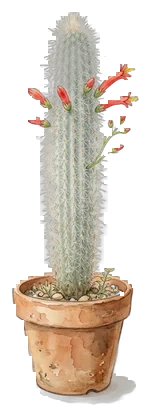
A slow-growing columnar cactus with a straight, cylindrical stem 6 to 10 cm across, covered in a dense layer of silky white wool through which fine yellowish spines poke out. In its habitat it can exceed two or three metres; in a pot it usually stays at half a metre to a metre, and it rarely branches. When very mature, it forms a band of brown wool down one side, the cephalium, from which night-blooming, funnel-shaped white to pink flowers about 5 cm across emerge, hidden among the wool, followed by small round fruits with tiny black seeds. It needs full sun, copes well with drought and does not tolerate excess water or cold, damp conditions. It is listed under the CITES convention (Appendix II, like most cacti): buy only nursery-grown specimens with their paperwork and never plants or seeds collected from the wild.
Family and origin: Cactus family (Cactaceae) · native to Peru (dry valleys of the northern Andes, at about 1000 to 2000 m above sea level) · More plants from Andes
01In your area
How will it do in your home?
Year calendar
| Task | J | F | M | A | M | J | J | A | S | O | N | D |
|---|---|---|---|---|---|---|---|---|---|---|---|---|
| Seed trayMar–May | no | no | yes | yes | yes | no | no | no | no | no | no | no |
| Plant / transplantApr–May | no | no | no | yes | yes | no | no | no | no | no | no | no |
| CuttingsMay–Aug | no | no | no | no | yes | yes | yes | yes | no | no | no | no |
Its life cycle at a glance
Swipe and tap a stage to see its details.
02Planting
Planting and transplanting
- TipIn a pot it grows slowly and almost never forms the cephalium or flowers; the night-blooming flowers only appear on large, very old specimens.
03Care
Care through the year
Sun and aspectFull sun · 8 h of sun · South or south-west, with nothing casting shade at midday
- Too little sun
- Ideal range
- Plenty of sun
South or south-west, with nothing casting shade at midday
Strong sun: Loves full midday sun and high temperatures.
Full sun, with bright light all day; in shade it stretches, becomes thin and loses its woolly covering. If it has been indoors, move it into the sun gradually. It does not tolerate frost: below about 5 °C, bring it inside (a rough guide).
- TipPut it in the sunniest spot.
WateringLet it dry out between waterings · summer: every 10 to 14 days
- Summerevery 10 to 14 days0.2 L per plant/week
- Spring / Autumnevery 10-14 days0.1 L per plant/week
- Winternone, or very little, from November to March0 L per plant/week
Let it dry out between waterings: A Mediterranean favourite: better thirsty than overwatered.
Water only when the potting mix is completely dry: soak it, let it drain and empty the saucer. Wet the potting mix, not the plant body, because the wool holds moisture and encourages fungal problems. In winter, almost no watering and a cool, bright spot above 10 °C (a rough guide).
When to water? Push your finger 5 cm into the soil next to the base of the plant:
- Damp: soil sticks to your finger. Do not water yet. It has more than enough; wait for it to dry out more.
- Cool but clean, no mud. Wait another 1-2 days before watering.
- Dry and dusty. Water now, but moderately. Do not overdo it: it prefers thirst to excess.
- TipWatch for mealybugs, which hide among the wool, and for collar rot from overwatering.
- TipThe watering, temperature and germination figures are a rough guide and depend on the light and the pot.
- TipA dry winter rest: with hardly any water they flower better in spring.
- Common mistakeWatering in cold winter weather is the fast track to rot.
Potting mix and feedingpH 6–7.5 · Mineral mix with almost no organic matter
Mineral mix with almost no organic matter.
20 % multi-purpose compost · 40 % silica sand · 40 % pumice or lava rock.
Extreme.
This plant prefers a pH between 6.0 and 7.5 (slightly acidic to slightly alkaline).
- Rich, compact mix: certain rot within a few months.
- Watering in cold winter weather: the first step towards rot.
- TipUse a tall terracotta pot with good drainage and a mineral potting mix (coarse sand, perlite or gravel, with a little cactus compost).
- TipFeed once a month in spring and summer with a low-nitrogen cactus fertiliser.
- TipPlenty of light and a free-draining mineral mix.
- Common mistakeA mix that holds water drowns the roots.
Common mistakes and tips
- TipRepot every two or three years, in spring, wearing thick gloves or using a folded strip of paper, because the fine spines stick in.
04Propagation
Make new plants
It is propagated by seed and by cuttings. A piece of stem about 15 to 30 cm long, cut with a clean knife, is left to callus for one or two weeks in a dry, shady place and then rested on or buried 1 or 2 cm deep in barely moist mineral potting mix; it roots in a few weeks in spring and summer (a rough guide). From seed, sow on the surface of a fine mineral mix at 20 to 28 °C, with high humidity and plenty of soft light; seedlings appear in one to four weeks and grow slowly. In a pot it takes years to reach flowering size.
Seeds: how to germinate them~14 days
05Uses and health
What it is used for, and with what care
Not edible. There are no reliable data on its toxicity to people or pets, so as a precaution do not eat any part of it, do not use it in herbal teas or for any other purpose, and do not let children, dogs or cats chew it. Although it looks soft, under the wool it carries fine spines that stick in: handle it with thick gloves or folded paper. If someone has swallowed any, in Spain call the Toxicology Information Service (91 562 04 20) or 112, and a vet if it is an animal. It is listed under the CITES convention (Appendix II, like most cacti): buy only nursery-grown specimens with their paperwork and never plants or seeds collected from the wild. It is not regulated as an invasive species in Spain or the EU.
- Properties
- An ornamental collector’s plant: it is not grown for consumption and has no proven health uses.
- Uses
- Not edible. It is grown for its covering of white wool, in a sunny pot, on a terrace or in a rockery in mild climates.
For guidance only; this is not medical treatment and does not replace advice from a doctor or vet.
06Companions and related plants
What to plant it with
Compare with similar varieties
| Variety | Sowing | Harvest | Days | Spacing | Difficulty |
|---|---|---|---|---|---|
| Espostoa lanata (cotton ball cactus) | Mar–May | — | — | 30 cm | Easy |
| Espostoa mirabilis (pale-woolled columnar cactus) | Mar–May | — | — | 30 cm | Easy |