
Credits and licences
- #1 — vueltaalhuerto illustration
- #2 — vueltaalhuerto illustration
- #3 — vueltaalhuerto illustration
- #4 — vueltaalhuerto illustration
- #5 — vueltaalhuerto illustration
- #6 — vueltaalhuerto illustration
- #7 — vueltaalhuerto illustration
- #8 — vueltaalhuerto illustration
- #9 — vueltaalhuerto illustration
- #10 — vueltaalhuerto illustration
Eriosyce subgibbosa (Chilean ribbed cactus)
and 2 more names
Chilean cactus, eriosyceEriosyce subgibbosa (Chilean ribbed cactus) is sown in seed trays from March to May, and planted out from April to May. Grow it in full sun, 20 cm apart, with little watering. Dates are for a mild temperate climate in the northern hemisphere; the calendar below adjusts them to your zone.
A slow-growing globular to short cylindrical cactus with a greyish-green body, some 16 to 22 prominent ribs and areoles full of rigid spines, dark brown to almost black, which almost cover the body. Grown in a pot it usually reaches 15 to 40 cm; in its habitat it can approach a metre. In late winter and spring it bears funnel-shaped flowers 3 to 6 cm across at the crown, magenta pink to violet, with a pale throat; the fruit is elongated and bright red, and opens through a pore at the base to release tiny black seeds. It is a very variable species, with several forms and subspecies, and does not tolerate overwatering. It needs full sun and a very mineral mix; it withstands light, brief frosts only if the mix is dry. It is listed in the CITES convention (Appendix II, like most cacti): buy only nursery-grown plants with their paperwork, never plants or seeds collected from the wild.
Family and origin: Cactus family (Cactaceae) · native to Chile (rocky slopes and coastal hills, from southern Atacama to the Biobío region) · More plants from Andes
01In your area
How will it do in your home?
Year calendar
| Task | J | F | M | A | M | J | J | A | S | O | N | D |
|---|---|---|---|---|---|---|---|---|---|---|---|---|
| Seed trayMar–May | no | no | yes | yes | yes | no | no | no | no | no | no | no |
| Plant / transplantApr–May | no | no | no | yes | yes | no | no | no | no | no | no | no |
Its life cycle at a glance
Swipe and tap a stage to see its details.
02Care
Care through the year
Sun and aspectFull sun · 8 h of sun · South or south-west, with nothing casting shade at midday
- Too little sun
- Ideal range
- Plenty of sun
South or south-west, with nothing casting shade at midday
Strong sun: Loves full midday sun and high temperatures.
Full sun, with bright light all day; in shade it stretches and stops flowering. If it has been indoors, move it into the sun gradually, because fierce midday summer sun can scorch the most exposed side.
WateringLet it dry out between waterings · summer: every 10 to 15 days
- Summerevery 10 to 15 days0.2 L per plant/week
- Spring / Autumnevery 10-14 days0.1 L per plant/week
- Winternone, from mid-November to February0 L per plant/week
Let it dry out between waterings: A Mediterranean favourite: better thirsty than overwatered.
Water only when the mix is completely dry: soak it, let it drain and empty the saucer. In spring and summer water moderately; in winter keep it almost dry, in a cool, very bright spot at about 5 to 12 °C (approximate), which encourages flowering. Do not wet the body of the cactus.
When to water? Push your finger 5 cm into the soil next to the base of the plant:
- Damp: soil sticks to your finger. Do not water yet. It has more than enough; wait for it to dry out more.
- Cool but clean, no mud. Wait another 1-2 days before watering.
- Dry and dusty. Water now, but moderately. Do not overdo it: it prefers thirst to excess.
- TipPlace it in the sunniest spot and avoid getting water on it.
- TipWatch out for mealybugs and for collar rot from overwatering.
- TipThe figures for watering, temperature and germination are approximate and depend on the light and the pot.
- TipA dry winter rest: with hardly any water they flower better in spring.
- Common mistakeWatering in cold winter weather is the fast track to rot.
Potting mix and feedingpH 6–7.5 · Mineral mix with almost no organic matter
Mineral mix with almost no organic matter.
20 % multi-purpose compost · 40 % silica sand · 40 % pumice or lava rock.
Extreme.
This plant prefers a pH between 6.0 and 7.5 (slightly acidic to slightly alkaline).
- Rich, compact mix: certain rot within a few months.
- Watering in cold winter weather: the first step towards rot.
- TipUse a terracotta pot with good drainage and a mineral mix (coarse sand, perlite or gravel, with a little cactus compost).
- TipFeed once a month in spring and summer with a low-nitrogen cactus fertiliser.
- TipPlenty of light and a free-draining mineral mix.
- Common mistakeA mix that holds water drowns the roots.
Common mistakes and tips
- TipGive it a cool, dry rest in winter and shelter it from rain and cold, damp conditions.
- TipRepot every two or three years, in spring, with thick gloves or a piece of folded paper.
03Propagation
Make new plants
It is propagated mainly from seed, because it hardly produces offsets. Sow in spring, at 18 to 24 °C, on a very free-draining mineral mix (coarse sand, perlite and a little soil), with the seeds barely covered, in high humidity and plenty of soft light; they germinate in two to four weeks (approximate) and the seedlings take several years to flower. Experienced growers graft the seedlings onto a fast-growing cactus rootstock to speed up growth. A nursery plant comes ready-formed and is the most advisable option.
Seeds: how to germinate them~14 days
04Uses and health
What it is used for, and with what care
It is not edible. There is no reliable data on its toxicity to people or pets, and some cacti contain alkaloids, so as a precaution do not eat any part of it, do not use it in infusions or for any other purpose, and do not let children, dogs or cats chew it. The rigid spines can stick in and cause wounds: handle it with thick gloves. If someone has swallowed it, in Spain contact the Toxicology Information Service (91 562 04 20) or 112, and the vet if it is an animal. It is listed in the CITES convention (Appendix II, like most cacti): buy only nursery-grown plants with their paperwork, never plants or seeds collected from the wild. It is not regulated as an invasive species in Spain or the EU.
- Properties
- An ornamental collector's plant: it is not grown for food and has no proven health uses.
- Uses
- It is not edible. It is grown for its shape and its flowers, in a bright pot, on a terrace or in a rock garden in mild climates.
For guidance only; this is not medical treatment and does not replace advice from a doctor or vet.
05Companions and related plants
What to plant it with
Compare with similar varieties
| Variety | Sowing | Harvest | Days | Spacing | Difficulty |
|---|---|---|---|---|---|
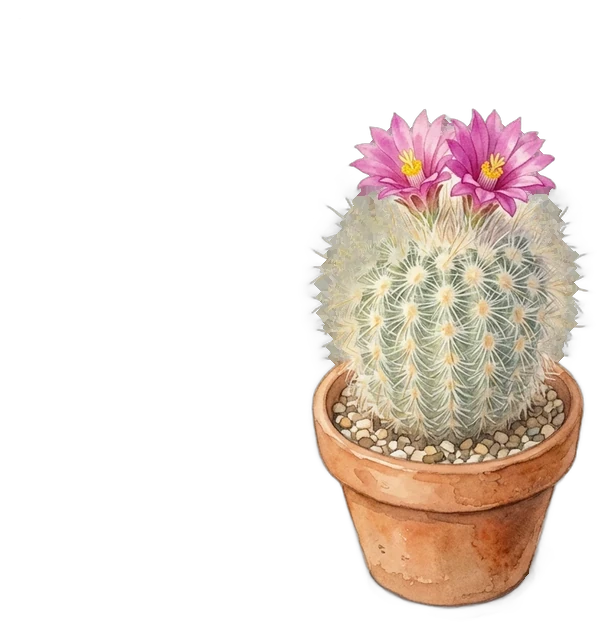
| Eriosyce senilis (white-haired Chilean cactus) | Mar–May | — | — | 15 cm | Moderate |
| Eriosyce subgibbosa (Chilean ribbed cactus) | Mar–May | — | — | 20 cm | Moderate |