Credits and licences
- #1 — vueltaalhuerto illustration
- #2 — vueltaalhuerto illustration
- #3 — vueltaalhuerto illustration
- #4 — vueltaalhuerto illustration
- #5 — vueltaalhuerto illustration
- #6 — vueltaalhuerto illustration
- #7 — vueltaalhuerto illustration
- #8 — vueltaalhuerto illustration
- #9 — vueltaalhuerto illustration
- #10 — vueltaalhuerto illustration
Elkhorn plant (Rhombophyllum dolabriforme)
and 2 more names
Hereroa dolabriformis, Mesembryanthemum dolabriformeElkhorn plant (Rhombophyllum dolabriforme) is sown in seed trays from April to June, and planted out from April to June. Grow it in full sun, 15 cm apart, with little watering. Dates are for a mild temperate climate in the northern hemisphere; the calendar below adjusts them to your zone.
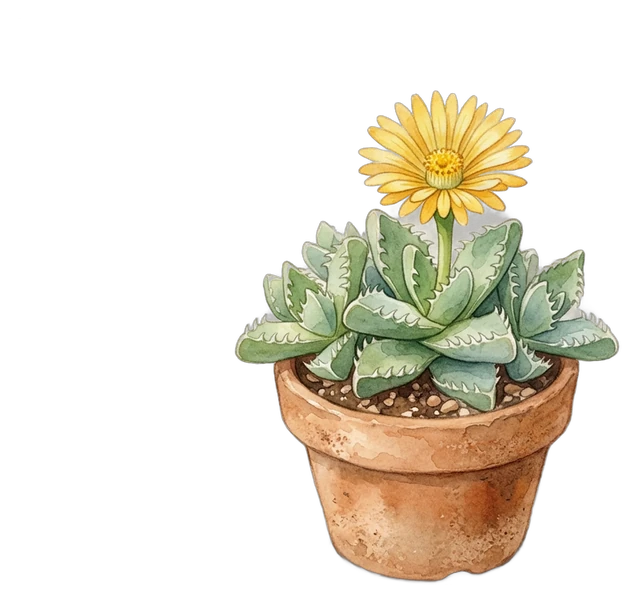
A small, much-branched succulent that over the years forms a low, dense clump up to about 30 cm tall, with fleshy, matt grey-green leaves dotted with translucent specks. Each leaf is shaped like a hatchet: flat on one side, with a keel ending in a tooth at the tip, hence the names elkhorn plant and hatchet plant. In spring and summer it produces golden-yellow, daisy-like flowers with fine petals, which open in the sun. It grows slowly and is easy to care for if it gets plenty of light, a very free-draining potting mix and a winter rest with minimal watering. It is not edible. Buy nursery-raised plants, because many South African succulents of this family are protected in their country of origin and must not be collected from the wild.
Family and origin: Ice plant family (Aizoaceae) · native to South Africa (Eastern Cape province), on stony soils and exposed slopes · More plants from Africa
01In your area
How will it do in your home?
Year calendar
| Task | J | F | M | A | M | J | J | A | S | O | N | D |
|---|---|---|---|---|---|---|---|---|---|---|---|---|
| Seed trayApr–Jun | no | no | no | yes | yes | yes | no | no | no | no | no | no |
| Plant / transplantApr–Jun | no | no | no | yes | yes | yes | no | no | no | no | no | no |
| CuttingsApr–Jul | no | no | no | yes | yes | yes | yes | no | no | no | no | no |
Its life cycle at a glance
Swipe and tap a stage to see its details.
02Care
Care through the year
Sun and aspectFull sun · 6 h of sun · shade in summer
- Too little sun
- Ideal range
- Plenty of sun
South or south-west, with nothing casting shade at midday
Strong sun: Loves full midday sun and high temperatures.
Plenty of light and several hours of direct sun; in low light it stretches and loses its compact shape. On the hottest summer days, protect it from sun during the middle of the day. It does not withstand frost: in winter keep it above about 5 °C, under cover and almost dry.
- Common mistakeLack of light makes them stretch and go soft (etiolation).
WateringLet it dry out between waterings · summer: every 7 to 14 days, when the potting mix is dry
- Summerevery 7 to 14 days, when the potting mix is dry0.2 L per plant/week
- Spring / Autumnevery 10-14 days0.1 L per plant/week
- Winterevery 3 to 4 weeks at most, just a few drops0 L per plant/week
Let it dry out between waterings: A Mediterranean favourite: better thirsty than overwatered.
Water more generously in spring and summer, when it is growing, but let the potting mix dry out completely between waterings. In winter, minimal watering every three or four weeks, because during this rest it rots easily. Avoid wetting the leaves and empty the saucer.
When to water? Push your finger 5 cm into the soil next to the base of the plant:
- Damp: soil sticks to your finger. Do not water yet. It has more than enough; wait for it to dry out more.
- Cool but clean, no mud. Wait another 1-2 days before watering.
- Dry and dusty. Water now, but moderately. Do not overdo it: it prefers thirst to excess.
- TipWrinkled leaves usually indicate lack of water in summer, and soft, dark leaves indicate overwatering.
- TipThe watering, temperature and timing figures are approximate.
- TipWater thoroughly and leave long gaps: better thirsty than overwatered.
- Common mistakeWatering often rots the crown and the roots.
Potting mix and feedingpH 6–7.5 · Very gritty, free-draining mix
Very gritty, free-draining mix.
30 % multi-purpose compost · 40 % coarse sand · 30 % perlite or pumice.
Very high: standing moisture rots them.
This plant prefers a pH between 6.0 and 7.5 (slightly acidic to slightly alkaline).
- Multi-purpose compost on its own with no drainage: rot sets in quickly.
- Watering the rosette or the leaves marks them and causes rot.
- TipPlant it in a terracotta pot, in a potting mix low in organic matter (for example, half cactus compost and half coarse sand, pumice or perlite).
- TipFeed it sparingly, with a cactus fertiliser at half strength once a month in spring and summer.
- TipVery free-draining mix (with sand/perlite) and pots with a drainage hole.
Common mistakes and tips
- TipRepot it in spring every two or three years.
- TipWatch out for mealybug at the base of the leaves.
03Propagation
Make new plants
It is propagated by stem cuttings and by seed. Cuttings are taken in spring or early summer, left to dry for a few days and planted in a mineral potting mix. The seed, tiny and brown, is surface-sown in the warm months, at 20 to 25 °C, on moist fine sand.
Seeds: how to germinate them~14 days
04Uses and health
What it is used for, and with what care
We have not found reliable information on the toxicity of this species to people, dogs or cats. To be on the safe side, do not eat it and stop children and pets from nibbling it. The leaves have no spines, although the tooth-shaped tip can scratch. It is not listed as an invasive species in Spain or in the EU.
- Properties
- An easy-to-grow ornamental succulent. It has no home medicinal uses.
- Uses
- It is not edible. It has no culinary uses and is not used in herbal teas.
For guidance only; this is not medical treatment and does not replace advice from a doctor or vet.
05Companions and related plants