
Credits and licences
- #1 — vueltaalhuerto illustration
- #2 — vueltaalhuerto illustration
- #3 — vueltaalhuerto illustration
- #4 — vueltaalhuerto illustration
- #5 — vueltaalhuerto illustration
- #6 — vueltaalhuerto illustration
- #7 — vueltaalhuerto illustration
- #8 — vueltaalhuerto illustration
- #9 — vueltaalhuerto illustration
- #10 — vueltaalhuerto illustration
Dancing bones cactus (Hatiora salicornioides)
and 3 more names
spice cactus, Rhipsalis salicornioides, hatioraDancing bones cactus (Hatiora salicornioides) is sown in seed trays from March to April, and planted out from April to May. It flowers from March to April. Grow it in sun or partial shade, 30 cm apart, with moderate watering. Dates are for a mild temperate climate in the northern hemisphere; the calendar below adjusts them to your zone.
A spineless epiphytic, trailing cactus with fine, branching stems made up of green segments shaped like little bottles or bones, 2 to 4 cm long, which gather in clusters and hang down in a mane of about 50 cm or more. In late winter and spring it bears tiny bell-shaped yellow-orange flowers at the tips of the stems, followed by small translucent pinkish-white berries. In shops it is sold as 'Rhipsalis', because it looks very like the true rhipsalis, but its accepted botanical name is Hatiora salicornioides. It is grown in a hanging pot, in a bright room or on a terrace sheltered from strong sun, and it does not want full sun or total drought like desert cacti. Like all cacti, it is listed in CITES Appendix II (regulated trade): always buy nursery-grown plants and do not collect specimens from the wild. It is not listed in the Spanish Catalogue of Invasive Alien Species or on the EU list. It is not edible.
Family and origin: Cactus family (Cactaceae) · native to Brazil (Atlantic rainforest of the south-east, where it grows as an epiphyte on trees and rocks) · More plants from South America
01In your area
How will it do in your home?
Year calendar
| Task | J | F | M | A | M | J | J | A | S | O | N | D |
|---|---|---|---|---|---|---|---|---|---|---|---|---|
| Seed trayMar–Apr | no | no | yes | yes | no | no | no | no | no | no | no | no |
| Plant / transplantApr–May | no | no | no | yes | yes | no | no | no | no | no | no | no |
| FloweringMar–Apr | no | no | yes | yes | no | no | no | no | no | no | no | no |
| CuttingsApr–Jul | no | no | no | yes | yes | yes | yes | no | no | no | no | no |
Its life cycle at a glance
Swipe and tap a stage to see its details.
02Care
Care through the year
Sun and aspectSun and shade · 3 h of sun · shade in summer
- Too little sun
- Ideal range
- Plenty of sun
East, or south with light shade during the middle of the day
Gentle sun: Morning or afternoon sun. Midday summer sun stresses and scorches it.
Bright but filtered light, with a little gentle morning or afternoon sun: strong direct sun, especially through glass, scorches the stems. Keep it at 15 to 25 °C and do not let it drop below about 7 to 10 °C. To flower, it appreciates a cool winter, at 10 to 15 °C, and long nights.
WateringLet it dry out between waterings · summer: every 7 to 10 days
- Summerevery 7 to 10 days0.3 L per plant/week
- Spring / Autumnevery 4-5 days0.2 L per plant/week
- Winterevery 15 to 20 days, sparingly0 L per plant/week
Let it dry out between waterings: A Mediterranean favourite: better thirsty than overwatered.
Water thoroughly when the top of the potting mix is dry, and let it drain well: too much water rots the roots and the base of the stems. In autumn and winter water less, without letting it dry out completely. It appreciates some humidity, but do not wet it every day.
When to water? Push your finger 3 cm into the soil next to the base of the plant:
- Damp: soil sticks to your finger. Do not water yet. It has more than enough; wait for it to dry out more.
- Cool but clean, no mud. Wait another 1-2 days before watering.
- Dry and dusty. Water now, but moderately. Do not overdo it: it prefers thirst to excess.
- TipWatch out for mealybug and for rot at the base from overwatering.
- TipA dry winter rest: with hardly any water they flower better in spring.
- Common mistakeWatering in cold winter weather is the fast track to rot.
Potting mix and feedingpH 5.5–6.5 · Mineral mix with almost no organic matter
Mineral mix with almost no organic matter.
20 % multi-purpose compost · 40 % silica sand · 40 % pumice or lava rock.
Extreme.
This plant prefers a pH between 5.5 and 6.5 (slightly acidic to neutral).
- Rich, compact mix: certain rot within a few months.
- Watering in cold winter weather: the first step towards rot.
- TipHang it in a small, free-draining pot with cactus compost mixed with fine bark and perlite; it grows well when slightly pot-bound and is repotted every three or four years, in spring.
- TipFeed it once a month from spring to summer with a cactus or foliage-plant fertiliser at half strength, and never onto dry potting mix.
- TipPlenty of light and a free-draining mineral mix.
- Common mistakeA mix that holds water drowns the roots.
Common mistakes and tips
- TipThe temperatures and timings are approximate.
03Propagation
Make new plants
It propagates very easily from stem cuttings: cut a length of two to four segments, leave it to dry for one or two days so that it callouses, and set it in free-draining, barely moist potting mix, in a bright spot out of direct sun; it roots in two to six weeks with warmth. The segments break off the parent plant easily. It can also be grown from the tiny black seeds in the berries, surface-sown on moist peat and sand at about 19 to 24 °C, but this is slow and unusual.
Seeds: how to germinate them~21 days
- TipIf it becomes long and straggly, trim the tips and use the pieces as cuttings.
04Uses and health
What it is used for, and with what care
There is no reliable information on the toxicity of this species to people or pets: gardening sources contradict each other, so it is treated with caution. Do not eat the stems, flowers or berries, and stop children, dogs and cats from chewing them. It has no spines, but the areoles may carry the odd tiny bristle that irritates the skin if handled carelessly. Like all cacti, it is listed in CITES Appendix II: buy nursery-grown plants.
- Properties
- An easy-care trailing ornamental, very decorative in hanging pots. It has no home medicinal uses.
- Uses
- It is not grown for eating. Although some epiphytic cacti produce small berries, there is no reliable information on those of this species: do not eat them.
For guidance only; this is not medical treatment and does not replace advice from a doctor or vet.
05Companions and related plants
What to plant it with
Compare with similar varieties
| Variety | Sowing | Harvest | Days | Spacing | Difficulty |
|---|---|---|---|---|---|
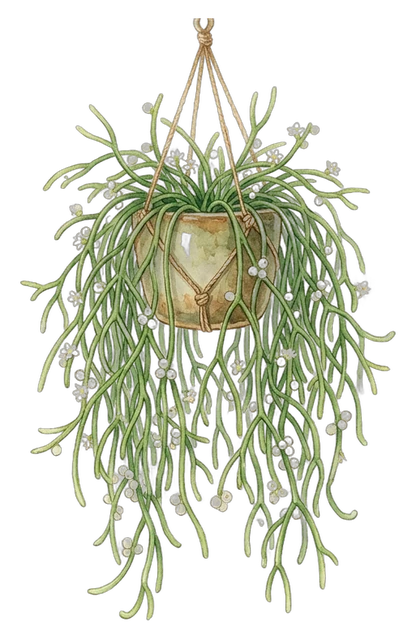
| Mistletoe cactus (Rhipsalis baccifera) | Mar–Apr | — | — | 30 cm | Easy |
| Dancing bones cactus (Hatiora salicornioides) | Mar–Apr | — | — | 30 cm | Easy |
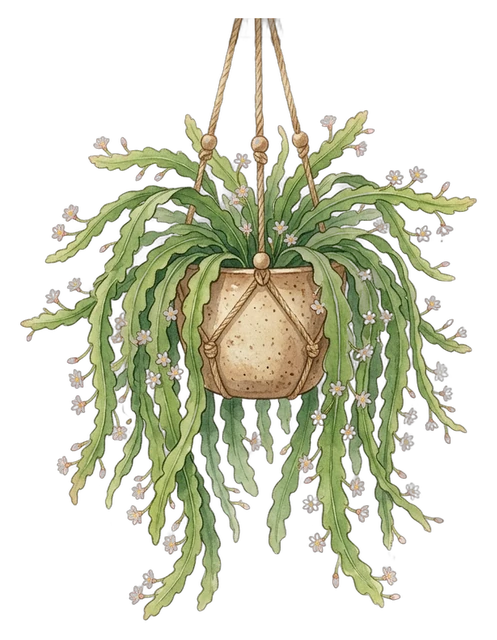
| Rhipsalis agudoensis (trailing cactus) | Mar–Apr | — | — | 30 cm | Easy |
| Rhipsalis ewaldiana (trailing cactus) | Mar–Apr | — | — | 30 cm | Easy |