Credits and licences
- #1 — vueltaalhuerto illustration
- #2 — vueltaalhuerto illustration
- #3 — vueltaalhuerto illustration
- #4 — vueltaalhuerto illustration
- #5 — vueltaalhuerto illustration
- #6 — vueltaalhuerto illustration
- #7 — vueltaalhuerto illustration
- #8 — vueltaalhuerto illustration
- #9 — vueltaalhuerto illustration
- #10 — vueltaalhuerto illustration
Cork oak
Cork oak is sown directly outdoors from October to December. It flowers from April to May. Grow it in full sun, 700 cm apart, with little watering. Dates are for a mild temperate climate in the northern hemisphere; the calendar below adjusts them to your zone.
What else to sow in October, November and December
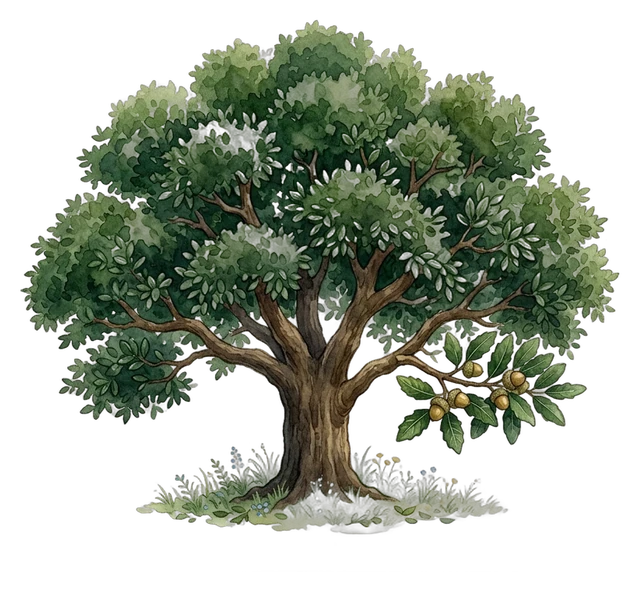
A long-lived, slow-growing evergreen tree, 10 to 20 m tall, with a broad, rounded crown and a trunk covered in thick, soft, deeply fissured bark, the cork, which is stripped every nine years or more without killing the tree and leaves the trunk a reddish colour. The leaves are leathery, dark green above and whitish and downy beneath, with slightly toothed edges. It flowers in spring with hanging yellowish catkins and bears elongated acorns, with cups of curly scales, that ripen in autumn. It grows in the cork oak woodlands of south-western Iberia and of Catalonia, on acid, siliceous soils, with rainfall above 500 to 600 mm, and does not tolerate lime. It is a tree for plenty of space, suited to estates and large gardens, although it is also sold as a bonsai. In Spain, cork stripping is regulated by forestry law, and in many regions felling and pruning require permission.
Family and origin: Beech family (Fagaceae) · native to Western Mediterranean: Iberian Peninsula, North Africa, southern France and Italy · More plants from Mediterranean basin
01In your area
How will it do in your garden?
Year calendar
| Task | J | F | M | A | M | J | J | A | S | O | N | D |
|---|---|---|---|---|---|---|---|---|---|---|---|---|
| Direct sowingOct–Dec | no | no | no | no | no | no | no | no | no | yes | yes | yes |
| Plant / transplantFeb–Mar, Nov–Dec | no | yes | yes | no | no | no | no | no | no | no | yes | yes |
| HarvestOct–Dec | no | no | no | no | no | no | no | no | no | yes | yes | yes |
| FloweringApr–May | no | no | no | yes | yes | no | no | no | no | no | no | no |
| PruningJan–Feb | yes | yes | no | no | no | no | no | no | no | no | no | no |
Its life cycle at a glance
Swipe and tap a stage to see its details.
02Planting
Where and how to plant it
Sow the seed 4 cm deep; leave 7 m between plants and 7 m between rows.
7 m between plants · 7 m between rows
Seed at a depth of 4 cm; seedlings go in with the root ball level with the soil.
- Transplanting
- Feb–Mar, Nov–Dec
- Direct sowing
- Oct–Dec
- Germination
- ~21 days
- TipThe simplest approach is to sow a fresh acorn in autumn in a deep container or in its final position, protected from rabbits and rodents with mesh.
- Common mistakePlanting too deep smothers the crown of the plant.
03Care
Care through the year
Sun and aspectFull sun · 8 h of sun · South or south-west, with nothing casting shade at midday
- Too little sun
- Ideal range
- Plenty of sun
South or south-west, with nothing casting shade at midday
Strong sun: Loves full midday sun and high temperatures.
Full sun or partial shade when young; as a mature tree it needs plenty of light and space. Bonsai: in full sun and outdoors.
WateringLet it dry out between waterings · summer: every 5-7 days
- Summerevery 5-7 days3 L per plant/week
- Spring / Autumnevery 10-14 days1.2 L per plant/week
- Winteronly in extreme drought (once a month)0.5 L per plant/week
Let it dry out between waterings: A Mediterranean favourite: better thirsty than overwatered.
Water regularly and deeply for the first two or three summers. After that it withstands the normal drought of a Mediterranean climate, although it needs more rain than the holm oak. It does not tolerate chalky soil or prolonged waterlogging.
When to water? Push your finger 5 cm into the soil next to the base of the plant:
- Damp: soil sticks to your finger. Do not water yet. It has more than enough; wait for it to dry out more.
- Cool but clean, no mud. Wait another 1-2 days before watering.
- Dry and dusty. Water now, but moderately. Do not overdo it: it prefers thirst to excess.
- TipWater generously in the first year until it is established; after that it looks after itself.
Soil and feedingpH 5–7 · Deep soil with good drainage
Deep soil with good drainage.
Medium/high.
This plant prefers a pH between 5.0 and 7.0 (acidic to neutral).
- Water generously in the first year until it is established.
- A thick mulch all year round, not touching the trunk.
- TipChoose acid or neutral, lime-free soil, and allow plenty of space.
PruningWhen: Jan–Feb
Pruning time for this plant: Jan–Feb.
- TipIt grows slowly and hardly needs pruning: just remove dead or crossing branches in winter.
- TipIn Spain, check the rules on pruning and felling with the town council or regional government before touching a cork oak.
- TipFormative pruning after flowering keeps the shape compact.
- Common mistakePruning at the wrong time removes the year's flower buds.
Common mistakes and tips
- TipIf you buy a young tree, make sure it is in a deep container and has healthy roots.
- TipDo not strip the cork from a tree yourself: badly done stripping damages or kills the tree, and it is regulated.
- TipDo not collect acorns in protected areas.
04Harvest
Harvesting and storing
Harvest in Oct–Dec.
05Propagation
Make new plants
It is propagated by seed, the acorn. Collect it fresh, in autumn, soon after it falls, and sow it straight away, because it loses viability as it dries. Discard acorns with holes, those that float in water and dry ones. Sow them about 4 cm deep, lying on their side, in a deep container, because the taproot is very long, and they come up within a few weeks. It cannot practically be propagated from cuttings, and young trees should not be transplanted bare-root.
Seeds: how to germinate them~21 days
06Uses and health
What it is used for, and with what care
WARNING: the acorns, young leaves and bark contain tannins that are toxic in quantity to dogs, cats, horses and ruminants, causing vomiting, diarrhoea, abdominal pain and possible kidney damage. Pick up acorns from the ground if there are dogs or horses around and consult a vet if you suspect they have been eaten. For people, raw acorns are very bitter and can cause digestive upset. PROTECTION: in Spain, cork oak woodland is a protected habitat and cork stripping, pruning and felling are regulated, and in some regions they require permission even if the tree is yours.
- Properties
- It is a tree of great ecological and economic value: its cork is a renewable material, and its woodland provides refuge for many species of Mediterranean wildlife and plants.
- Uses
- It is not grown for food. Cork oak acorns are more bitter than holm oak acorns and are not used in cooking or in home remedies; in the dehesa (Spanish wood pasture) they feed livestock, especially Iberian pigs.
For guidance only; this is not medical treatment and does not replace advice from a doctor or vet.
07Companions and related plants