Credits and licences
- #1 — vueltaalhuerto illustration
- #2 — vueltaalhuerto illustration
- #3 — vueltaalhuerto illustration
- #4 — vueltaalhuerto illustration
- #5 — vueltaalhuerto illustration
- #6 — vueltaalhuerto illustration
- #7 — vueltaalhuerto illustration
- #8 — vueltaalhuerto illustration
Blue star fern (Phlebodium aureum)
and 3 more names
hare's foot fern, golden serpent fern, Polypodium aureumBlue star fern (Phlebodium aureum) is planted from March to June. Grow it in sun or partial shade, 45 cm apart, with moderate watering. Dates are for a mild temperate climate in the northern hemisphere; the calendar below adjusts them to your zone.
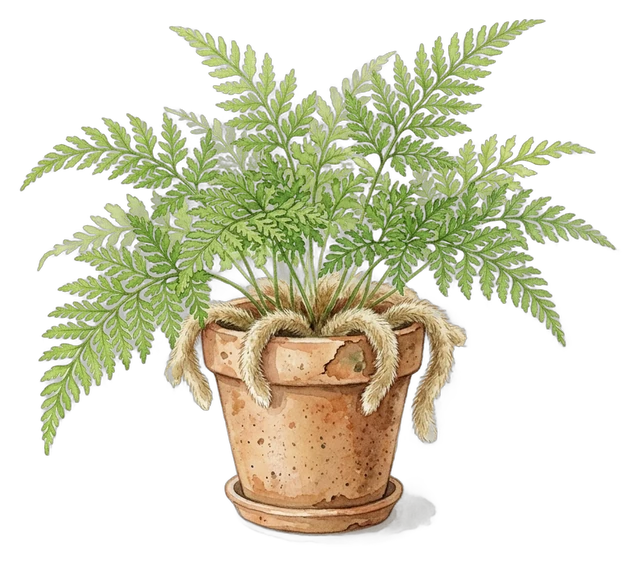
An epiphytic fern with arching fronds 40 to 90 cm long, deeply lobed and of a very distinctive greyish-blue colour, especially in the cultivar ‘Blue Star’, the one most often sold. They grow from a thick rhizome covered in golden and brown scales, which creeps over the surface of the potting mix and hangs over the edge of the pot like a furry paw: do not bury it or cut it. On the underside of mature fronds it has rows of round, golden-orange sori that contain the spores. It is more tolerant of dry air than other ferns, but not of waterlogging or cold. It is grown indoors in good light, in a pot or hanging basket, and on sheltered terraces in mild climates. It is not edible. Do not confuse it with common polypody (Polypodium vulgare), a fern native to woods and walls in Spain that should not be dug up from the wild.
Family and origin: Polypody family (Polypodiaceae) · native to Tropical and subtropical regions of the Americas, from the southern United States to northern Argentina; grows as an epiphyte on tree trunks · More plants from South America
01In your area
How will it do in your home?
Year calendar
| Task | J | F | M | A | M | J | J | A | S | O | N | D |
|---|---|---|---|---|---|---|---|---|---|---|---|---|
| Plant / transplantMar–Jun | no | no | yes | yes | yes | yes | no | no | no | no | no | no |
| PruningMar–Apr | no | no | yes | yes | no | no | no | no | no | no | no | no |
| Divide the clumpApr–Jul | no | no | no | yes | yes | yes | yes | no | no | no | no | no |
Its life cycle at a glance
Swipe and tap a stage to see its details.
02Care
Care through the year
Sun and aspectSun and shade · 3 h of sun · shade in summer
- Too little sun
- Ideal range
- Plenty of sun
East, or south with light shade during the middle of the day
Gentle sun: Morning or afternoon sun. Midday summer sun stresses and scorches it.
Bright, indirect light, near an east- or north-facing window, or behind a curtain at a sunny window. Direct sun scorches the fronds, and in a dark corner it loses its blue colour and becomes sparse. It likes 18 to 26 °C and a fairly humid atmosphere; it should not drop below about 5 to 10 °C.
- TipHumidity and shade: ideal indoors in bright spots without direct sun.
- Common mistakeDry air and direct sun scorch the fronds.
WateringMoist but never waterlogged · summer: every 5 to 7 days
- Summerevery 5 to 7 days1.2 L per plant/week
- Spring / Autumnevery 4-5 days0.6 L per plant/week
- Winterevery 10 to 14 days0.2 L per plant/week
Moist but never waterlogged: Water before the surface is completely dry. Never puddles.
Water when the top centimetre or two has dried out, with rainwater or tap water that has been left to stand, and empty the saucer. The rhizomes should remain visible on top of the potting mix and can be moistened now and then with a spray bottle. It copes badly with both complete dryness and soggy potting mix: the roots rot. It appreciates air humidity, but does not need as much as other ferns.
When to water? Push your finger 2 cm into the soil next to the base of the plant:
- Damp: soil sticks to your finger. Do not water today. The moisture is fine.
- Cool but clean, no mud. Water early tomorrow if it stays like this, or this evening.
- Dry and dusty. Water now, and deeply. This is not where it likes to be.
- TipDry tips indicate dry air or irregular watering, and general yellowing, too much water.
- TipTemperatures, watering and timings are a guide only.
Potting mix and feedingpH 5.5–6.5 · Acidic, spongy, moist mix
Acidic, spongy, moist mix.
50 % multi-purpose compost · 30 % coir · 20 % perlite.
Medium: constantly moist but airy.
This plant prefers a pH between 5.5 and 6.5 (slightly acidic to neutral).
- Mist the foliage several times a week in dry climates.
- A little worm castings every spring is enough.
- TipPlant it in a wide, shallow pot or a hanging basket with a very airy potting mix of peat, fine bark and perlite; the rhizomes stay on the surface.
- TipFeed every three or four weeks from spring to summer with a balanced fertiliser diluted to half strength.
- TipKeep the potting mix always moist, never waterlogged.
PruningWhen: Mar–Apr
Pruning time for this plant: Mar–Apr.
03Propagation
Make new plants
It is propagated by dividing the rhizome, which is the most practical method at home: in spring or early summer, use a clean knife to cut a piece of rhizome about 8 to 10 cm long that has at least one frond and some root, and lay it on a light, moist potting mix, held down with a hairpin-shaped piece of wire, without burying it. It takes in a few weeks. It can also be propagated from spores collected from ripe sori, but this method is slow and more delicate.
04Uses and health
What it is used for, and with what care
Many commercial guides describe it as harmless to pets, but we have not found a veterinary source that confirms this for this species. To be safe, do not eat it and stop children, dogs and cats from chewing the fronds or rhizomes; if this happens and vomiting or other symptoms appear, consult a doctor or vet.
- Properties
- A highly decorative ornamental fern thanks to the blue colour of its fronds. It has no home medicinal uses.
- Uses
- It is not edible. There are no culinary uses.
For guidance only; this is not medical treatment and does not replace advice from a doctor or vet.
05Companions and related plants