Credits and licences
- #1 — vueltaalhuerto illustration
- #2 — vueltaalhuerto illustration
- #3 — vueltaalhuerto illustration
- #4 — vueltaalhuerto illustration
- #5 — vueltaalhuerto illustration
- #6 — vueltaalhuerto illustration
- #7 — vueltaalhuerto illustration
- #8 — vueltaalhuerto illustration
- #9 — vueltaalhuerto illustration
- #10 — vueltaalhuerto illustration
African boxwood (Myrsine africana)
and 2 more names
myrsine, cape myrtle shrubAfrican boxwood (Myrsine africana) is sown in seed trays from February to March, and planted out from March to May and from September to October. Grow it in sun or partial shade, 70 cm apart, with moderate watering. Dates are for a mild temperate climate in the northern hemisphere; the calendar below adjusts them to your zone.
What else to sow in February and March
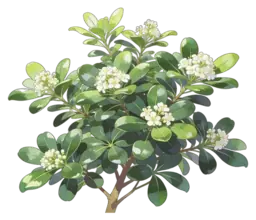
African boxwood is a compact, dense evergreen shrub that slowly grows to 1 to 1.5 m (sometimes more over the years). It has reddish twigs and many small, rounded, glossy, dark green leaves with finely toothed edges and a faint resinous scent when crushed. It is dioecious, meaning there are male and female plants: the tiny greenish flowers appear in spring, and only female plants, with a male nearby, produce small pale violet-blue berries in autumn. It is widely used as a low hedge, for edging, in pots and for clipping into balls and shapes, as a substitute for common box. It copes well with sun, heat, wind and pruning, and holds up against moderate frost.
Family and origin: Primrose family (Primulaceae) · native to Eastern and southern Africa, the Azores, Arabia and mountainous areas of Asia (from the Himalayas to China) · More plants from Africa
01In your area
How will it do in your garden?
Year calendar
| Task | J | F | M | A | M | J | J | A | S | O | N | D |
|---|---|---|---|---|---|---|---|---|---|---|---|---|
| Seed trayFeb–Mar | no | yes | yes | no | no | no | no | no | no | no | no | no |
| Plant / transplantMar–May, Sep–Oct | no | no | yes | yes | yes | no | no | no | yes | yes | no | no |
| FloweringMar–Apr | no | no | yes | yes | no | no | no | no | no | no | no | no |
| PruningMar–Apr, Sep | no | no | yes | yes | no | no | no | no | yes | no | no | no |
| CuttingsJul–Sep | no | no | no | no | no | no | yes | yes | yes | no | no | no |
Its life cycle at a glance
Swipe and tap a stage to see its details.
02Planting
Where and how to plant it
Sow the seed 3 mm deep; leave 70 cm between plants.
70 cm between plants
Seed at a depth of 3 mm; seedlings go in with the root ball level with the soil.
- Transplanting
- Mar–May, Sep–Oct
- Seed tray
- Feb–Mar
- Germination
- ~30 days
- TipFor a hedge, space the plants about 60 to 80 cm apart and clip them once or twice a year, in spring and at the end of summer; it regrows well and keeps its shape for years.
- Common mistakePlanting too deep smothers the crown of the plant.
03Care
Care through the year
Sun and aspectSun and shade · 5 h of sun · shade in summer
- Too little sun
- Ideal range
- Plenty of sun
East, or south with light shade in the middle of the day
Moderate sun: Copes with full sun, but give it some shade during heatwaves.
It does well in sun and in partial shade. If you put it in a very hot courtyard, it is best given shade at midday; hard frosts, below about -5 °C, can scorch the tips.
WateringMoist but never waterlogged · summer: every 2-3 days
- Summerevery 2-3 days6 L per plant/week
- Spring / Autumnevery 4-5 days3 L per plant/week
- Winterevery 2-3 weeks0.9 L per plant/week
Moist but never waterlogged: Water before the surface is completely dry. Never puddles. Mulch: straw or dry plant material cuts watering by 30-50 %.
Water regularly in the first year and then in moderation: it tolerates some drought, but looks better with occasional watering in summer. It dislikes waterlogging. In pots, water when the top of the potting mix is dry.
When to water? Push your finger 3 cm into the soil next to the base of the plant:
- Damp: soil sticks to your finger. Do not water today. The moisture is fine.
- Cool but clean, no mud. Water early tomorrow if it stays like this, or this evening.
- Dry and dusty. Water now, and deeply. This is not where it likes to be.
- TipWater generously in the first year until it is established; after that it looks after itself.
Soil and feedingpH 6–8 · Deep soil with good drainage
Deep soil with good drainage.
Medium/high.
This plant prefers a pH between 6.0 and 8.0 (slightly acidic to alkaline).
- Water generously in the first year until it is established.
- A thick mulch all year round, not touching the trunk.
- TipPlant it in spring or autumn in well-drained soil; it tolerates lime but does not thrive in dry, shallow chalky soil.
- TipIn pots, use multipurpose potting mix with sand and feed sparingly, in spring.
PruningWhen: Mar–Apr, Sep
Pruning time for this plant: Mar–Apr, Sep.
- TipFormative pruning after flowering keeps the shape compact.
- Common mistakePruning at the wrong time removes the year's flower buds.
Common mistakes and tips
- TipIt grows slowly, so do not expect a tall hedge soon.
- TipIt is often recommended as an alternative to common box because it is not attacked by the box tree moth, but it is worth checking this with your nursery for your area.
- TipSize, cold-tolerance and germination details are approximate.
04Propagation
Make new plants
It is propagated from semi-ripe cuttings 8 to 10 cm long, cut in summer from this year's branches that have begun to harden; they root within a few weeks in a sandy potting mix with bottom heat, better with rooting hormone. It can also be grown from seed, sown in autumn in a protected seed tray or in late winter with gentle warmth, but only female plants with a male nearby produce seed, and seedlings grow slowly. It sometimes produces small shoots from the root that can be separated. As it is dioecious, cuttings let you choose the sex of the plant.
Seeds: how to germinate them~30 days
05Uses and health
What it is used for, and with what care
There are no reliable toxicity data for people, dogs and cats. Although traditional uses are attributed to it in some regions where it grows wild, there is no basis for recommending eating any part of the plant: do not consume the leaves or berries and do not let children and animals chew them. Do not confuse it with common box (Buxus sempervirens), which is toxic if eaten and is not related.
- Properties
- An evergreen shrub for low hedges and topiary with little care; its berries, on female plants, feed birds in autumn.
- Uses
- It is not grown for eating. There are no reliable culinary uses.
For guidance only; this is not medical treatment and does not replace advice from a doctor or vet.
06Companions and related plants