
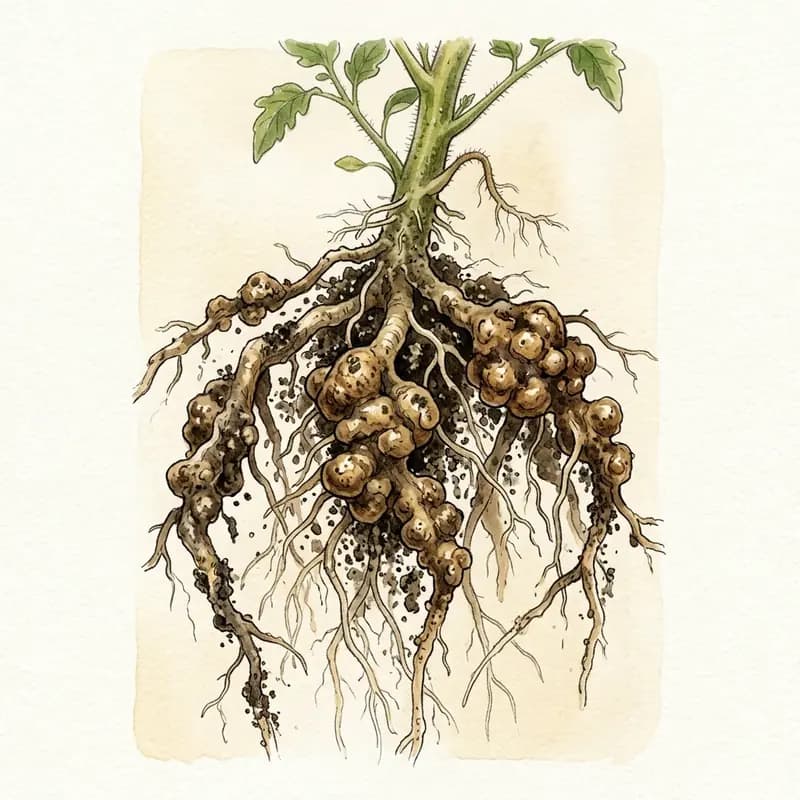
Nematodes
Also known as: nematodes, root-knot nematodes, eelworms, root knot, Meloidogyne
Microscopic soil worms that attack the roots and form knots or galls. The plant wilts even when you water it, because the roots cannot absorb properly. The first step is to pull up a plant and look at the roots to confirm it.

How to recognise it at every stage
Shares your gardenThey like the roots of your tomatoes, carrots and lettuces, especially in warm sandy soils.
Life cycle: Microscopic worms: egg in a jelly mass, a juvenile that swims in soil water and enters the root, and a swollen adult female inside a knot. In warm weather, a cycle every 3-6 weeks.
Tap a stage to see it full size. The photos are AI reference images checked against real photographs; stages without a reliable photo are shown as text only.
Life-stage calendar
| Jan | Feb | Mar | Apr | May | Jun | Jul | Aug | Sep | Oct | Nov | Dec | |
|---|---|---|---|---|---|---|---|---|---|---|---|---|
| Egg mass | ||||||||||||
| Juvenile | ||||||||||||
| Female | ||||||||||||
| Knots on the roots |
Approximate months for mainland Spain; in cold areas they start later and in warm areas they last longer. Garden creatures this month
No reliable photo yet
1Keep an eye on itEgg mass
· Under 1 mmA jelly droplet on the surface of the knot, with hundreds of eggs (with a lens).
- Where to find it
- On swollen roots.
- When: Apr–Oct
- What to do
- When you pull a plant, look at the roots: if they have knots, do not put it in the compost.
No reliable photo yet
2Protect your plantsJuvenile
· 0.4 mmInvisible to the naked eye: a tiny transparent worm.
- Where to find it
- In soil water, searching for roots.
- When: Apr–Oct
- What to do
- Add plenty of organic matter: living soil is full of fungi and nematodes that eat them.
No reliable photo yet
3Protect your plantsFemale
· 0.5-1 mmA tiny white pear-shaped pearl inside the knot.
- Where to find it
- Inside the root.
- When: May–Oct
- What to do
- Rotate crops, grow French marigolds or mustard as green manure and choose resistant varieties (marked 'N').
Nests, egg clutches and shelters
- Protect your plants
Knots on the roots
Roots with lumps and strings of hard knots that are part of the root itself.
- Where to find it
- On tomato, cucumber, carrot and lettuce roots.
- When: May–Oct
- What to do
- Pull the plant out with all its roots and put it in the bin, not the compost.
- Often confused with
- Legume root nodules. Broad beans, peas and beans have small balls that are pink inside and come off easily: they are bacteria that fix nitrogen. They are good! Nematode knots are part of the root and do not come off.
Often confused with
- Legume root nodules. Broad beans, peas and beans have small balls that are pink inside and come off easily: they are bacteria that fix nitrogen. They are good! Nematode knots are part of the root and do not come off.
How to recognise it (symptoms)
- Knots, swellings or galls on the roots, visible when you pull up the plant
- Plants that wilt in the heat of the day even when the soil is moist
- Stunted growth, yellowing and lower yields, in patches
- Groups of weak plants clustered in one area of the bed
Crops affected
 TomatoMarmande tomato, flattened and ribbed, a good size for salads.
 PepperCalifornia Wonder pepper, a blocky bell type with thick flesh, for stuffing or eating fresh.
 CucumberThe 'Marketmore' cucumber is a classic salad cucumber resistant to several diseases.
 CarrotThe Nantes carrot, cylindrical and sweet.
 LettuceCos lettuce, with a long, crisp heart.
 MelonPiel de Sapo is the classic Spanish melon, one that keeps for a long time.
What favours it
- Warm, sandy soils, which heat up early and hold little moisture
- Monoculture without rotation: the same host year after year keeps the population going in the soil
- A lack of organic matter: poor soil has less life to keep nematodes in check
Prevention
- A long crop rotation, avoiding repeating the most susceptible crops
- Add plenty of organic matter to encourage the soil life that controls them
- Use nematode-resistant varieties and rootstocks
- Solarise the soil in summer with clear plastic (see the soil solarisation remedy)
Organic treatment
Always start here: these remedies are kind to the garden, the soil and pollinators.
- First: pull up a wilted plant and look at the roots. If there are knots, avoid repeating susceptible crops in that bed and plan to solarise it in summer
- Soil solarisation under clear plastic of 25-50 microns for 4-6 weeks in high summer, with the soil very moist
- Grow French marigolds (Tagetes patula) over the whole bed for a full season before the next crop: this reduces populations, although it does not eliminate them. Dotted among the vegetables they are of little use
- Biofumigation by digging in brassica residues (and, with care, well-rotted manure) and increasing the organic matter and microorganisms in the soil
Chemical treatment (with caution)
Chemical nematicides are highly toxic and heavily restricted. In a home garden, rely on rotation, solarisation and organic matter.
Don't confuse it with…
The wilting is easily confused with underwatering or soil-borne fungi. Confirm it by checking the roots for knots.
In-depth guide — plant-parasitic nematodes
These are microscopic soil worms that form nodules or lesions on the roots. Rotation, solarisation and tolerant varieties are the basis of management in the Mediterranean vegetable garden.
Symptoms on the plant
- Patchy yellowing, stunting and wilting at midday despite watering.
- Nodules on the roots (Meloidogyne) or dark lesions (Pratylenchus).
- Areas of the garden where crops fail to establish for several years running.
Summer solarisation
Cover thoroughly moist soil with clear plastic for four to six weeks in high summer. It reduces part of the nematode population in the top layer of soil and kills some weed seeds, although it does not reach the deeper layers.
Rotation and trap plants
- Alternate with cereals or with marigolds (Tagetes) during a fallow period.
- Avoid repeating tomatoes, peppers and carrots on a suspect plot.
- Dig in well-rotted compost to encourage the microorganisms that compete with them.
Beneficial nematodes and plant-parasitic nematodes
Do not confuse beneficial nematodes (Steinernema, Heterorhabditis), which are used against insect larvae, with those that damage roots. A laboratory soil analysis can confirm which species you have.
Use plant protection products responsibly, even organic ones. Always read and follow the label, the doses and the harvest interval, and never treat plants in flower or while bees are flying, in order to protect pollinators. If in doubt, put prevention and organic methods first.

In the plant catalogue you'll see what to plant, how and when: a well-tended plant resists pests much better.