
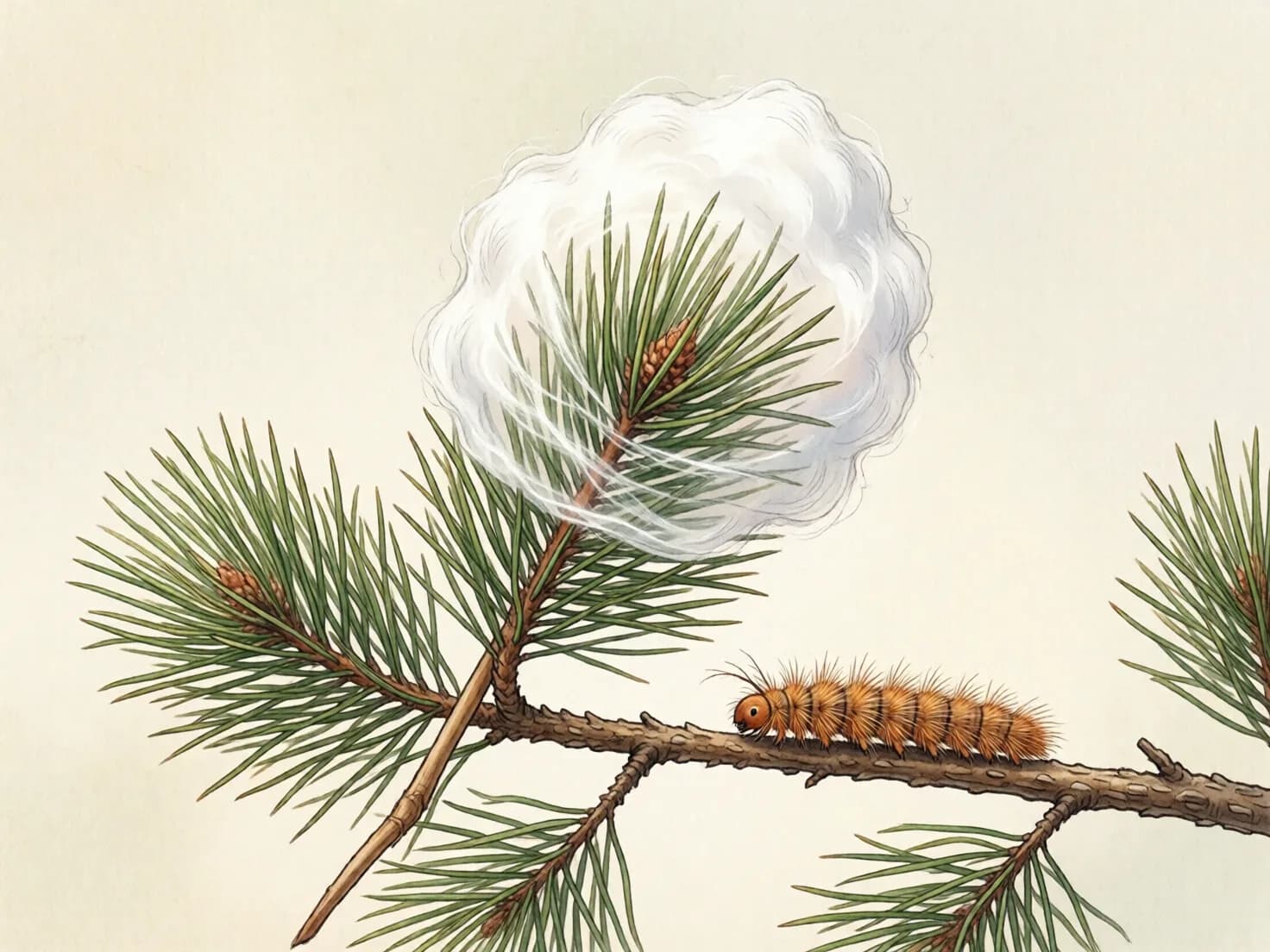
Pine processionary caterpillar
Also known as: pine processionary, pine processionary moth, processionary caterpillar, processionary caterpillars, Thaumetopoea pityocampa, pine nests, stinging caterpillar
A hairy caterpillar that lives on pines and cedars: it spends the winter in white silk nests and at the end of winter walks down in a line to bury itself in the soil. Its stinging hairs irritate the skin and eyes and are dangerous for dogs and cats. The sensible approach is not to touch it, to remove the nests in winter with protection, and to encourage the birds that eat it.

How to recognise it at every stage
Shares your gardenIt likes pines and cedars. Its hairs irritate the skin: better not to touch it.
Life cycle: Complete metamorphosis with one generation a year: the moth flies in summer, the caterpillars spend autumn and winter in silk nests in the pines, and at the end of winter they walk down in a "procession" to bury themselves and form the chrysalis. The chrysalis can wait in the soil for one or more years.
Tap a stage to see it full size. The photos are AI reference images checked against real photographs; stages without a reliable photo are shown as text only.
Life-stage calendar
| Jan | Feb | Mar | Apr | May | Jun | Jul | Aug | Sep | Oct | Nov | Dec | |
|---|---|---|---|---|---|---|---|---|---|---|---|---|
| Egg batch | ||||||||||||
| Caterpillar | ||||||||||||
| Chrysalis | ||||||||||||
| Moth | ||||||||||||
| Silk nest |
Approximate months for mainland Spain; in cold areas they start later and in warm areas they last longer. Garden creatures this month
- 1Protect your plants
Egg batch
· 3-5 cmA cylindrical sleeve covered in grey or beige scales, like a tiny pine cone, wrapped around two needles.
- Where to find it
- On the needles of pines and cedars, especially on sunny branches.
- When: Jul–Sep
- What to do
- On low branches, cut off the twig with the egg batch before the caterpillars hatch (there are no stinging hairs yet).
- 2Protect your plants
Caterpillar
· Up to 3-4 cmHairy, dark grey or blackish with brown-orange tufts on the back. They move in a line, each one touching the one in front.
- Where to find it
- In the nest and the crowns of pines; at the end of winter, in a line along the ground.
- When: Sep–Apr
- What to do
- Do not touch it or let children and dogs go near: its hairs are released into the air. Collar traps on the trunk from January to March to collect the processions; in public spaces, tell the town council.
- Often confused with
- Other hairy caterpillars. Many hairy caterpillars are harmless, but if in doubt, do not touch any of them with your hand.
- 3Keep an eye on it
Chrysalis
· 2 cmReddish brown and shiny, inside a silk cocoon covered in soil.
- Where to find it
- Buried 5-20 cm deep in loose, sunny soil near the pines.
- When: Mar–Aug
- What to do
- Nothing is needed. Hoopoes and other birds look for it on the ground.
- 4Keep an eye on it
Moth
· 3.5-4.5 cm wingspanA stout, hairy moth, forewings grey with dark wavy bands and hindwings white. It lives one or two days.
- Where to find it
- It flies at night in summer; by day, resting still on trunks.
- When: Jun–Aug
- What to do
- Pheromone traps are useful to learn whether there are many. Bats and nightjars eat them.
Nests, egg clutches and shelters
- Protect your plants
Silk nest
A white silk bag the size of a fist or larger, at the tip of the branches, with dark droppings inside.
- Where to find it
- On pines and cedars, on the sunniest branches.
- When: Nov–Mar
- What to do
- Remove it in winter, on a cold day, with a pole, gloves, goggles, a mask and long sleeves. Put the branch in a closed bag and take it to the recycling centre or your town council. Put up nest boxes for great tits and blue tits, which eat the caterpillars.
- Often confused with
- Ermine moth nests (Yponomeuta). Webs that wrap branches of fruit trees and hedges (apple, spindle) with smooth, pale caterpillars. They do not sting.
- Oak processionary. Very similar, but it lives on oaks and makes its nests on the trunk. It also stings.
Often confused with
- Ermine moth nests (Yponomeuta). Webs that wrap branches of fruit trees and hedges (apple, spindle) with smooth, pale caterpillars. They do not sting.
- Oak processionary. Very similar, but it lives on oaks and makes its nests on the trunk. It also stings.
- Other hairy caterpillars. Many hairy caterpillars are harmless, but if in doubt, do not touch any of them with your hand.
How to recognise it (symptoms)
- White silk nests at the tips of pine and cedar branches, from November to March
- Needles eaten and bare branches on the sunny parts of the tree
- Lines of hairy caterpillars walking along the ground at the end of winter
- Itching and hives on the skin after passing near pines with nests
Crops affected
 PineA fast-growing Mediterranean conifer, 10 to 20 m tall when mature, with an open, irregular crown, an often…
 CedarA very large conifer of majestic habit, with bluish foliage in the most widely grown glauca form.
 Fir (occasionally)A large evergreen conifer with a conical crown, horizontal branches and drooping branchlets, reaching 30 or…
What favours it
- Mild winters, which let the caterpillars feed more and climb in altitude
- Isolated, sunny pines in gardens, road edges and replanted woodland
Prevention
- Put up nest boxes for great tits and blue tits near the pines
- Check the pines in autumn and remove the young nests, which are easier to cut
- Fit collar traps on the trunk before January to collect the processions
- Pheromone traps in summer to see if there are many moths
Organic treatment
Always start here: these remedies are kind to the garden, the soil and pollinators.
- Remove the nests in winter with a pole, gloves, goggles, a mask and long sleeves; put them in a closed bag and take it to the recycling centre or the municipal service
- Collar traps on the trunk from January to March
- For large or public trees, tell the town council, which usually has a control service
- Encourage its predators: great tits, blue tits, hoopoes, cuckoos and bats
Chemical treatment (with caution)
In large pine woods, Bacillus thuringiensis treatments are used in autumn, carried out by professionals. In a garden it is not needed.
Don't confuse it with…
With the ermine moth (Yponomeuta), which spins webs on fruit trees and hedges and does not sting, and with the oak processionary, which lives on oaks.
Use plant protection products responsibly, even organic ones. Always read and follow the label, the doses and the harvest interval, and never treat plants in flower or while bees are flying, in order to protect pollinators. If in doubt, put prevention and organic methods first.

In the plant catalogue you'll see what to plant, how and when: a well-tended plant resists pests much better.