
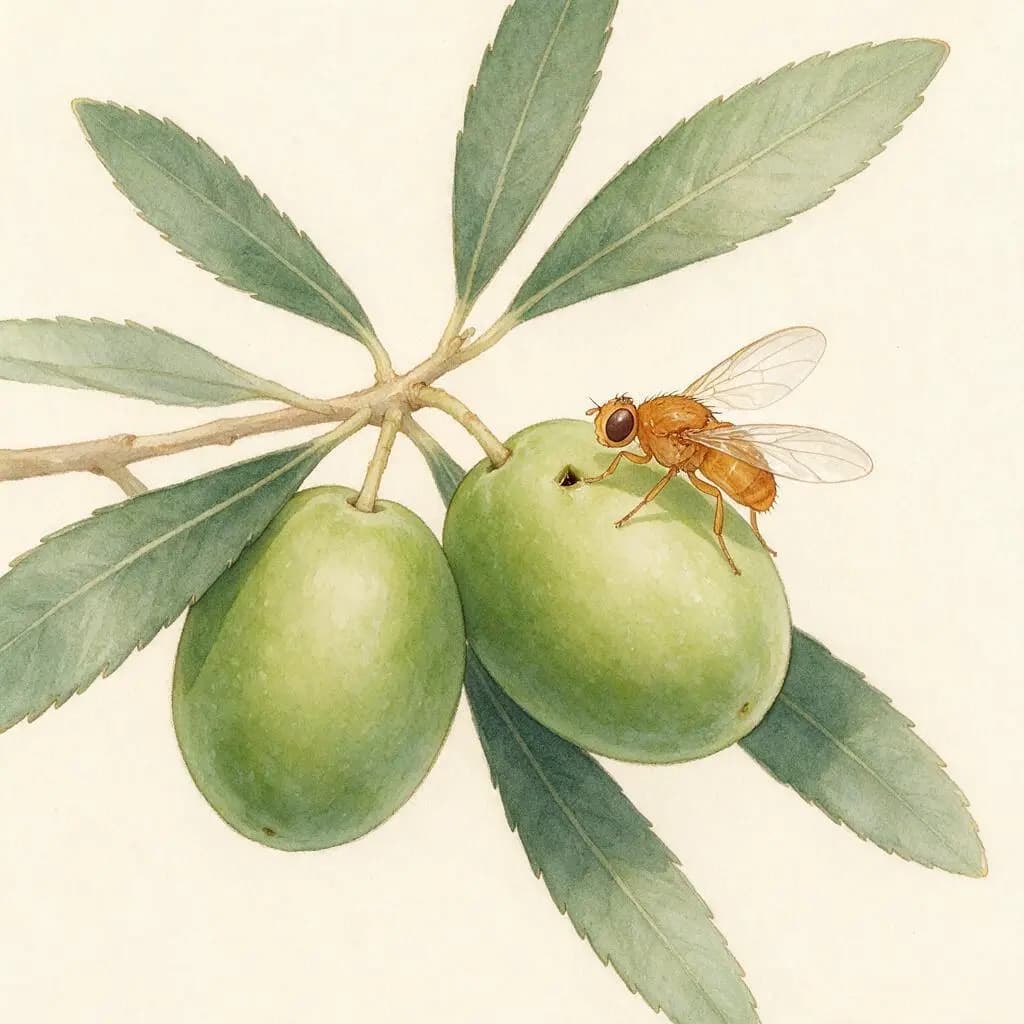
Olive fruit fly
Also known as: olive fruit fly, olive fly, Bactrocera oleae, Dacus oleae
A fly specific to the olive tree whose larvae tunnel through the olives. It causes premature fruit drop and high acidity in the oil. The first step is to hang fly traps from July and gather up fallen olives.

Its best ally
Blue tit
A natural predator that helps to keep this pest under control. Tap to see how to attract it.

How to recognise it at every stage
Shares your gardenIt likes your olives.
Life cycle: Complete metamorphosis: egg under the olive skin, larva inside the flesh (2-3 weeks), pupa in the olive or in the soil, and adult fly. Three to five generations a year, mainly from summer to autumn.
Tap a stage to see it full size. The photos are AI reference images checked against real photographs; stages without a reliable photo are shown as text only.
Life-stage calendar
| Jan | Feb | Mar | Apr | May | Jun | Jul | Aug | Sep | Oct | Nov | Dec | |
|---|---|---|---|---|---|---|---|---|---|---|---|---|
| Egg (sting) | ||||||||||||
| Larva | ||||||||||||
| Pupa | ||||||||||||
| Fly |
Approximate months for mainland Spain; in cold areas they start later and in warm areas they last longer. Garden creatures this month
- 1Keep an eye on it
Egg (sting)
· 0.8 mmNot visible: just a triangular sting mark on the olive skin.
- Where to find it
- Under the skin of olives that are starting to swell.
- When: Jul–Nov
- What to do
- Check sunny olives from July to October for stings.
- 2Protect your plants
Larva
· 6-7 mmA creamy-white legless maggot in a tunnel in the flesh.
- Where to find it
- Inside the olive.
- When: Jul–Dec
- What to do
- Harvest early if there are many stings and pick up fallen olives.
- 3Keep an eye on it
Pupa
· 4 mmA small yellowish-brown barrel.
- Where to find it
- Inside the olive (in summer) or in the soil (autumn and winter).
- When: Aug–Mar
- What to do
- Hens under the olive trees find many of them.
- 4Protect your plants
Fly
· 4-5 mmA small fly with a brown thorax and a creamy-white shield, orange abdomen and a dark spot at the tip of each wing.
- Where to find it
- In olive tree canopies.
- When: May–Nov
- What to do
- Bait traps from summer; kaolin on the olives confuses them.
- Often confused with
- Mediterranean fruit fly (Ceratitis). Black thorax with silver markings and wings with yellow bands; it does not sting olives. See profile
Often confused with
- Mediterranean fruit fly (Ceratitis). Black thorax with silver markings and wings with yellow bands; it does not sting olives. See profile
Sources
How to recognise it (symptoms)
- A small sting on the skin of the olive, a dark dot, where the female laid her egg
- Internal tunnels and a white larva when you split the fruit
- Premature olive drop and dark marks on the stone
- Very high acidity in the oil if stung fruit is pressed
Crops affected

What favours it
- Mild, humid summers (coastal areas, cool valleys)
- Abandoned olive groves nearby, which maintain uncontrolled populations of the pest
Prevention
- Gather fallen olives and press them or put them in the rubbish bin: this gets rid of the larvae before they pupate
- Encourage insect-eating birds (blue tits, great tits) with nest boxes
- Prune so that the tree is well ventilated
Organic treatment
Always start here: these remedies are kind to the garden, the soil and pollinators.
- First: hang fly traps (bottles with diammonium phosphate) from July, one per tree, and gather fallen olives often
- Kaolin sprayed over the canopy (a registered product), which acts as a physical barrier
- Spinosad bait (accepted in organic farming) only as a registered product and following the technical advice for your area
Don't confuse it with…
The external damage can be confused with that of the olive moth (Prays), but the fly leaves a pinpoint sting and a white larva inside the fruit.
In-depth guide — olive fruit fly
Bactrocera oleae damages olives, whether table olives or oil olives, and lowers oil quality. Integrated control combines traps, gathering fallen fruit and well-timed treatments.
Fly traps
- Bottles with a protein attractant (diammonium phosphate) from July, one per tree in a home garden.
- Check and top up the liquid every two weeks in summer.
- Note down the catches to decide whether an additional treatment is needed.
Gathering fallen olives
Pick them up from the ground every week. Seal them in a bag and put it in the rubbish bin, or press them soon: the larvae can stay alive in fruit that decomposes slowly.
When to treat
In Spain, the plant health services of the autonomous communities usually publish alerts with the right time to treat. Always respect the safety interval, especially for table olives.
Beneficial wildlife
- Nest boxes for great tits and blue tits.
- Avoid broad-spectrum insecticides during flowering.
- Keep flowers in the olive grove for pollinators and predators.
Use plant protection products responsibly, even organic ones. Always read and follow the label, the doses and the harvest interval, and never treat plants in flower or while bees are flying, in order to protect pollinators. If in doubt, put prevention and organic methods first.

In the plant catalogue you'll see what to plant, how and when: a well-tended plant resists pests much better.