
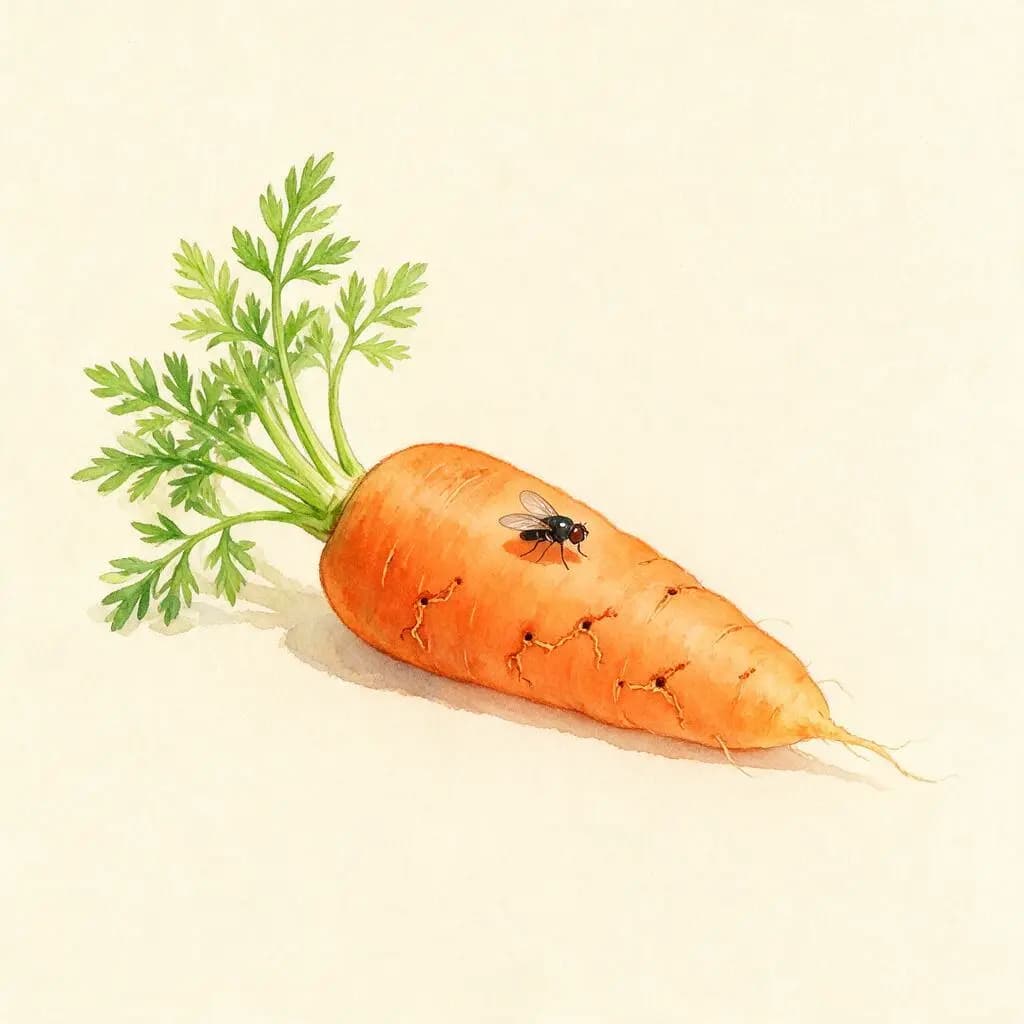
Carrot fly
Also known as: carrot fly, carrot rust fly, carrot root fly, Psila rosae
A fly whose yellowish larvae make very fine tunnels in carrots, celery and parsley. It spoils the root even when the attack is light. The first step is to cover the sowing with fine mesh right from the start.

How to recognise it at every stage
Shares your gardenIt likes your carrots, parsnips and celery.
Life cycle: Complete metamorphosis: egg next to the plant, larva tunnelling in the root (4-6 weeks), pupa in the soil and small adult fly. Two or three generations a year (spring and late summer).
Tap a stage to see it full size. The photos are AI reference images checked against real photographs; stages without a reliable photo are shown as text only.
Life-stage calendar
| Jan | Feb | Mar | Apr | May | Jun | Jul | Aug | Sep | Oct | Nov | Dec | |
|---|---|---|---|---|---|---|---|---|---|---|---|---|
| Eggs | ||||||||||||
| Larva | ||||||||||||
| Pupa | ||||||||||||
| Small fly |
Approximate months for mainland Spain; in cold areas they start later and in warm areas they last longer. Garden creatures this month
No reliable photo yet
1Keep an eye on itEggs
· 1 mmWhite and elongated, in the soil; not visible.
- Where to find it
- In cracks in the soil next to the carrot necks.
- When: Apr–Jun, Aug–Sep
- What to do
- Do not thin on flying days, or do it at dusk and water: the smell of crushed leaves attracts it.
- 2Protect your plants
Larva
· 7-9 mmA small creamy-yellow legless maggot in rust-coloured tunnels inside the root.
- Where to find it
- In the carrot root, especially the lower half.
- When: May–Nov
- What to do
- Harvest on time and do not leave forgotten carrots over winter.
- Often confused with
- Wireworm. Hard, amber-orange and with legs; it makes clean round holes, not rust-coloured tunnels. See profile
- 3Keep an eye on it
Pupa
· 4-5 mmA small brown barrel.
- Where to find it
- In the soil, near the roots.
- When: Jun–Jul, Oct–Mar
- What to do
- Rotate the crop so they do not emerge next to the new carrots.
- 4Protect your plants
Small fly
· 4-5 mmA shiny black fly with a yellowish head and legs. It flies low, just above the leaves.
- Where to find it
- In hedges and damp edges; it comes down to the carrots to lay.
- When: Apr–May, Jul–Sep
- What to do
- Mesh or a barrier 60-80 cm high around the bed; grow alongside onions or leeks.
Often confused with
- Wireworm. Hard, amber-orange and with legs; it makes clean round holes, not rust-coloured tunnels. See profile
Sources
How to recognise it (symptoms)
- Fine, winding, rust-coloured tunnels in the skin and flesh of the carrot
- Yellowish larvae less than 1 cm long inside the tunnels
- Young leaves with reddish or purplish tinges and slow growth
Crops affected
 CarrotThe Nantes carrot, cylindrical and sweet.
 CeleryA celery with green stalks that needs constant watering and rich soil.
 ParsleyLeaf parsley, a biennial that is slow to germinate.
 ParsnipA root vegetable with a white root and a sweet flavour that improves after the first frosts, when the cold…
 FennelFennel grown for its leaves and aromatic seeds, hardier and wilder than bulb fennel.
What favours it
- Carrots from the previous year or wild carrot (Daucus carota) growing nearby
- Damp, shady soils, where the fly lays its eggs more readily
Prevention
- Cover the sowing with fine insect-proof mesh from the time the seedlings come up until harvest, well sealed and not touching the leaves
- Alternate rows of carrots with onions or leeks: this may confuse the fly, but it is no substitute for mesh
- Do not sow carrots on the same plot two years running
- If there is a clear flight period in spring in your area, sowing later may help you avoid it
Organic treatment
Always start here: these remedies are kind to the garden, the soil and pollinators.
- First: cover the sowing with mesh with an aperture of 1.3 mm or less, sealed with soil or stones at the edges
- Use yellow or orange sticky traps to monitor the fly and decide when to cover
- Remove badly damaged roots and put them in the rubbish bin: if they are left on the plot, the larvae complete part of their cycle there
Don't confuse it with…
Damage to the skin looks like nematode damage, but nematodes distort the whole root and form knots or forked roots.
In-depth guide — carrot fly
The larvae mine the root, leaving brown tunnels. In a Mediterranean climate, mesh and rotation are the most reliable tools.
Choosing the sowing date
The fly has distinct flight periods (spring, early summer and autumn). Ask local growers or your plant health service about the flight periods in your area and, if you can, adjust your sowing to avoid the heaviest ones.
Insect-proof mesh
Cover the crop with mesh with an aperture of 1.3 mm or less, well sealed to the ground, from germination to harvest in the highest-risk seasons. Keep it off the leaves.
Rotation
- Do not grow carrots or other Apiaceae in the same place for three years running.
- Keep carrots away from nearby flowering parsley and fennel.
Traps and monitoring
Yellow or orange sticky traps for adults help you decide when to cover. Reddish leaves and roots with tunnels confirm that larvae are present.
Use plant protection products responsibly, even organic ones. Always read and follow the label, the doses and the harvest interval, and never treat plants in flower or while bees are flying, in order to protect pollinators. If in doubt, put prevention and organic methods first.

In the plant catalogue you'll see what to plant, how and when: a well-tended plant resists pests much better.