
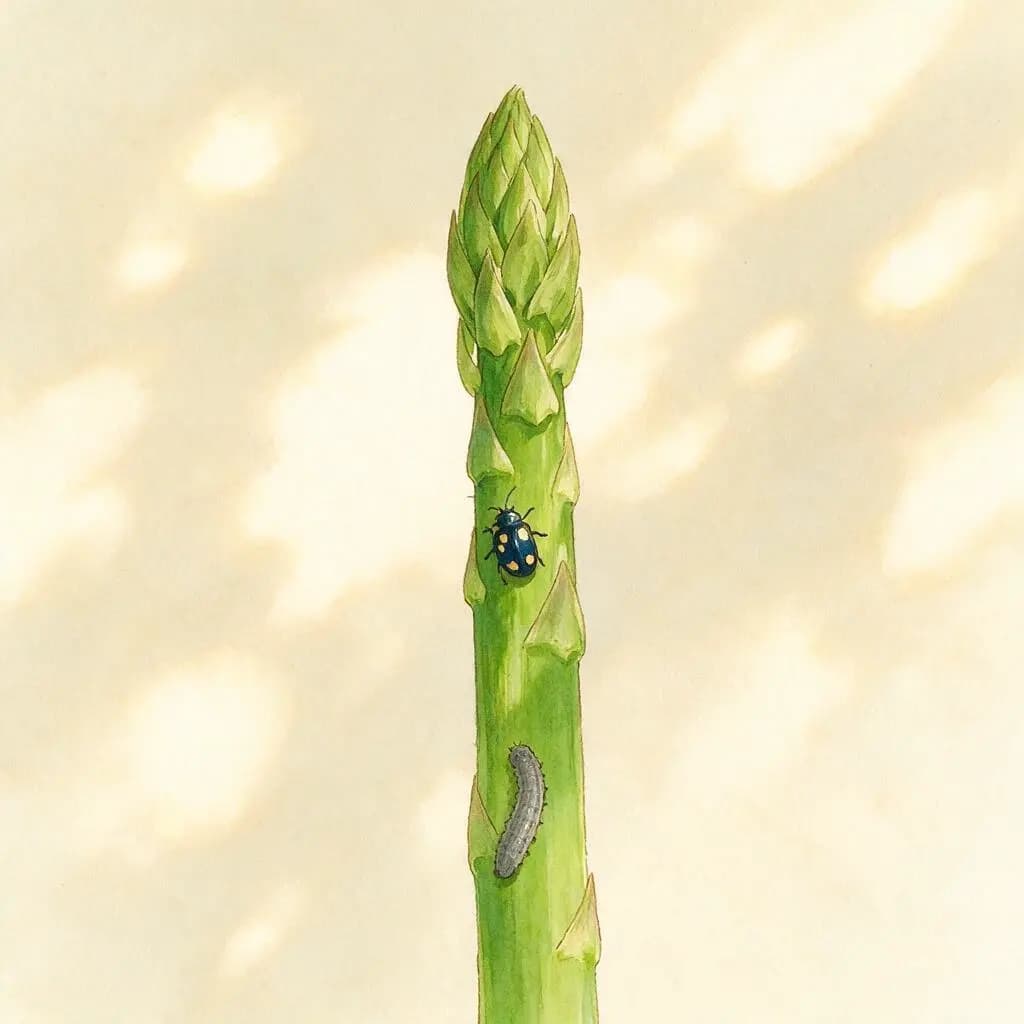
Asparagus beetle
Also known as: asparagus beetle, common asparagus beetle, Crioceris asparagi, asparagus leaf beetle
A small, elongated beetle (6 to 7 mm), blue-black with yellow markings, that feeds on asparagus spears and leaves. Its grey larvae strip the plant of foliage. The first step is to pick them off by hand at dawn.

How to recognise it at every stage
Shares your gardenIt likes your asparagus.
Life cycle: Complete metamorphosis: egg (1 week), larva (2 weeks), pupa in the soil (1-2 weeks) and adult. Two or three generations a year; adults overwinter under debris and bark.
Tap a stage to see it full size. The photos are AI reference images checked against real photographs; stages without a reliable photo are shown as text only.
Life-stage calendar
| Jan | Feb | Mar | Apr | May | Jun | Jul | Aug | Sep | Oct | Nov | Dec | |
|---|---|---|---|---|---|---|---|---|---|---|---|---|
| Eggs | ||||||||||||
| Larva | ||||||||||||
| Pupa | ||||||||||||
| Adult |
Approximate months for mainland Spain; in cold areas they start later and in warm areas they last longer. Garden creatures this month
- 1Protect your plants
Eggs
· 1.2 mmElongated and dark, standing on end in a row on spears and shoots.
- Where to find it
- On asparagus spears and foliage.
- When: Apr–Aug
- What to do
- Run your hand along the spears to knock them off.
- 2Protect your plants
Larva
· Up to 8 mmPlump and soft, greyish-green or olive, with a black head.
- Where to find it
- Eating the foliage.
- When: May–Aug
- What to do
- Shake the fronds over a container in the morning.
- 3Keep an eye on it
Pupa
Yellowish, in an earthen cocoon.
- Where to find it
- In the soil under the asparagus bed.
- When: Jun–Aug
- What to do
- Not visible.
- 4Protect your plants
Adult
· 6 mmA small beetle with a red shield and blue-black wing cases with cream spots and reddish edges (or orange with 12 spots, the other species).
- Where to find it
- On spears and foliage.
- When: Apr–Sep
- What to do
- Pick them off by hand and clear dry foliage in autumn to take away their winter shelter.
- Often confused with
- Ladybirds. The orange spotted species looks similar, but it is longer and always on asparagus, with no aphids. See profile
Often confused with
- Ladybirds. The orange spotted species looks similar, but it is longer and always on asparagus, with no aphids. See profile
How to recognise it (symptoms)
- Spears with dark marks and bent over
- Greyish, slimy larvae eating the green foliage
- Adults that drop to the ground when the plant is touched
Crops affected

What favours it
- Old asparagus beds that have not been cleared of remains, where the adults spend the winter
- Neighbouring abandoned fields with asparagus, which act as a reservoir
Prevention
- Cut the dry stems at the end of the cycle and put them in the rubbish, or shred them finely before composting
- Harvest all the spears daily in the main season
- Encourage ladybirds and lacewings with flowering hedges
Organic treatment
Always start here: these remedies are kind to the garden, the soil and pollinators.
- First: pick the adults and larvae off by hand at dawn, when they are most visible and slow
- For strong outbreaks, natural pyrethrin or spinosad from a registered product, following the label: they are toxic to bees, so apply them in the evening and not during flowering
Don't confuse it with…
With Crioceris duodecimpunctata (the 12-spotted asparagus beetle), which is more reddish and eats less asparagus.
In-depth guide: asparagus beetle
The adults and larvae strip the foliage that feeds the root for the following season.
Season
They appear in spring and summer on the stems and foliage.
- Pick off the adults by hand first thing in the morning.
- Protect the spears with netting if numbers are high.
Prevention
Do not leave dry foliage remains where they spend the winter.
- Tidy up at the end of the season.
- Avoid planting too densely, with no air gaps between rows.
Use plant protection products responsibly, even organic ones. Always read and follow the label, the doses and the harvest interval, and never treat plants in flower or while bees are flying, in order to protect pollinators. If in doubt, put prevention and organic methods first.

In the plant catalogue you'll see what to plant, how and when: a well-tended plant resists pests much better.