
Amphibians: a small fish-free pond with a sloping edge
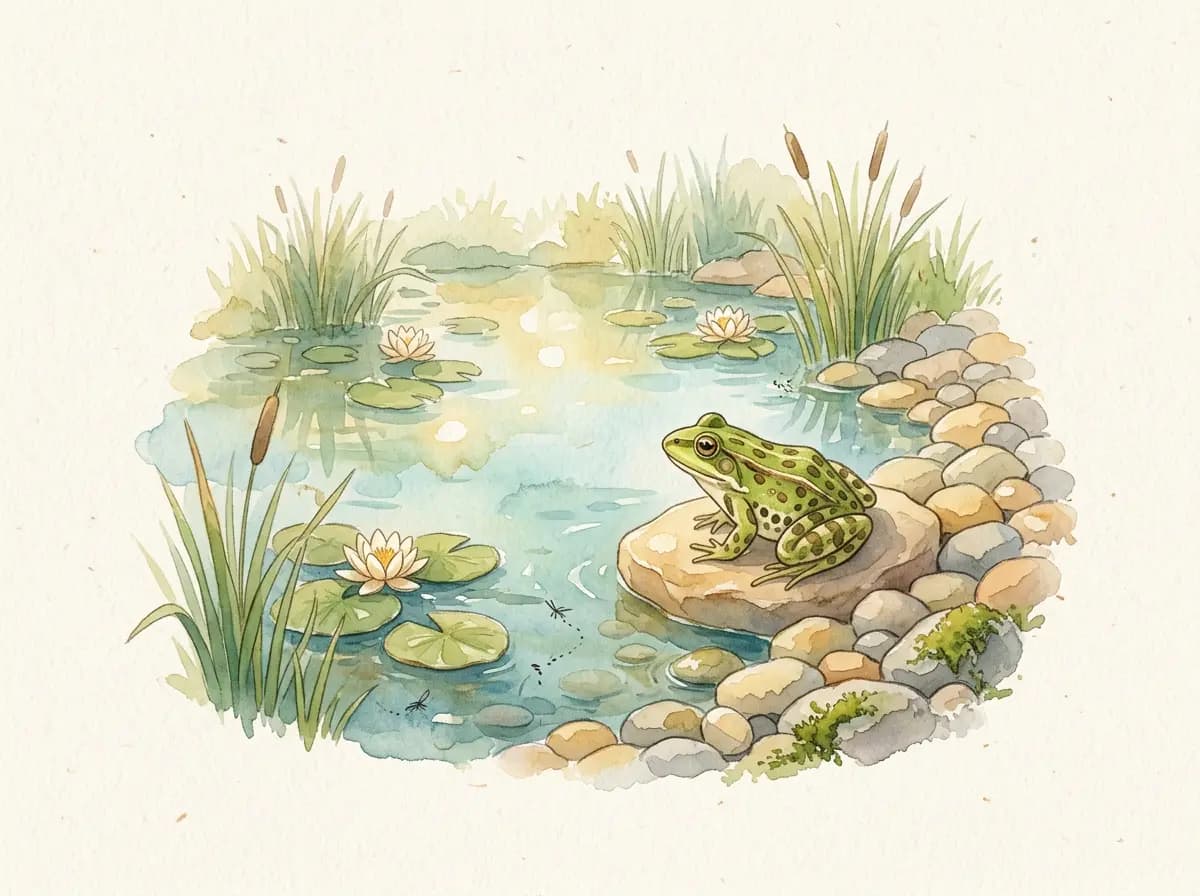
Toads, frogs and newts eat slugs, snails, insect larvae and mosquitoes. A small pond, without fish, with a ramp to get in and out and shelter at the edge becomes their breeding home. You do not need to bring animals: they arrive on their own, sometimes after a year.
- Difficulty: medium
- Surface: at least 1 m² (about 120 × 100 cm); bigger is better
- Profile: Common toad
What it helps with
- Adults eat slugs, snails, beetles, caterpillars and mosquitoes.
- Dragonfly larvae and tadpoles keep the water clean.
- It is a watering point for all the garden’s wildlife: bees, birds and hedgehogs.
Materials
- 1 mm EPDM or butyl liner (no thin PVC)
- Geotextile felt or sand to protect the liner
- Stones, gravel and logs for the edge
- Native water and marginal plants (rushes, water lilies, water mint)
- Rainwater (best) or tap water left to stand for 48 h
- A spade, a spirit level and a long stick
Measurements
- Surface
- at least 1 m² (about 120 × 100 cm); bigger is better
- Depth
- 40–60 cm in the deepest part; shelves at 10 cm and 30 cm
- Edge ramp
- gentle slope of 1:3 to 1:5 (11–18°), 60 cm or more
- Liner
- 1 mm EPDM or butyl, with 30 cm to spare on each side
- Sun
- 4–6 hours a day; partial shade in the afternoon
Diagram drawn by a program with the same measurements as the table. The figures are indicative: each author proposes slightly different values.
Step by step
1. Choose the site
A place with morning sun and afternoon shade, away from big trees that drop leaves, and near a corner with plants and stones. With small children, cover it with a grille or fence it.

2. Dig with different levels
Dig a hole of about 120 × 100 cm with three zones: a shelf 10 cm deep, another 30 cm deep and a bottom of 40–60 cm. On one side, make a gentle ramp (1:3 to 1:5) so tadpoles, toads and hedgehogs can get in and out.

3. Protect and lay the liner
Remove sharp stones. Spread geotextile felt or 3–5 cm of sand, and on top the EPDM or butyl liner, leaving 30 cm to spare on each side. Fill it a little with water so it settles and smooth out the wrinkles.

4. Cover with stones and fill
Put gravel or stones on the ramp and the edge, and fill with rainwater. Plant rushes and native water plants on the shelves.

5. Make shelters nearby
Put a pile of stones and logs next to the pond, and leave some tall grass. They hide there by day and spend the winter.

6. Wait
Do not introduce animals. Amphibians arrive on their own within weeks or months. The algae of the first weeks are normal: they balance out when the plants grow.

How to recognise it at every stage
Garden allyGarden ally: at night it eats slugs, snails and insects.
Life cycle: Amphibian metamorphosis: eggs in strings in the water, tadpoles that live in the pond for two or three months, tiny toadlets that come out onto land and adults that take three or four years to breed. They live for more than ten years.
Tap a stage to see it full size. The photos are AI reference images checked against real photographs; stages without a reliable photo are shown as text only.
Life-stage calendar
| Jan | Feb | Mar | Apr | May | Jun | Jul | Aug | Sep | Oct | Nov | Dec | |
|---|---|---|---|---|---|---|---|---|---|---|---|---|
| Spawn | ||||||||||||
| Tadpole | ||||||||||||
| Toadlet | ||||||||||||
| Adult | ||||||||||||
| Toad shelter |
Approximate months for mainland Spain; in cold areas they start later and in warm areas they last longer. Garden creatures this month
- 1Protect it
Spawn
Long strings of transparent jelly with two rows of black eggs, wound around water plants (frogs lay them in masses, not strings).
- Where to find it
- In ponds, pools and garden ponds.
- When: Jan–Apr
- What to do
- Do not touch the spawn. A pond without fish is the best help.
- Often confused with
- Frog spawn. Frogs lay round masses of eggs like tapioca; toads lay long strings.
- 2Protect it
Tadpole
· 1-3 cmSmall black tadpoles in groups; the back legs grow first and then the front ones.
- Where to find it
- In the water, in groups near the edge.
- When: Feb–Jun
- What to do
- Do not put fish or ducks in the pond; leave one edge sloping so they can get out.
- 3Protect it
Toadlet
· 1 cmTiny toadlets, the size of a fingernail, that leave the pond all at once on rainy days.
- Where to find it
- In the grass and under stones around the pond.
- When: May–Jul
- What to do
- Take care when mowing or using the strimmer on those days.
- 4Protect it
Adult
· 8-15 cmRough, warty skin, brown, grey or olive, golden eyes; it walks instead of hopping.
- Where to find it
- By day hidden under stones, boards or in the compost; at night hunting.
- When: Feb–Nov
- What to do
- Protect it (it is protected by law): leave damp shelters, do not use slug killers and wash your hands if you touch it.
Nests, egg clutches and shelters
- Protect it
Toad shelter
A broken flowerpot half buried, a pile of stones or logs in a damp, shady corner.
- Where to find it
- Near the pond or the lettuce bed.
- When: all year
- What to do
- Do not move it in winter: they hibernate there.
Often confused with
- Frog spawn. Frogs lay round masses of eggs like tapioca; toads lay long strings.
Where and when to put it
- Make it in autumn or late winter so it is ready for spring, when amphibians breed.
- Morning sun and afternoon shade; away from walkways and from trees that drop a lot of leaves.
- Near shelters: stones, logs, hedges, tall grass.
Maintenance
- Top up with rainwater in summer.
- Remove some of the excess vegetation at the end of summer and the fallen leaves in autumn; do it carefully and gradually.
- Do not use fertilisers or products in the water.
- Do not empty the pond in winter; leave the ramp and some area unfrozen.
- Remove invasive plants if they appear (too much duckweed, water hyacinth).
Common mistakes
What comes up most often, so you can avoid it from the start.
Putting in fish, including goldfish and carp.
Fish eat eggs and tadpoles, so the pond stops being useful for breeding. Amphibians choose fish-free ponds to lay in.
Making vertical or very smooth edges.
Toads, froglets just out of the water and hedgehogs that come to drink cannot climb a smooth wall: they get trapped and drown.
Making the pond very deep, with no shelves or ramp.
The spawn and tadpoles need shallow areas, where the water warms in the sun. Without shelves or a ramp, they also have no way out.
Bringing eggs, tadpoles or adults from other ponds.
It is illegal, because they are protected wildlife, and it can also spread serious amphibian diseases such as chytridiomycosis. They arrive on their own if the pond is well made.
Releasing Florida turtles or other exotic species.
They eat eggs, tadpoles and plants, displace local species and releasing them is prohibited by law.
Placing the pond under a tree that drops a lot of leaves.
Leaves fall into the water and rot; as they rot they use up the oxygen, the water gets dirty and the bottom fills with sludge.
Plants that help
 Water mintA perennial mint of banksides and waterlogged soils, with upright, somewhat reddish or purplish, hairy stems…
It grows at the edge with its base in the water; tadpoles and newts hide among its stems, and in summer its flowers attract many pollinators.
More information on the site
Sources
The measurements are a synthesis of these conservation guides; where each author gives different figures, they appear as a range.