
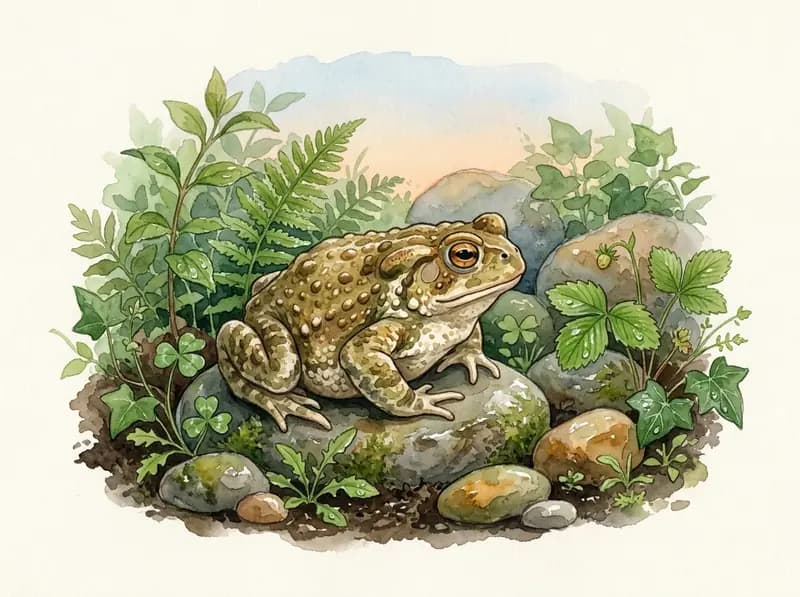
Common toad
Bufo spinosus
Also called: toad, spiny toad, Bufo, garden toad
A night hunter of slugs. A big toad can eat several slugs every night, as well as snails, earwigs, larvae and ants. Having one in the garden is a good sign.

How to recognise it at every stage
Garden allyGarden ally: at night it eats slugs, snails and insects.
Life cycle: Amphibian metamorphosis: eggs in strings in the water, tadpoles that live in the pond for two or three months, tiny toadlets that come out onto land and adults that take three or four years to breed. They live for more than ten years.
Tap a stage to see it full size. The photos are AI reference images checked against real photographs; stages without a reliable photo are shown as text only.
Life-stage calendar
| Jan | Feb | Mar | Apr | May | Jun | Jul | Aug | Sep | Oct | Nov | Dec | |
|---|---|---|---|---|---|---|---|---|---|---|---|---|
| Spawn | ||||||||||||
| Tadpole | ||||||||||||
| Toadlet | ||||||||||||
| Adult | ||||||||||||
| Toad shelter |
Approximate months for mainland Spain; in cold areas they start later and in warm areas they last longer. Garden creatures this month
- 1Protect it
Spawn
Long strings of transparent jelly with two rows of black eggs, wound around water plants (frogs lay them in masses, not strings).
- Where to find it
- In ponds, pools and garden ponds.
- When: Jan–Apr
- What to do
- Do not touch the spawn. A pond without fish is the best help.
- Often confused with
- Frog spawn. Frogs lay round masses of eggs like tapioca; toads lay long strings.
- 2Protect it
Tadpole
· 1-3 cmSmall black tadpoles in groups; the back legs grow first and then the front ones.
- Where to find it
- In the water, in groups near the edge.
- When: Feb–Jun
- What to do
- Do not put fish or ducks in the pond; leave one edge sloping so they can get out.
- 3Protect it
Toadlet
· 1 cmTiny toadlets, the size of a fingernail, that leave the pond all at once on rainy days.
- Where to find it
- In the grass and under stones around the pond.
- When: May–Jul
- What to do
- Take care when mowing or using the strimmer on those days.
- 4Protect it
Adult
· 8-15 cmRough, warty skin, brown, grey or olive, golden eyes; it walks instead of hopping.
- Where to find it
- By day hidden under stones, boards or in the compost; at night hunting.
- When: Feb–Nov
- What to do
- Protect it (it is protected by law): leave damp shelters, do not use slug killers and wash your hands if you touch it.
Nests, egg clutches and shelters
- Protect it
Toad shelter
A broken flowerpot half buried, a pile of stones or logs in a damp, shady corner.
- Where to find it
- Near the pond or the lettuce bed.
- When: all year
- What to do
- Do not move it in winter: they hibernate there.
Often confused with
- Frog spawn. Frogs lay round masses of eggs like tapioca; toads lay long strings.
What it eats
- Slugs and snails (all sizes)
- Earwigs, caterpillars, larvae
- Ants and termites
- Beetles
How it helps in the garden
How to attract this ally to your garden
- Make a shallow pond with gently sloping edges: amphibians and birds drink and hunt there, and without an exit ramp animals drown.
- Cool, damp shelters: stacked flat stones, old roof tiles, a log pile in the shade.
- Leave strips of dense vegetation: hedgehogs and toads hide by day and come out to hunt at night.
- Water in summer: toads need damp skin.
What to avoid so you do not harm it by accident
- Smooth or very high fences and kerbs they cannot climb: you cut off their access to the garden where they hunt slugs.
- Insecticides and slug pellets: they build up in toads when they eat poisoned prey.
- Swimming pools or vertical tanks with no way out: they drown.
How to recognise it
10-15 cm, rough dry skin, horizontal yellow-coppery eyes. It walks, it does NOT hop (frogs do). It is nocturnal: it hides by day.
Risk to people: It does not bite or attack. Its skin secretes a defensive substance that can be toxic: if a dog or cat bites or licks it, rinse its mouth with plenty of water and call the vet. Wash your hands after touching it and do not rub your eyes.
Many allies are protected by Spanish law: do not capture or keep in captivity toads, hedgehogs, bats or native reptiles. Attract them, watch them and thank them from a distance. Rules in other countries differ: check your local regulations.

Allies do better if the garden is varied. Learn to identify each visitor and to prevent problems with good habits.