
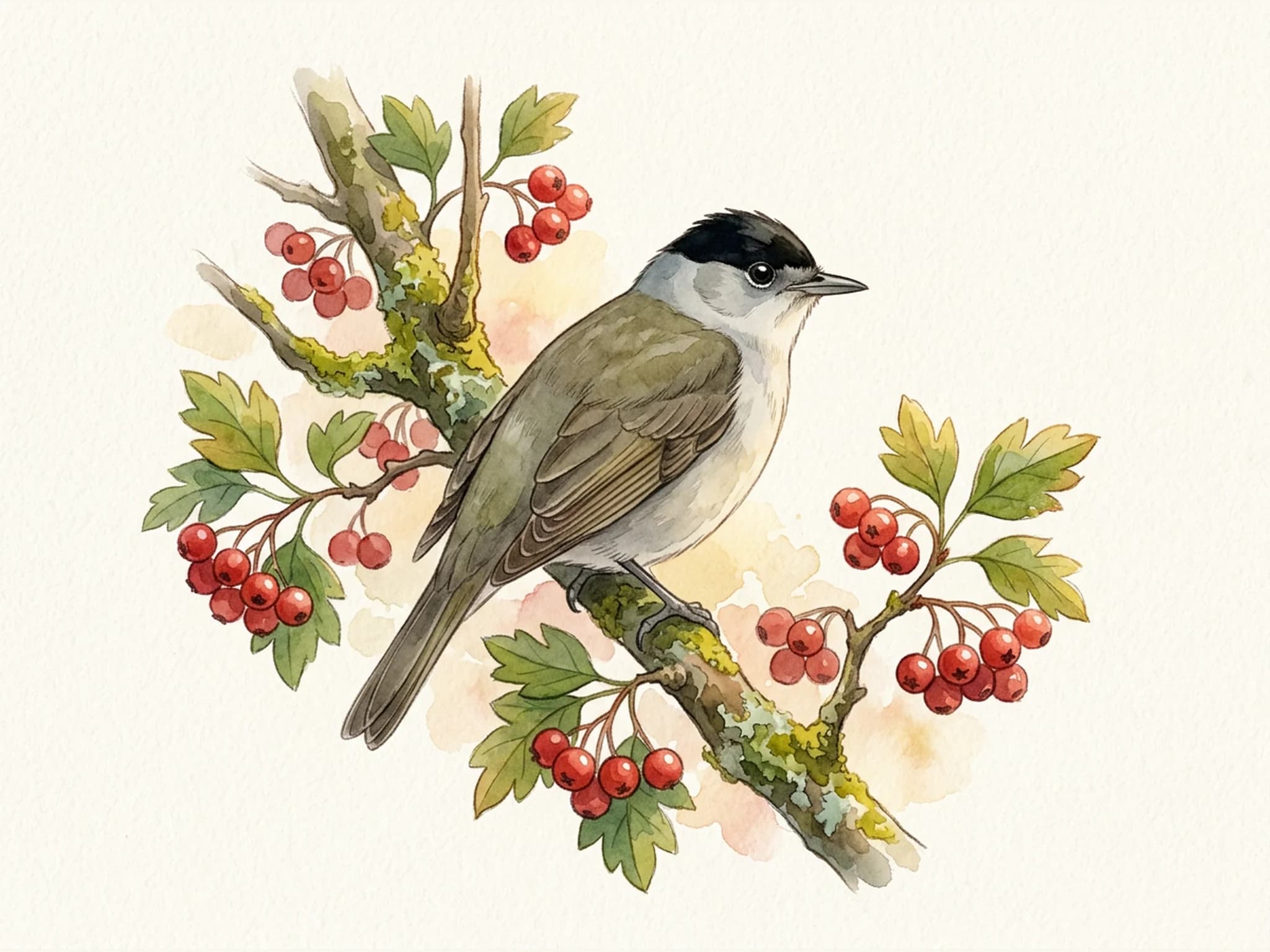
Eurasian blackcap
Sylvia atricapilla
Also called: blackcap, capirote warbler
Look after the blackberries and elders in your hedge: in autumn it feasts on berries.
A slender hedge and scrub bird with a black cap (male) or chestnut cap (female). It sings a beautiful, flexible melody from the hedge.
Months when you can see it
How it helps in the garden
It eats aphids, caterpillars, flies and spiders from hedges and trees; that is why a living hedge next to the garden is worthwhile.
How to recognise it
- Size
- Small: 13 cm and 16–20 g.
- Colours
- Black cap in the male, chestnut in the female; olive-grey body, pale belly.
- Song
- A fluid, melodious, variable warble ending in fluting notes. It resembles the blackbird’s song, but is faster.
What it eats through the year
Spring
Small caterpillars, aphids and flies.
Summer
Insects and soft berries.
Autumn
Berries (elder, ivy, strawberry tree, blackberry) and small fruits.
Winter
Berries, ripe fruit and a little soft food at the feeder; many winter in the south.
Breeding
- When
- From April to July.
- Broods
- 2 (sometimes only 1).
- Eggs
- 4–6 cream eggs with brown spots.
Which nest it uses
A thin cup of grass in brambles, wild roses or dense shrubs, low down. It does not use a nest box.
How to attract it
Plants
A mixed hedge with bramble, wild rose, elder, hawthorn and honeysuckle; fruit you leave unpicked.
Water
A shallow drinking dish next to the hedge.
Shelter
Thick, unpruned scrub between March and July.
Nest box
It does not use a nest box: offer it a dense hedge at 0.5–2 m.
Plants from the catalogue it likes
 Ivy (berries in winter)A self-clinging evergreen climber, able to cover walls and the ground even in deep shade, where few plants…
 Thornless blackberryA cultivated thornless blackberry with long canes that are best trained on wires or along a fence, bearing…
 Dog rose (rose hips)A wild rose (Rosa canina) with pale pink flowers.
 ElderA large wild shrub with flat clusters of white flowers in spring and bunches of black berries in summer.
 Hawthorn (common hawthorn)A thorny shrub of wild hedgerows, with white spring flowers and red fruits.
 Japanese honeysuckleA semi-evergreen climber of very vigorous growth, with white flowers that turn yellow over the days and are…
What to avoid
Pruning or clearing hedges in spring
It nests inside them, and cutting destroys the nest or leaves it in view of magpies and cats.
Letting cats roam or running a brush cutter next to the scrub
The nest is low, among the branches, and the chicks cannot escape.
Using pesticides on fruit trees and hedges
They remove the insects it feeds its chicks with and poison the berries it eats in autumn.
Leaving panes of glass unmarked next to the hedge
Flying out of the hedge it does not see the glass and hits it.