
Black soldier fly larvae (Hermetia illucens): the self-harvesting composter
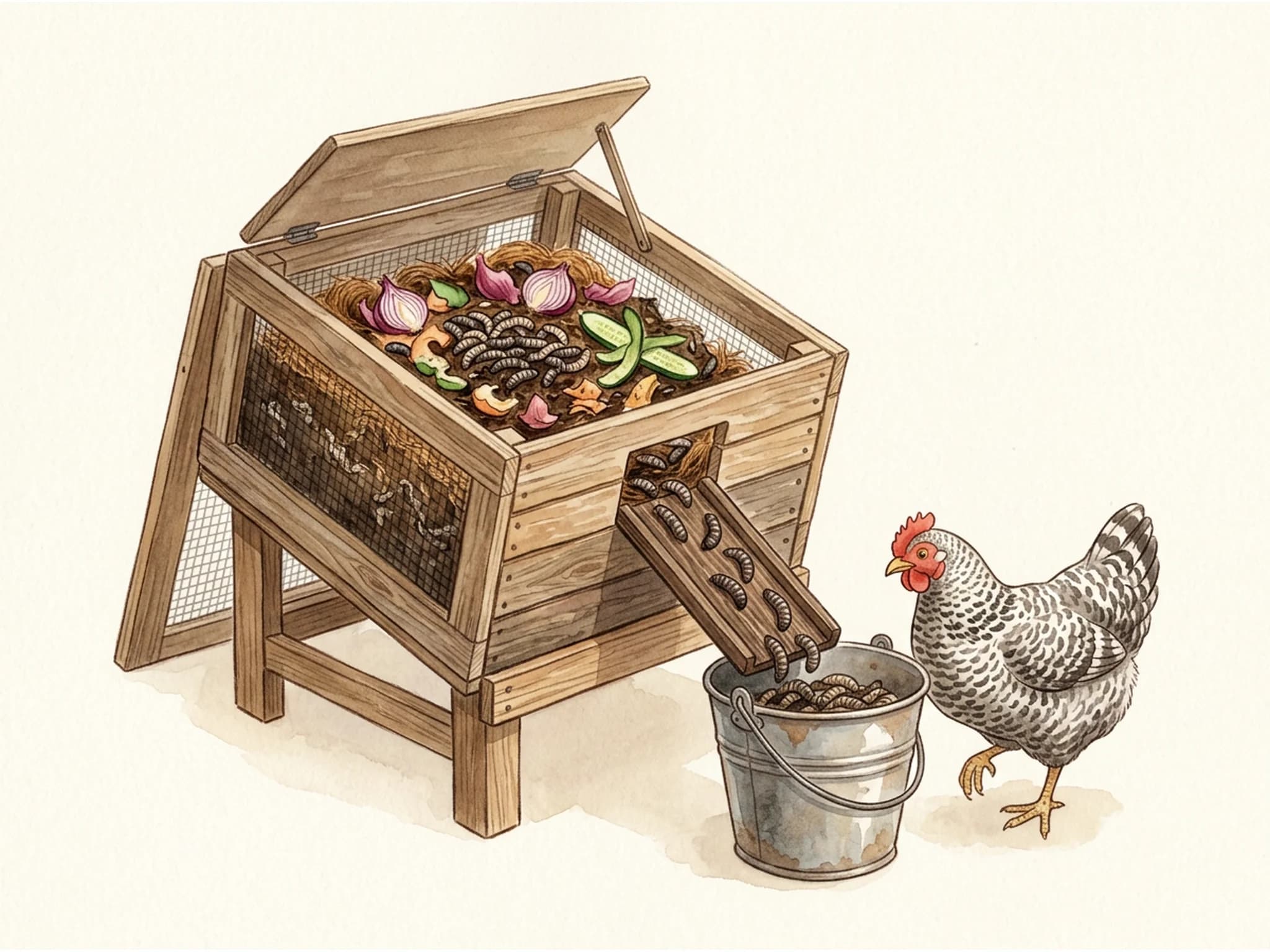
The black soldier fly lays its eggs near decomposing organic matter and its larvae eat it at great speed. With a sloping box and a ramp, the mature larvae climb out on their own into a bucket: the harvest is already done. They reduce kitchen and garden waste and produce a fertiliser (frass) and, if reared properly, a feed rich in protein and fat.
- Difficulty: medium
- Hermetia illucens
Which animals it suits and how much to give
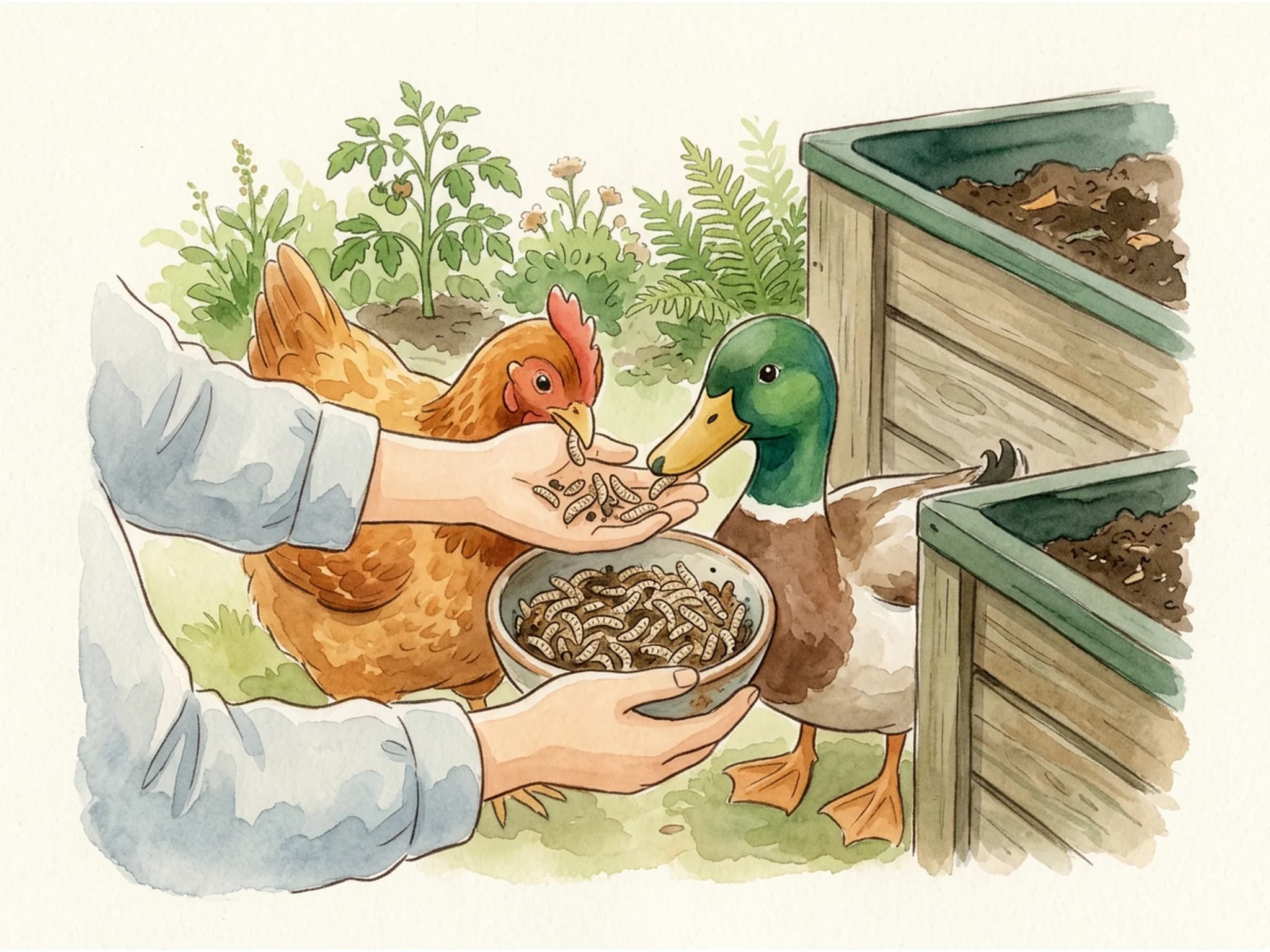
- Chickens
- Up to 10 g per hen per day of live or dried larvae, as a supplement (at most 10% of the ration).
- Ducks
- Up to 10 g per duck per day, best moistened.
- Quail
- 1–3 g per quail per day, with the small larvae.
- Pond fish
- A few small larvae, 1–2 times a week.
- Rabbits and hedgehogs
- No.
If you are going to give the larvae to chickens, ducks or quail, feed them only on raw plant scraps; use the ones reared on kitchen scraps only for making compost.
Indicative doses: a supplement to a complete feed. See the table for all the animals.
Materials
- Rigid plastic box of 60 × 40 × 30 cm, with a 2 mm mesh lid
- Non-slip 45° channel or ramp with an outlet to the outside
- 10 L collection bucket with a perforated lid
- Wedges or a support to tilt the box by 15°
- Sponge or drainage tube at the low end of the box
- 200 g of small larvae (or let the fly lay its own eggs: a few weeks’ wait in summer)
- Chopped plant scraps (and kitchen scraps only if the larvae go to the compost, not to your birds)
Set-up measurements
- Box
- 600 × 400 × 300 mm
- Box tilt
- 15° towards the drainage end
- Exit ramp
- 45° (the mature larvae climb it on their own)
- Food layer
- 30 mm of chopped scraps every 2–3 days
- Temperature
- 27–32 °C ideal; below 15 °C they stop, above 36 °C they die
- Substrate moisture
- 60–70%: like a wrung-out sponge, no puddles
- Location
- In the shade, outdoors, more than 5 m from windows if you have neighbours
Diagram drawn by a program with the same measurements as the table. The temperature and humidity figures are indicative.
Step by step
- 1
Choose the site
Outdoors, in the shade and sheltered from direct rain. In a cold climate, in a greenhouse or shed to keep it above 20 °C.

- 2
Set up the sloping box
Rest one end on wedges until you get a 15° tilt. At the low end put the drainage (sponge or tube with a bucket) and at the high end, the 45° ramp.

- 3
Fit the ramp and the bucket
The ramp must leave from the high part of the box and drop into the bucket, with a smooth edge that the larvae can climb but not get back over. Put a dry bottom in the bucket.

- 4
Sow the larvae
Put in 5 cm of plant scraps and release 200 g of small larvae. Cover with mesh. If you prefer to attract wild flies, leave the box open for a few weeks in summer.

- 5
Feed in thin layers
Every 2–3 days add a layer of about 3 cm of scraps chopped into pieces of 1–2 cm. The smaller the piece, the faster they eat it. Do not add more until the previous food has gone.

- 6
Collect the larvae
The mature larvae (2–2.5 cm, dark brown) climb the ramp on their own and fall into the bucket. Collect them daily. Leave 10% in the box so the colony continues.

- 7
Remove the frass
When the box fills with a dark, crumbly residue (frass), take out half, let it mature for 2 weeks in a bucket and use it as a soil improver in the garden.

Cycle and timings
| Stage | Duration | What happens |
|---|---|---|
| Egg | 4–6 days | In clusters stuck to dry cracks near the food. |
| Larva | 2–3 weeks to the prepupa (up to 2 months in cold) | It eats non-stop; it is the stage that is harvested. |
| Prepupa | A few days | Dark and stiff; it climbs the ramp on its own looking for a place to pupate. |
| Pupa | 1–2 weeks | Inside a dry capsule. |
| Adult fly | 5–10 days of life | It does not eat and does not sting; it only reproduces. |
Maintenance
- Stir the top layer once a week so it does not clump.
- Measure the temperature: below 20 °C the colony slows down.
- Empty the bucket every day; the prepupae that are not collected end up pupating outside.
- Avoid very salty foods, oils, too many citrus fruits, onion and garlic: they slow the larvae down.
- Stop adding scraps for 2 weeks if the box is too damp.
Common problems
Smells, mites, mould, leaks and others: why they happen and how to fix them.
Strong smell of rot
Why it happens: Too much protein (meat, fish) or excess moisture.
What to do: Stop feeding, aerate the substrate, add dry matter (bran, sawdust) and do not put in meat or dairy.
Common flies and white maggots (not soldier flies)
Why it happens: Uncovered scraps outdoors.
What to do: Cover with 2 mm mesh and bury the scraps under a dry layer.
Liquid leaking
Why it happens: Excess moisture, blocked drainage.
What to do: Clean the outlet, add dry material and collect the leachate in a container.
Mites or mould
Why it happens: Substrate too damp and cold.
What to do: Increase ventilation and dry scraps; discard anything mouldy.
Larvae not climbing the ramp
Why it happens: Slippery or badly angled ramp.
What to do: Roughen it (stick on fine mesh) and check the 45°.
Yield
- A box of this size, well fed at 28 °C, processes between 0.5 and 1 kg of plant scraps a day (indicative).
- You can collect about 100–200 g of larvae a week and a good amount of frass.
- The larvae reduce the volume of scraps by half or more in a few weeks.
Safety and hygiene
- Wash your hands with soap after touching the colony or the substrate.
- Do not use the liquid that drains off to water plants that are eaten raw.
- Soldier flies do not sting, do not carry diseases and do not enter houses, but they can be a visual nuisance for neighbours.
More information on the site
Sources
Figures synthesised from these sources; where each author gives different values, they appear as a range or as “indicative”.
- FAO (2013): Edible insects. Future prospects for food and feed security
- Diener, Zurbrügg and Tockner (2009) and Čičková et al. (2015): rearing and bioconversion with Hermetia illucens (open-access scientific literature)