
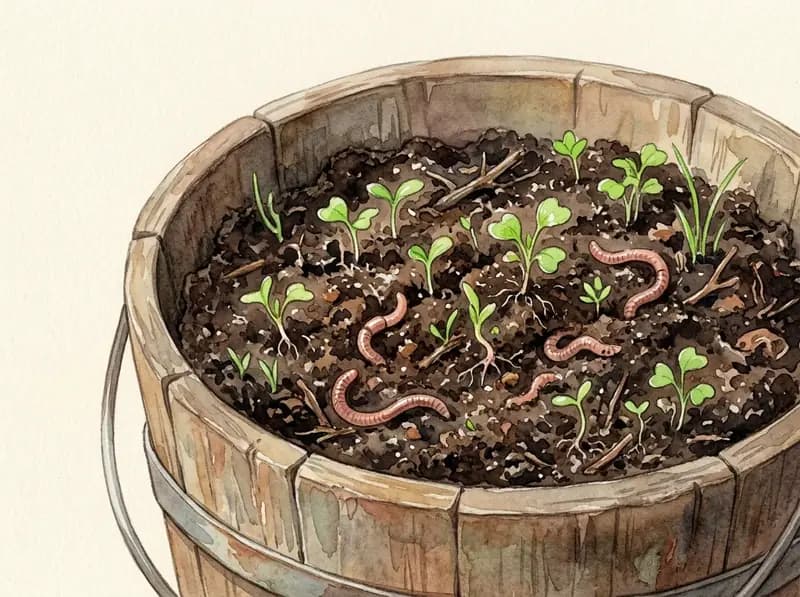
Compost / humus Solid Top dressing
Mature home-made compost
Also called: home-made compost, garden compost, homemade compost, organic fertiliser, organic fertilizer, compost heap compost
A fertiliser made from kitchen and garden waste. It improves the soil and releases nutrients gradually; when well matured, there is hardly any risk of burning the plants.
N
1-2 %
Nitrogen
P
0.3-0.7 %
Phosphorus
K
0.5-1.5 %
Potassium
Good-fertiliser rule of thumb. Put organic matter first and use half the dose printed on the label. A garden is spoiled faster by over-feeding than by under-feeding.
What it provides
- Stable organic matter (humus)
- Beneficial microorganisms
- Micronutrients (Ca, Mg, Fe…)
- Water-holding capacity
When to use it
- Autumn: spread it over the bed and let the rain and earthworms work it in, or mix it into the top few centimetres only.
- Late winter or spring: 2-3 weeks before planting hungry crops.
- As a top dressing during the growing season: a handful around each plant every 4-6 weeks.
How to make or apply it
- In the composting guide on this site you will find the proportions, layers and timings for the size of your compost bin.
- It takes between two and four months if composted hot and turned, and six months to a year if left to its own devices. It is ready when it smells like woodland soil, is dark and crumbles between your fingers.
Dose
- Mixed into the soil: 3-5 L/m² (about 2-3 kg, 4.4–6.6 lb) once a year. In poor soil you can increase it a little in the first year.
- Top dressing: 1 handful (about 0.5 L, about 0.5 quart) per plant every 4-6 weeks.
- Mixed into transplanting or potting soil: up to 30 % of the total volume.
Good for…
Practically any crop.Hungry crops: tomato, courgette (zucchini), pumpkin, broccoli, cabbage.
Precautions
- If you can still make out undecomposed material, it is not mature: wait another one or two months.
- Do not bury it deeply, because there is little air down there and soil life works less well. Mix it into the top 5-10 cm (2–3.9 in) only.
Sustainability: It is the most sustainable option: it closes the loop with the waste from your own home.
Make your own compost
The best organic fertiliser is made at home from what you would otherwise throw away. Learn to make good compost step by step.