
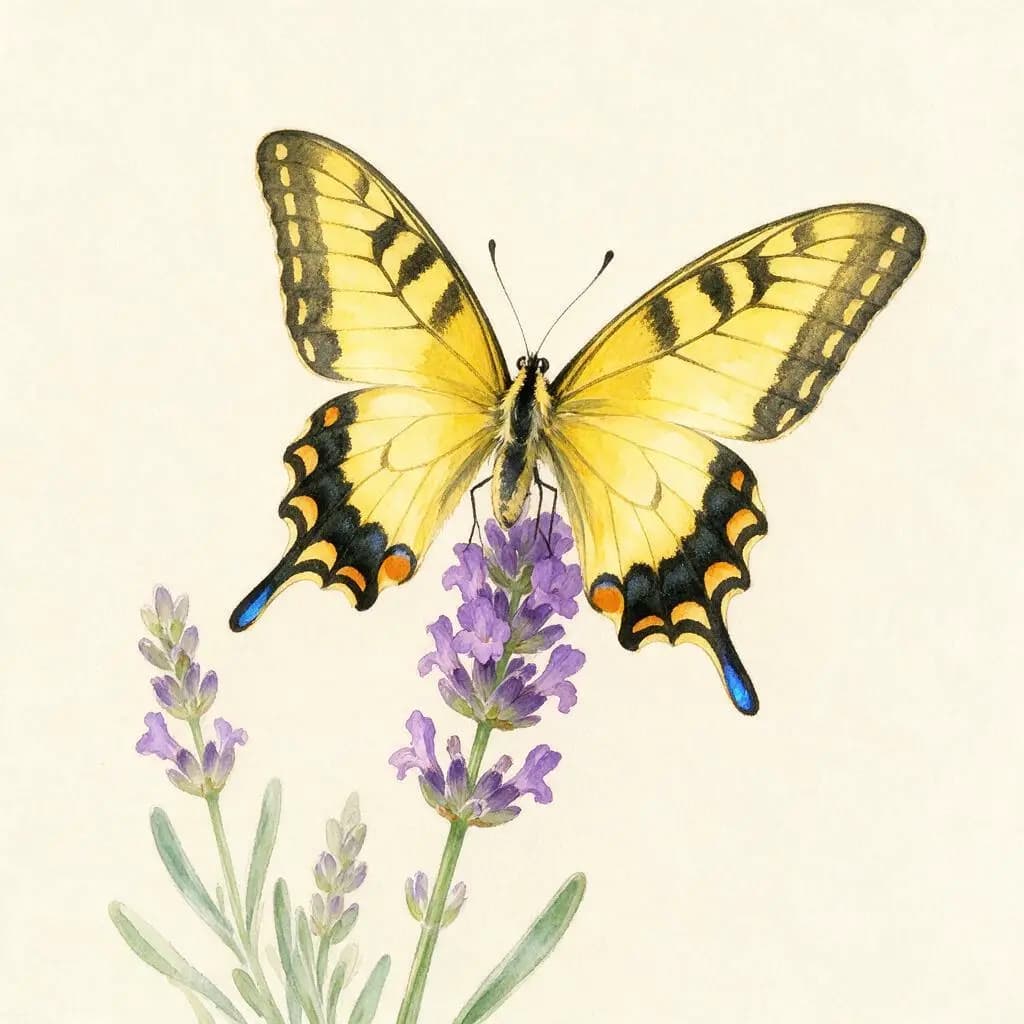
Pollinating butterflies and moths
Lepidoptera (adults)
Also called: butterfly, day-flying butterfly, hawk-moth, hummingbird hawk-moth, moth
Butterflies and some night-flying moths pollinate flowers that bees cannot reach: tubular ones (sage, flowering tobacco), spurred ones (columbine) and those that open at night (four o'clock flower, jasmine).

How to recognise it at every stage
PollinatorPollinator: butterflies and moths visit flowers by day and by night.
Life cycle: Complete metamorphosis: egg, caterpillar (which grows by moulting several times), chrysalis or cocoon, and adult. Depending on the species, one to four generations a year; some overwinter as an egg, others as a caterpillar, chrysalis or adult.
Tap a stage to see it full size. The photos are AI reference images checked against real photographs; stages without a reliable photo are shown as text only.
Life-stage calendar
| Jan | Feb | Mar | Apr | May | Jun | Jul | Aug | Sep | Oct | Nov | Dec | |
|---|---|---|---|---|---|---|---|---|---|---|---|---|
| Eggs | ||||||||||||
| Caterpillar | ||||||||||||
| Chrysalis | ||||||||||||
| Butterfly |
Approximate months for mainland Spain; in cold areas they start later and in warm areas they last longer. Garden creatures this month
- 1Protect it
Eggs
· 0.5-1.5 mmSmall, round or bottle-shaped, often with raised patterns; single or in groups.
- Where to find it
- On the caterpillar's host plant (fennel, nettle, thistle, brassicas, legumes).
- When: Mar–Sep
- What to do
- Leave nettles, thistles or fennel in a corner: they are butterfly nurseries.
- 2Protect it
Caterpillar
· 1-8 cmVery varied: smooth, hairy, spiny or in warning colours. The swallowtail's is green with black bands and orange dots.
- Where to find it
- Eating its host plant.
- When: Apr–Oct
- What to do
- If it is eating a wild plant or an aromatic you can spare (fennel, rue), leave it: not every caterpillar competes with the garden.
- Often confused with
- Swallowtail caterpillar on fennel or carrot. Green with black bands and orange dots; if you touch it, it puts out two orange "horns". It eats very little: it is a beautiful butterfly, protect it.
- Cabbage white caterpillar. Yellowish green with black dots and fine hairs, in groups, only on cabbages. See profile
- 3Protect it
Chrysalis
· 1-4 cmMotionless, often angular, green or brown, hanging or held by a silk thread.
- Where to find it
- On stems, walls, fences or under leaves.
- When: May–Mar
- What to do
- When pruning or tidying in autumn, leave the dry stems with chrysalises in a corner until spring.
- 4Protect it
Butterfly
Wings covered in coloured scales; day-flying butterflies close them upwards and moths usually fold them like a little roof.
- Where to find it
- On flowers with nectar: lavender, buddleia, thyme, thistles, valerian.
- When: Feb–Nov
- What to do
- Sow flowers in succession and leave a shallow mud puddle: they drink salts from the mud.
Often confused with
- Swallowtail caterpillar on fennel or carrot. Green with black bands and orange dots; if you touch it, it puts out two orange "horns". It eats very little: it is a beautiful butterfly, protect it.
- Cabbage white caterpillar. Yellowish green with black dots and fine hairs, in groups, only on cabbages. See profile
What it eats
- Flower nectar (adults)
- The caterpillars of most species feed on wild plants; a few, such as those of the cabbage white, do eat crops
How to attract this ally to your garden
- Flat, clustered flowers: lavender, scabious, Verbena bonariensis, buddleia, oregano in flower.
- Leave a corner with wild plants, such as nettles or mustards, which feed the caterpillars of several butterflies.
- Do not cut off faded flowers until the seeds have formed.
Plants in the catalogue that attract it
 English lavenderA Mediterranean aromatic shrub with blue-violet spikes much loved by bees, indispensable in dry gardens and…
 Small scabious (pincushion flower)A perennial with pincushion-like flowers on long, slender stems, a magnet for butterflies.
 Butterfly bush (Buddleja)A vigorous shrub with highly fragrant flower spikes that attract butterflies and bees all summer long.
 Oregano (wild marjoram)A perennial Mediterranean oregano, very aromatic, especially when dried.
 Japanese red mustardJapanese red mustard, a hot salad leaf that grows quickly in cool weather.
What to avoid so you do not harm it by accident
- Bacillus thuringiensis sprayed carelessly: it also kills the caterpillars of the butterflies you want to keep.
- Treating every caterpillar as a pest: many will become butterflies that pollinate. Identify them before acting.
How to recognise it
Day-flying: colourful wings, antennae ending in a club. Hawk-moths (hummingbird hawk-moth): they fly by day with a characteristic hum and feed hovering, like hummingbirds.
Risk to people: None for adult butterflies. Be careful with hairy caterpillars, such as the pine processionary, whose stinging hairs irritate the skin and eyes: do not touch them.
Many allies are protected by Spanish law: do not capture or keep in captivity toads, hedgehogs, bats or native reptiles. Attract them, watch them and thank them from a distance. Rules in other countries differ: check your local regulations.

Allies do better if the garden is varied. Learn to identify each visitor and to prevent problems with good habits.