

Marigolds (Tagetes) to hold back soil nematodes
Planting dense marigolds for a whole cycle and digging them in reduces root-knot nematodes in infested soils.
Well established. Certain Tagetes (especially French marigold) suppress root-knot and lesion nematodes, but only with continuous planting for a whole season; in intercropping the control is usually poor, and the nematodes build up again as soon as a susceptible crop is planted.
Before you start, read the precautions
You will need
- marigold seeds (Tagetes patula)
- hoe
- watering can
When to use it
In spring, after the frosts, on plots where you saw roots with galls (tomato, cucumber, lettuce) the previous season.
Step by step
1Sow in a seed tray at the end of winter and transplant after the last frosts, 15–20 cm (5.9–7.9 in) apart.

2Cover the whole bed (not just one edge) with continuous planting and keep the plants for a full season, watering them as needed.

3Cut the plants before the flowers open, so that they do not self-seed, and use them as mulch or work them into the surface before planting the vegetable.

Dose
Continuous planting across the whole bed for a full season; spacing of 15–20 cm (5.9–7.9 in) between plants (indicative; there is no standard distance).
Which plants
Tomato, pepper, aubergine, cucumber, courgette and lettuce on plots with root-knot nematodes.
Plants mentioned in this remedy
 Tomato 'Marmande'Marmande tomato, flattened and ribbed, a good size for salads.
 Sweet pepper 'California Wonder'California Wonder pepper, a blocky bell type with thick flesh, for stuffing or eating fresh.
 Long black aubergineAn aubergine with glossy black fruit, for warm climates.
 Cucumber 'Marketmore'The 'Marketmore' cucumber is a classic salad cucumber resistant to several diseases.
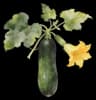 Courgette 'Nero di Milano'A cylindrical, very dark green courgette, productive and early, the classic bush type for continuous picking.
 Cos lettuce (romaine)Cos lettuce, with a long, crisp heart.
Precautions
- French marigold (Tagetes patula) stands out, with varieties such as Nemagold or Petite Blanc; Tagetes tenuifolia (“signet”) are a poor choice: nematodes can feed and multiply on them. Not all marigolds will do.
- It does not eliminate the problem: numbers go down. Combine it with rotation and solarisation.
- It is no use against other soil problems such as fungi or deficiencies.
- Do not stop watering: dry marigolds lose their effect.
Why it works
Compounds in the roots of Tagetes (such as alpha-terthienyl) are credited with a toxic effect on nematodes; in the right varieties, the juveniles do not develop and the population falls.
Sources
- University of California Integrated Pest Management: nematodes (technical note); French marigold, continuous planting for a season, cut before flowering, of little effect in intercropping