
Credits and licences
- #1 — vueltaalhuerto illustration
- #2 — vueltaalhuerto illustration
- #3 — vueltaalhuerto illustration
- #4 — vueltaalhuerto illustration
- #5 — vueltaalhuerto illustration
- #6 — vueltaalhuerto illustration
- #7 — vueltaalhuerto illustration
- #8 — vueltaalhuerto illustration
Whale fin snake plant (Sansevieria masoniana)
and 3 more names
Sansevieria masoniana, Dracaena masoniana, snake plantWhale fin snake plant (Sansevieria masoniana) is planted from April to June. Grow it in sun or partial shade, 30 cm apart, with little watering. Dates are for a mild temperate climate in the northern hemisphere; the calendar below adjusts them to your zone.
A very tough houseplant with a sculptural look, producing a single huge, broad, flat leaf shaped like a paddle or a whale's fin, 50 to 100 cm tall and up to 30 cm wide, greyish green mottled with darker bands and with a fine reddish edge. Each rhizome usually produces a single leaf, and over time offsets appear beside it, until a group of two or three leaves forms. It grows slowly, copes with dry air, low light and weeks without watering, and rarely flowers indoors; when it does, it produces a tall spike of greenish-white tubular flowers that are very fragrant at night. Its accepted botanical name is now Dracaena masoniana, but in shops it is still sold as Sansevieria masoniana, just like the classic mother-in-law's tongue, which is another species. Like other sansevierias, it is toxic to dogs and cats if they chew it. It is not among the regulated invasive alien species. It is an ornamental plant: it is not eaten.
Family and origin: Asparagus family (Asparagaceae) · native to Central Africa (Congo basin and neighbouring regions); dry scrub and open woodland · More plants from Africa
01In your area
How will it do in your home?
Year calendar
| Task | J | F | M | A | M | J | J | A | S | O | N | D |
|---|---|---|---|---|---|---|---|---|---|---|---|---|
| Plant / transplantApr–Jun | no | no | no | yes | yes | yes | no | no | no | no | no | no |
| CuttingsMay–Aug | no | no | no | no | yes | yes | yes | yes | no | no | no | no |
| Divide the clumpApr–Jun | no | no | no | yes | yes | yes | no | no | no | no | no | no |
Its life cycle at a glance
Swipe and tap a stage to see its details.
02Planting
Planting and transplanting
- TipWhen the rhizome fills the pot, repot it in spring.
- TipDates, spacing and minimum temperature are approximate.
03Care
Care through the year
Sun and aspectSun and shade · 5 h of sun · shade in summer
- Too little sun
- Ideal range
- Plenty of sun
East, or south with light shade in the middle of the day
Moderate sun: Copes with full sun, but give it some shade during heatwaves.
Bright light, with some gentle direct sun, or partial shade; it copes with dim corners but grows more slowly and its bands lose contrast. Strong midday sun through glass can leave marks on the broad leaf.
- TipTurn the pot every week so it grows evenly towards the light.
WateringLet it dry out between waterings · summer: every 5-7 days
- Summerevery 5-7 days0.3 L per plant/week
- Spring / Autumnevery 10-14 days0.1 L per plant/week
- Winteronly in extreme drought (once a month)0 L per plant/week
Let it dry out between waterings: A Mediterranean favourite: better thirsty than overwatered.
Water only when the potting mix is completely dry, every two or three weeks in summer and every month or longer in winter, and empty the saucer. Too much water rots the rhizome and is almost the only reason it dies. Use a sandy, free-draining cactus or succulent mix.
When to water? Push your finger 5 cm into the soil next to the base of the plant:
- Damp: soil sticks to your finger. Do not water yet. It has more than enough; wait for it to dry out more.
- Cool but clean, no mud. Wait another 1-2 days before watering.
- Dry and dusty. Water now, but moderately. Do not overdo it: it prefers thirst to excess.
- TipDo not mist it or leave water at the base of the leaf.
- TipAdjust watering to the light and the season: in winter almost all of them need much less water.
- Common mistakeOverwatering is the number one killer: let it dry out as the species requires.
Potting mix and feedingpH 6–7.5 · Multi-purpose compost lightened with perlite
Multi-purpose compost lightened with perlite.
70 % multi-purpose compost · 20 % perlite · 10 % coir.
High: always a pot with a drainage hole and a shallow saucer.
This plant prefers a pH between 6.0 and 7.5 (slightly acidic to slightly alkaline).
- Repot every 2-3 years into a pot a finger's width wider, not much more.
- A handful of worm castings a year keeps the potting mix alive.
- Reusing old potting mix without refreshing it compacts and rots the roots.
- No drainage in the pot = waterlogged roots = dead plant.
- TipGrow it in a heavy pot, not much bigger than the root ball, so that it does not topple over with its broad leaf, and with a very free-draining mix.
- TipFeed with a diluted cactus fertiliser once or twice between May and September.
- Common mistakePots without drainage waterlog the roots and rot the plant.
Common mistakes and tips
- TipKeep it at 15-30 °C and do not let it drop below about 10 °C in winter.
- TipWipe the leaf with a damp cloth to remove dust, without leaf shine products.
04Propagation
Make new plants
The safest method is to divide the clump in spring: take it out of the pot, separate the offsets with their own roots using a clean knife and plant them in small pots. It can also be propagated by leaf cuttings, cutting the leaf into sections of about 5 to 8 cm, letting them dry for two or three days and planting them base downwards in moist sand, but this is slow and the new leaves take a long time to appear. As it produces only one leaf per rhizome, it is better to divide it than to cut the only leaf of a small plant.
05Uses and health
What it is used for, and with what care
WARNING FOR PETS: like other sansevierias and dracaenas, it contains saponins. If a dog or cat chews or swallows the leaves it may drool, vomit, have diarrhoea and become lethargic. Keep it out of their reach and, if you suspect ingestion, call the vet. For people its toxicity is mild: eating it can cause nausea and digestive upset, and the sap can irritate the skin of sensitive people. Keep an eye on young children.
- Properties
- It is a very tough decorative houseplant that copes with dry air and lack of watering. There is no evidence that it purifies the air in a home to any noticeable degree.
- Uses
- It is not edible.
For guidance only; this is not medical treatment and does not replace advice from a doctor or vet.
06Companions and related plants
What to plant it with
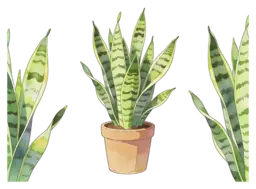
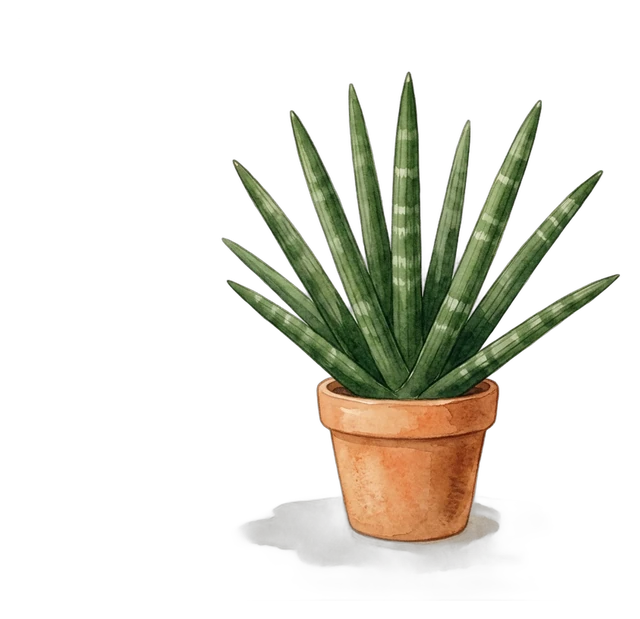
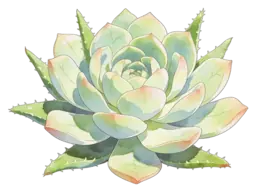
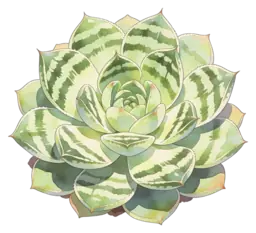
Compare with similar varieties
| Variety | Sowing | Harvest | Days | Spacing | Difficulty |
|---|---|---|---|---|---|
| Snake plant (mother-in-law's tongue) | — | — | — | 30 cm | Easy |
| Cylindrical snake plant | Apr–Jun | — | — | 25 cm | Easy |
| Sword sansevieria (Sansevieria ehrenbergii) | Apr–Jun | — | — | 30 cm | Easy |
| Sansevieria francisii | Apr–Jun | — | — | 20 cm | Easy |
| Whale fin snake plant (Sansevieria masoniana) | Apr–Jun | — | — | 30 cm | Easy |