
Credits and licences
- #1 — vueltaalhuerto illustration
- #2 — vueltaalhuerto illustration
- #3 — vueltaalhuerto illustration
- #4 — vueltaalhuerto illustration
- #5 — vueltaalhuerto illustration
- #6 — vueltaalhuerto illustration
- #7 — vueltaalhuerto illustration
- #8 — vueltaalhuerto illustration
- #9 — vueltaalhuerto illustration
- #10 — vueltaalhuerto illustration
Senecio cephalophorus (Kleinia cephalophora, cultivar 'Mountain Fire')
and 3 more names
blazing glory, cliff kleinia, orange-flowered senecioSenecio cephalophorus (Kleinia cephalophora, cultivar 'Mountain Fire') is sown in seed trays from March to April and in September, and planted out from April to June. Grow it in full sun, 25 cm apart, with little watering. Dates are for a mild temperate climate in the northern hemisphere; the calendar below adjusts them to your zone.
A low, clump-forming succulent up to about 40 cm tall, made up of fleshy stems and thin, cylindrical, blue-grey leaves covered in whitish wax, like little pencils. In winter, on slender stems, it produces solitary pompom-shaped flower heads in an intense orange-yellow, without strap-shaped petals, which give the cultivar ‘Mountain Fire’ its name. Afterwards it forms seed heads with white pappus, like small dandelions. The name you will see in the shop is Senecio cephalophorus, but Kleinia cephalophora is now accepted (according to EPPO and World Flora Online), so you will find it under both. It is a plant of dry areas and mild climates, easy to grow if the potting mix drains well. It is not edible and is best treated with caution, like other Senecio and Kleinia. LEGAL AND SAFETY NOTICE: there are no toxicity data for this particular species, but pyrrolizidine alkaloids, substances that can damage the liver if swallowed, have been described in the genus Senecio and in closely related plants. For this reason you should not eat any part of the plant, or make infusions or any home use of it, and you should keep it out of reach of children, dogs and cats. There are no known legal restrictions on growing it in Spain: as far as we know, it is not listed under the CITES convention and is not regulated as an invasive species in Spain or the EU.
Family and origin: Daisy family (Asteraceae) · native to Southern Namibia and the Northern Cape of South Africa, on dry, rocky ground · More plants from Africa
01In your area
How will it do in your home?
Year calendar
| Task | J | F | M | A | M | J | J | A | S | O | N | D |
|---|---|---|---|---|---|---|---|---|---|---|---|---|
| Seed trayMar–Apr, Sep | no | no | yes | yes | no | no | no | no | yes | no | no | no |
| Plant / transplantApr–Jun | no | no | no | yes | yes | yes | no | no | no | no | no | no |
| CuttingsMar–May, Sep–Oct | no | no | yes | yes | yes | no | no | no | yes | yes | no | no |
Its life cycle at a glance
Swipe and tap a stage to see its details.
02Care
Care through the year
Sun and aspectFull sun · 6 h of sun · shade in summer
- Too little sun
- Ideal range
- Plenty of sun
South or south-west, with nothing casting shade at midday
Strong sun: Loves full midday sun and high temperatures.
Plenty of light and direct sun for most of the day; in poor light it stretches and loses its bluish tone. On the hottest summer days, protect it from strong sun in the middle of the day. Sources describe it as hardy to very light frosts, of about -1 °C: protect it below 3 to 5 °C and from cold damp.
- Common mistakeLack of light makes them stretch and go soft (etiolation).
WateringLet it dry out between waterings · summer: every 2 to 3 weeks, only if the potting mix is completely dry
- Summerevery 2 to 3 weeks, only if the potting mix is completely dry0.2 L per plant/week
- Spring / Autumnevery 10-14 days0.1 L per plant/week
- Winterevery 2 to 3 weeks, with little water, if the winter is mild0 L per plant/week
Let it dry out between waterings: A Mediterranean favourite: better thirsty than overwatered.
Water thoroughly and let the potting mix dry out completely between waterings. Its growth cycle may well be in winter, since it flowers in that season, so keep up some watering in autumn and spring and cut back almost completely in the full heat of summer; this is approximate. Avoid wetting the leaves, which are waxy, and empty the saucer.
When to water? Push your finger 5 cm into the soil next to the base of the plant:
- Damp: soil sticks to your finger. Do not water yet. It has more than enough; wait for it to dry out more.
- Cool but clean, no mud. Wait another 1-2 days before watering.
- Dry and dusty. Water now, but moderately. Do not overdo it: it prefers thirst to excess.
- TipWatering, temperatures and timings are approximate.
- TipWater thoroughly and leave long gaps: better thirsty than overwatered.
- Common mistakeWatering often rots the crown and the roots.
Potting mix and feedingpH 6–7.5 · Very gritty, free-draining mix
Very gritty, free-draining mix.
30 % multi-purpose compost · 40 % coarse sand · 30 % perlite or pumice.
Very high: standing moisture rots them.
This plant prefers a pH between 6.0 and 7.5 (slightly acidic to slightly alkaline).
- Multi-purpose compost on its own with no drainage: rot sets in quickly.
- Watering the rosette or the leaves marks them and causes rot.
- TipPlant it in a terracotta pot with drainage holes and a very free-draining mix (half cactus compost and half coarse sand or perlite).
- TipFeed it very little, with a cactus fertiliser at half strength, once or twice during the growing season.
- TipVery free-draining mix (with sand/perlite) and pots with a drainage hole.
Pruning
- TipPrune it lightly after flowering to keep it compact.
Common mistakes and tips
- TipHandle it with gloves if you have sensitive skin, and wash your hands afterwards.
03Propagation
Make new plants
It is propagated from stem cuttings and from seed. Cuttings are taken in spring or autumn, left to dry for a few days and planted in a mineral mix. The seeds, thin dark achenes with a tuft of white hairs, are sown on the surface at 19 to 24 °C with plenty of light. The propagation data for this species are approximate and based on related species.
Seeds: how to germinate them~14 days
04Uses and health
What it is used for, and with what care
SAFETY WARNING: there are no toxicity data for this species, but pyrrolizidine alkaloids, which can damage the liver if swallowed, have been described in the genus Senecio and in related plants. Do not eat it, do not make infusions or any home use of it, and keep it out of reach of children, dogs and cats. If a child or an animal has bitten it, consult a doctor or the vet. It is not regulated as an invasive species in Spain or the EU.
- Properties
- An ornamental winter-flowering succulent. It has no home medicinal uses.
- Uses
- It is not edible. It has no culinary uses and is not used in infusions.
For guidance only; this is not medical treatment and does not replace advice from a doctor or vet.
05Companions and related plants
What to plant it with
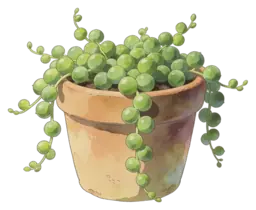
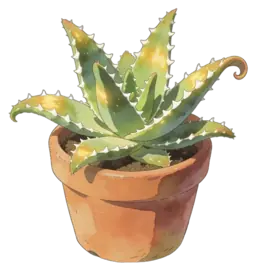
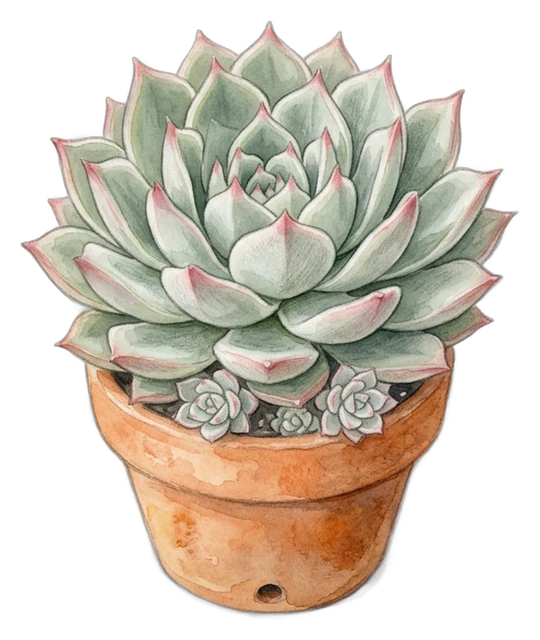
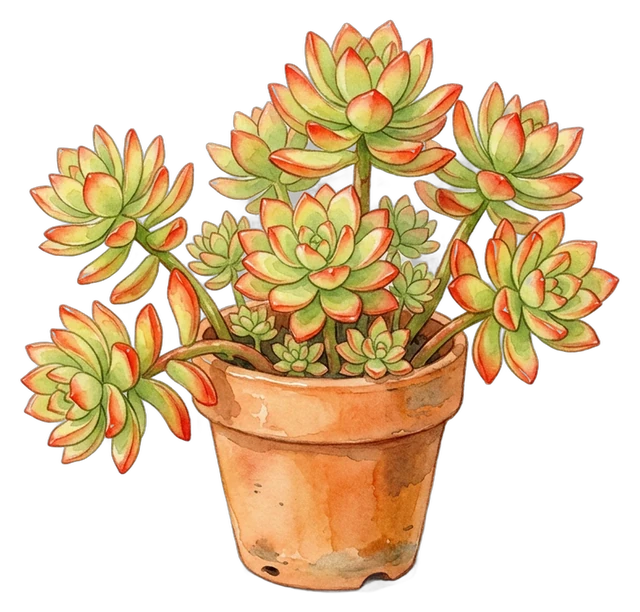
Compare with similar varieties
| Variety | Sowing | Harvest | Days | Spacing | Difficulty |
|---|---|---|---|---|---|
| Variegated string of hearts | — | — | — | 20 cm | Easy |
| String of pearls | — | — | — | 25 cm | Moderate |
| Senecio cephalophorus (Kleinia cephalophora, cultivar 'Mountain Fire') | Mar–Apr, Sep | — | ~730 | 25 cm | Easy |