Credits and licences
- #1 — vueltaalhuerto illustration
- #2 — vueltaalhuerto illustration
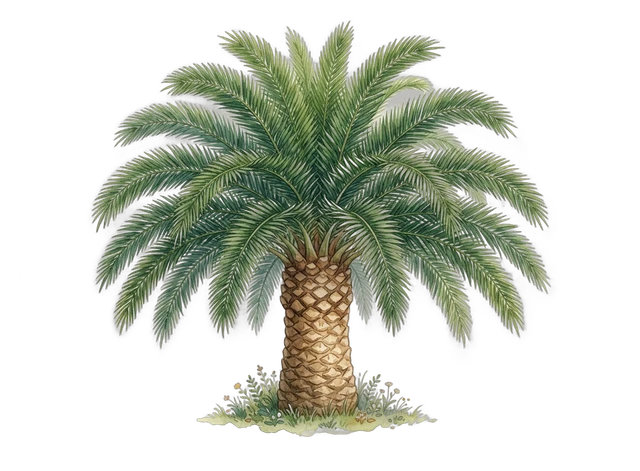
- #3 — vueltaalhuerto illustration
- #4 — vueltaalhuerto illustration
- #5 — vueltaalhuerto illustration
- #6 — vueltaalhuerto illustration
- #7 — vueltaalhuerto illustration
- #8 — vueltaalhuerto illustration
- #9 — vueltaalhuerto illustration
- #10 — vueltaalhuerto illustration
Royal poinciana (Delonix regia)
and 4 more names
flame of the forest, Delonix regia, poinciana, peacock flowerRoyal poinciana (Delonix regia) is sown in seed trays from March to April or directly outdoors from April to May, and planted out from May to June. It flowers from June to August. Grow it in full sun, 800 cm apart, with moderate watering. Dates are for a mild temperate climate in the northern hemisphere; the calendar below adjusts them to your zone.
What else to sow in March, April and May
A tree with a broad, flattened, umbrella-shaped crown, 8 to 12 m tall and as wide in warm areas, with twice-divided, fern-like, light green leaves that drop in the cold or dry season. In early summer it is covered in clusters of very large flowers, 8 to 10 cm across, orange-red, with one petal speckled white and yellow, followed by flat, woody, dark brown pods 30 to 60 cm long containing many hard seeds. It is one of the most spectacular tropical trees, but very sensitive to cold: in Spain it is only viable in the Canary Islands and in the warmest, most sheltered spots on the Mediterranean coast, and elsewhere it is grown in a pot or greenhouse, where it rarely flowers. It has shallow, extensive, strong roots and brittle branches. It is an ornamental species: it is not grown for eating. Do not confuse it with wattles (Acacia) or other trees called flame tree.
Family and origin: Pea family (Fabaceae) · native to Madagascar (very scarce in the wild); planted throughout the tropical and subtropical regions of the world, including the Canary Islands and the warmest coasts of mainland Spain · More plants from Africa
01In your area
How will it do in your garden?
Year calendar
| Task | J | F | M | A | M | J | J | A | S | O | N | D |
|---|---|---|---|---|---|---|---|---|---|---|---|---|
| Seed trayMar–Apr | no | no | yes | yes | no | no | no | no | no | no | no | no |
| Direct sowingApr–May | no | no | no | yes | yes | no | no | no | no | no | no | no |
| Plant / transplantMay–Jun | no | no | no | no | yes | yes | no | no | no | no | no | no |
| HarvestJun–Aug | no | no | no | no | no | yes | yes | yes | no | no | no | no |
| FloweringJun–Aug | no | no | no | no | no | yes | yes | yes | no | no | no | no |
| PruningJul–Sep | no | no | no | no | no | no | yes | yes | yes | no | no | no |
Its life cycle at a glance
Swipe and tap a stage to see its details.
02Planting
Where and how to plant it
Sow the seed 1.5 cm deep; leave 8 m between plants and 8 m between rows.
8 m between plants · 8 m between rows
Seed at a depth of 1.5 cm; seedlings go in with the root ball level with the soil.
- Transplanting
- May–Jun
- Seed tray
- Mar–Apr
- Direct sowing
- Apr–May
- Germination
- ~20 days
- TipIn areas with frost, grow it in a large pot and shelter it in winter, although in a pot it hardly ever flowers.
- Common mistakePlanting too deep smothers the crown of the plant.
03Care
Care through the year
Sun and aspectFull sun · 10 h of sun · South or south-west, with nothing casting shade at midday
- Too little sun
- Ideal range
- Plenty of sun
South or south-west, with nothing casting shade at midday
Strong sun: Loves full midday sun and high temperatures.
Full sun and warmth all year round: it is a tropical tree. Young plants suffer at temperatures of about 5 °C or below, and a mature tree only withstands very brief, mild frosts of about -2 °C, with damage; with minimum temperatures below 5 to 10 °C it loses some or all of its leaves.
WateringMoist but never waterlogged · summer: every 2-3 days
- Summerevery 2-3 days6 L per plant/week
- Spring / Autumnevery 4-5 days3 L per plant/week
- Winterevery 2-3 weeks0.9 L per plant/week
Moist but never waterlogged: Water before the surface is completely dry. Never puddles. Mulch: straw or dry plant material cuts watering by 30-50 %.
Water regularly during the first few years and in summer, with a deep watering every week, and cut back on watering in winter. Once established it tolerates moderate drought, but it flowers and grows better with water. It does not tolerate waterlogged soil.
When to water? Push your finger 5 cm into the soil next to the base of the plant:
- Damp: soil sticks to your finger. Do not water today. The moisture is fine.
- Cool but clean, no mud. Water early tomorrow if it stays like this, or this evening.
- Dry and dusty. Water now, and deeply. This is not where it likes to be.
- TipWater generously in the first year until it is established; after that it looks after itself.
Soil and feedingpH 5.5–8 · Deep soil with good drainage
Deep soil with good drainage.
Medium/high.
This plant prefers a pH between 5.5 and 8.0 (slightly acidic to alkaline).
- Water generously in the first year until it is established.
- A thick mulch all year round, not touching the trunk.
- TipPlant it in spring or early summer, when the soil is warm, in a very sunny spot sheltered from wind and away from buildings, pipes, walls and paving, about 8 to 10 m away, because the roots are shallow and powerful and the branches break in the wind.
- TipFeed with compost in spring.
PruningWhen: Jul–Sep
Pruning time for this plant: Jul–Sep.
- TipAvoid hard pruning: just remove dead or crossing branches, at the end of flowering and in warm weather, never in the cold.
- TipFormative pruning after flowering keeps the shape compact.
- Common mistakePruning at the wrong time removes the year's flower buds.
Common mistakes and tips
- TipHeights, temperatures and timings are a rough guide.
04Harvest
Harvesting and storing
Harvest in Jun–Aug.
- TipIn some tropical regions it naturalises: do not throw seeds or pods out in the countryside.
05Propagation
Make new plants
It is propagated from seed, which is the usual method. The pods ripen in winter; collect them dry and take out the seeds, which have a very hard, waterproof coat. To make them germinate you have to scarify them, for example by soaking them in very hot water, at about 80 to 90 °C, and leaving it to cool for 24 hours, or by rubbing them with sandpaper. Sow them shallowly, at about 24 to 30 °C, in a loose, moist mix; they germinate in two to four weeks. The seedlings grow fast and are moved on into deep pots. A seed-raised tree takes five to ten years to flower. It can also be grafted or grown from cuttings, but this is less common.
Seeds: how to germinate them~20 days
06Uses and health
What it is used for, and with what care
WARNING: there are no reliable data on the toxicity of this species in people, dogs and cats, so to be on the safe side do not eat the seeds, pods, leaves or flowers, and stop children and pets from chewing them. The hard, woody pods, up to 60 cm long, fall in the wind, and the branches break easily: do not plant it over walkways, car parks or play areas. Its shallow roots can lift floors, walls and pipes. In some tropical regions it naturalises: do not throw seeds or pods out in the countryside.
- Properties
- It gives a wide canopy of shade and a spectacular, long-lasting display of flowers in summer, which feeds bees, bumblebees and nectar-feeding birds, with little maintenance in warm climates.
- Uses
- It is not grown for eating and is not used in cooking or home remedies. The seeds and pods are not edible, and the flowers are not taken in infusions.
For guidance only; this is not medical treatment and does not replace advice from a doctor or vet.
07Companions and related plants