
Credits and licences
- #1 — vueltaalhuerto illustration
- #2 — vueltaalhuerto illustration
Showy stonecrop (hierba callera)
and 2 more names
Sedum spectabile, hierba calleraIt flowers from August to October. Grow it in full sun, 40 cm apart, with little watering. Dates are for a mild temperate climate in the northern hemisphere; the calendar below adjusts them to your zone.
An upright succulent clump with fleshy grey-green leaves and large heads of pink star-shaped flowers that open in late summer and autumn. It is one of the best late-nectar plants for butterflies such as the peacock, the red admiral and the painted lady, and also for bees and bumblebees, just when flowers are scarce. Very tough: it withstands drought and hard frost, and its dry stems shelter insects in winter. It is the tall sedum known in gardening as hierba callera; it is not the carpeting sedum (Sedum acre).
Family and origin: Stonecrop family (Crassulaceae) · native to China and Korea · More plants from Far East
01In your area
How will it do in your garden?
Year calendar
| Task | J | F | M | A | M | J | J | A | S | O | N | D |
|---|---|---|---|---|---|---|---|---|---|---|---|---|
| FloweringAug–Oct | no | no | no | no | no | no | no | yes | yes | yes | no | no |
| PruningFeb–Mar | no | yes | yes | no | no | no | no | no | no | no | no | no |
| Divide the clumpMar–Apr | no | no | yes | yes | no | no | no | no | no | no | no | no |
Its life cycle at a glance
Swipe and tap a stage to see its details.
02Care
Care through the year
Sun and aspectFull sun · 7 h of sun · South or south-west, in full sun
- Too little sun
- Ideal range
- Plenty of sun
South or south-west, in full sun
Strong sun: Loves full midday sun and high temperatures.
Full sun. With little light the stems lengthen, flop, and it flowers less.
- Common mistakeLack of light makes them stretch and go soft (etiolation).
WateringLet it dry out between waterings · summer: every 10-14 days in the first year; almost none afterwards
- Summerevery 10-14 days in the first year; almost none afterwards0.2 L per plant/week
- Spring / Autumnrain is usually enough0.1 L per plant/week
- Winternone0 L per plant/week
Let it dry out between waterings: A Mediterranean favourite: better thirsty than overwatered.
Water little and let the soil dry out between waterings. What it tolerates worst is waterlogging, which rots the root. In pots, use a very free-draining mix.
When to water? Push your finger 5 cm into the soil next to the base of the plant:
- Damp: soil sticks to your finger. Do not water yet. It has more than enough; wait for it to dry out more.
- Cool but clean, no mud. Wait another 1-2 days before watering.
- Dry and dusty. Water now, but moderately. Do not overdo it: it prefers thirst to excess.
- TipWater thoroughly and leave long gaps: better thirsty than overwatered.
- Common mistakeWatering often rots the crown and the roots.
Soil and feedingpH 6–8 · Very gritty, free-draining mix
Very gritty, free-draining mix.
30 % multi-purpose compost · 40 % coarse sand · 30 % perlite or pumice.
Very high: standing moisture rots them.
This plant prefers a pH between 6.0 and 8.0 (slightly acidic to alkaline).
- Multi-purpose compost on its own with no drainage: rot sets in quickly.
- Watering the rosette or the leaves marks them and causes rot.
- TipIf it flops, it has too little sun or too much feed; do not fertilise it.
- TipVery free-draining mix (with sand/perlite) and pots with a drainage hole.
PruningWhen: Feb–Mar
Pruning time for this plant: Feb–Mar.
Common mistakes and tips
- TipLeave the dry stems over winter: insects use them as shelter and birds perch on them, and cut them to the ground at the end of winter, before they sprout.
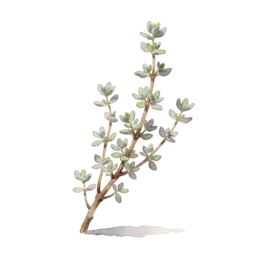
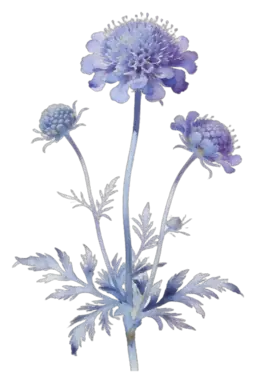
- TipTo have nectar from summer to autumn, combine it with lavender, scabious and thyme.
- TipTimings are approximate.
03Propagation
Make new plants
It is easily propagated by dividing the clump in spring every 3 or 4 years, or from stem cuttings with leaves in early summer, which root in two or three weeks. The seed is very small and is sown on the surface, with light and at about 15 to 20 °C, but it is slow and seed-grown plants are less uniform.
Seeds: how to germinate them~20 days
04Uses and health
What it is used for, and with what care
No significant toxicity is known, but swallowing it is not recommended either. It can cause mild digestive upset if a pet eats a lot. If a lot is eaten, consult a vet.
- Properties
- A late-nectar plant very valuable to butterflies, bees and bumblebees. No home uses are recommended.
- Uses
- Eating it is not recommended.
For guidance only; this is not medical treatment and does not replace advice from a doctor or vet.
05Companions and related plants
What to plant it with
Good companions

Compare with similar varieties
| Variety | Sowing | Harvest | Days | Spacing | Difficulty |
|---|---|---|---|---|---|
| Burro's tail (Sedum) | — | — | — | 30 cm | Easy |
| Showy stonecrop (hierba callera) | — | — | — | 40 cm | Easy |
| Golden sedum (Sedum adolphii 'Firestorm') | Mar–May | — | ~730 | 20 cm | Easy |
| Jelly bean plant (Sedum rubrotinctum) | — | — | — | 20 cm | Easy |
| Biting stonecrop (Sedum acre) | — | May–Jul | — | 20 cm | Easy |