Credits and licences
- #1 — vueltaalhuerto illustration
- #2 — vueltaalhuerto illustration
- #3 — vueltaalhuerto illustration
- #4 — vueltaalhuerto illustration
- #5 — vueltaalhuerto illustration
- #6 — vueltaalhuerto illustration
- #7 — vueltaalhuerto illustration
- #8 — vueltaalhuerto illustration
- #9 — vueltaalhuerto illustration
- #10 — vueltaalhuerto illustration
Globe candytuft
and 1 more names
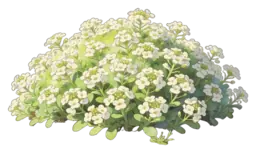
Iberis umbellataGlobe candytuft is sown in seed trays from February to March or directly outdoors from March to May and from September to October, and planted out from April to May. It flowers from April to July. Grow it in full sun, 20 cm apart, with moderate watering. Dates are for a mild temperate climate in the northern hemisphere; the calendar below adjusts them to your zone.
What else to sow in February, March, April, May, September and October
A compact annual about 25 to 30 cm tall, with narrow dark green leaves, forming a rounded clump that in spring and early summer is covered with flat clusters of small four-petalled flowers in white, pink, lilac or purple, with the two outer petals longer than the others. It is a hardy, undemanding plant that is very effective in borders, rock gardens, window boxes and low bedding. It attracts bees and butterflies and copes well with sun, but it flags in the strong heat of high summer. It is an ornamental flower, not an edible one, and belongs to the cabbage family, so it is best not to sow it where cabbages grew recently.
Family and origin: Cabbage family (Brassicaceae) · native to Southern Europe and the Mediterranean basin · More plants from Mediterranean basin
01In your area
How will it do in your garden?
Year calendar
| Task | J | F | M | A | M | J | J | A | S | O | N | D |
|---|---|---|---|---|---|---|---|---|---|---|---|---|
| Seed trayFeb–Mar | no | yes | yes | no | no | no | no | no | no | no | no | no |
| Direct sowingMar–May, Sep–Oct | no | no | yes | yes | yes | no | no | no | yes | yes | no | no |
| Plant / transplantApr–May | no | no | no | yes | yes | no | no | no | no | no | no | no |
| HarvestMay–Aug | no | no | no | no | yes | yes | yes | yes | no | no | no | no |
| FloweringApr–Jul | no | no | no | yes | yes | yes | yes | no | no | no | no | no |
Its life cycle at a glance
Swipe and tap a stage to see its details.
02Planting
Where and how to plant it
Sow the seed 2 mm deep; leave 20 cm between plants and 30 cm between rows.
20 cm between plants · 30 cm between rows
Seed at a depth of 2 mm; seedlings go in with the root ball level with the soil.
- Transplanting
- Apr–May
- Seed tray
- Feb–Mar
- Direct sowing
- Mar–May, Sep–Oct
- Germination
- ~14 days
- TipSow in batches every two or three weeks to extend flowering, and trim the plants after the first flush so they regrow with more flowers.
- TipThin the plants out to about 20 or 30 cm.
- TipDo not plant it where cabbages, radishes or other brassicas have grown in recent years, because it shares clubroot with them.
- Common mistakeSowing out of season: many need warmth or a cold spell beforehand to sprout.
03Care
Care through the year
Sun and aspectFull sun · 8 h of sun · South or south-west, with nothing casting shade at midday
- Too little sun
- Ideal range
- Plenty of sun
South or south-west, with nothing casting shade at midday
Strong sun: Loves full midday sun and high temperatures.
Full sun. In shade it becomes leggy and flowers less.
WateringMoist but never waterlogged · summer: every 2-3 days
- Summerevery 2-3 days1.2 L per plant/week
- Spring / Autumnevery 4-5 days0.6 L per plant/week
- Winterevery 2-3 weeks0.2 L per plant/week
Moist but never waterlogged: Water before the surface is completely dry. Never puddles. Mulch: straw or dry plant material cuts watering by 30-50 %.
Water regularly until the plants are established and then sparingly, when the soil is dry a few centimetres below the surface. It does not tolerate waterlogging or heavy, wet soils.
When to water? Push your finger 3 cm into the soil next to the base of the plant:
- Damp: soil sticks to your finger. Do not water today. The moisture is fine.
- Cool but clean, no mud. Water early tomorrow if it stays like this, or this evening.
- Dry and dusty. Water now, and deeply. This is not where it likes to be.
Soil and feedingpH 6.5–8 · Loose soil with organic matter and good drainage
Loose soil with organic matter and good drainage.
50 % topsoil · 30 % well-rotted compost · 20 % sand or perlite.
Medium/high.
This plant prefers a pH between 6.5 and 8.0 (neutral to alkaline).
- Overfeeding gives lots of leaf and few flowers.
- Compacted, poorly drained soil rots the roots in winter.
- TipIt tolerates poor and chalky soils.
- Common mistakeOverfeeding gives lush leaves but few flowers.
Pruning
- TipRemove faded flowers to prolong flowering.
Common mistakes and tips
- TipWatch out for slugs and snails on the seedlings.
04Harvest
Harvesting and storing
Harvest in May–Aug; the first, about 70 days after sowing.
05Propagation
Make new plants
It is propagated only from seed. The tiny seeds are scattered over the soil and covered with a thin layer, a couple of millimetres deep. Sow them where they are to flower from March, once hard frosts are over, until May, or in September and October in areas with mild winters. They can also be sown in a seed tray in February or March, preferably in individual small pots, because the main root does not cope well with transplanting. To save seed, let some clusters dry until the little pods turn straw-coloured and collect them in dry weather.
Seeds: how to germinate them~14 days
06Uses and health
What it is used for, and with what care
There are no reliable data on toxicity to people or to dogs and cats. Some plants in the cabbage family (brassicas) contain compounds that can irritate the digestive system if eaten in quantity, so do not eat it and stop animals from chewing the plant or the pods. The seeds are very small: store them out of reach of children and pets. Do not confuse it with perennial candytuft (Iberis sempervirens) or with other wild brassicas.
- Properties
- It is an ornamental flower that offers nectar and pollen to bees, hoverflies and butterflies from spring until early summer.
- Uses
- It is not grown for food. Do not use its leaves or flowers in cooking or in home remedies.
For guidance only; this is not medical treatment and does not replace advice from a doctor or vet.
07Companions and related plants