
Credits and licences
- #1 — vueltaalhuerto illustration
- #2 — vueltaalhuerto illustration
- #3 — vueltaalhuerto illustration
- #4 — vueltaalhuerto illustration
- #5 — vueltaalhuerto illustration
- #6 — vueltaalhuerto illustration
- #7 — vueltaalhuerto illustration
- #8 — vueltaalhuerto illustration
- #9 — vueltaalhuerto illustration
- #10 — vueltaalhuerto illustration
Drooping prickly pear (Opuntia monacantha)
and 3 more names
Opuntia vulgaris, Opuntia monacantha 'Variegata', Joseph's coat cactusDrooping prickly pear (Opuntia monacantha) is sown in seed trays from March to May, and planted out from April to June. It flowers from April to June. Grow it in full sun, 80 cm apart, with little watering. Dates are for a mild temperate climate in the northern hemisphere; the calendar below adjusts them to your zone.
The drooping prickly pear (Opuntia monacantha) is an upright, shrubby or tree-like prickly pear which, grown in a pot, usually reaches 50 cm to 1 m, and in the open ground between 2 and 3 m and sometimes more, with a pale trunk and drooping upper branches. It is made up of flat, elongated, thin pads, 10 to 30 cm long, of a glossy green, with a single long spine, 3 to 7 cm, per areole, hence its name ("monacantha" means "one spine"), and with glochids. In spring and summer it produces large flowers, about 5 to 7 cm across, orange-yellow with a reddish outer side, followed by pear-shaped, reddish-purple fruits 5 to 7 cm long, which are considered edible in its native range; here it is not grown to be eaten. Shops mainly sell the variegated form ('Variegata'), with pads splashed with cream and pink, which is more delicate than the species and more sensitive to cold. It is an easy plant, tolerant of drought and heat, which needs sun and a very free-draining potting mix. LEGAL AND SAFETY NOTICE: according to the text of Real Decreto 630/2013, the Spanish Catalogue of Invasive Alien Species includes Opuntia dillenii, Opuntia maxima (the name under which many authors identify the common prickly pear, O. ficus-indica, although the BOE text does not mention it), Opuntia stricta (in mainland Spain and the Balearic Islands) and Cylindropuntia spp.; keeping, transporting, trading and introducing them into the wild are prohibited. Opuntia monacantha is not on that catalogue, but it has naturalised in the Iberian Peninsula (in Tarragona, from garden waste) and in the Canary Islands, and it behaves as an invasive species in other countries (South Africa, Australia, Asia), where it causes serious damage. Like all members of the cactus family, it is listed in CITES Appendix II (Annex B of Regulation (EC) 338/97): buy nursery-grown plants and do not collect wild specimens. There is some confusion over the name: the "Opuntia vulgaris" sold in shops, often in its variegated form, is considered a synonym of O. monacantha, but in other texts the name vulgaris has been applied to other prickly pears; if your plant turns out to be O. maxima (or a common prickly pear identifiable with it), O. stricta or O. dillenii, treat it as a regulated species and do not trade or plant it. Grow it only in a pot, do not plant it in open ground or near the countryside, and never dump pads, fruit or prunings in the wild, because every fallen pad takes root and birds and other animals spread the seeds. Safety risks: the spines, 1 to 7 cm long, wound easily, and the glochids, extremely fine hairs, stick into the skin and eyes and are hard to remove; wear thick gloves and goggles and use tongs, and do not rub the affected skin with your hand.
Family and origin: Cactus family (Cactaceae) · native to South-eastern South America (from southern Brazil to northern Argentina, Uruguay and Paraguay), in dry areas and scrub · More plants from South America
01In your area
How will it do in your home?
Year calendar
| Task | J | F | M | A | M | J | J | A | S | O | N | D |
|---|---|---|---|---|---|---|---|---|---|---|---|---|
| Seed trayMar–May | no | no | yes | yes | yes | no | no | no | no | no | no | no |
| Plant / transplantApr–Jun | no | no | no | yes | yes | yes | no | no | no | no | no | no |
| FloweringApr–Jun | no | no | no | yes | yes | yes | no | no | no | no | no | no |
| CuttingsMay–Aug | no | no | no | no | yes | yes | yes | yes | no | no | no | no |
Its life cycle at a glance
Swipe and tap a stage to see its details.
02Care
Care through the year
Sun and aspectFull sun · 8 h of sun · South or south-west, with nothing casting shade at midday
- Too little sun
- Ideal range
- Plenty of sun
South or south-west, with nothing casting shade at midday
Strong sun: Loves full midday sun and high temperatures.
Full sun and warmth. Sources disagree on cold tolerance: some say it withstands about -5 °C briefly and in dry conditions, while others say it does not tolerate a hard frost; as a precaution, protect it below about 0 °C, especially the variegated form.
WateringLet it dry out between waterings · summer: every 10 to 14 days
- Summerevery 10 to 14 days0.2 L per plant/week
- Spring / Autumnevery 10-14 days0.1 L per plant/week
- Winternone or almost none0 L per plant/week
Let it dry out between waterings: A Mediterranean favourite: better thirsty than overwatered.
Water sparingly: from spring to autumn, when the potting mix is completely dry, and not at all in winter. Use a very free-draining mix with gravel or volcanic grit.
When to water? Push your finger 8 cm into the soil next to the base of the plant:
- Damp: soil sticks to your finger. Do not water yet. It has more than enough; wait for it to dry out more.
- Cool but clean, no mud. Wait another 1-2 days before watering.
- Dry and dusty. Water now, but moderately. Do not overdo it: it prefers thirst to excess.
- TipWatering, temperatures and timings are a guide only.
- TipA dry winter rest: with hardly any water they flower better in spring.
- Common mistakeWatering in cold winter weather is the fast track to rot.
Potting mix and feedingpH 6–7.5 · Mineral mix with almost no organic matter
Mineral mix with almost no organic matter.
20 % multi-purpose compost · 40 % silica sand · 40 % pumice or lava rock.
Extreme.
This plant prefers a pH between 6.0 and 7.5 (slightly acidic to slightly alkaline).
- Rich, compact mix: certain rot within a few months.
- Watering in cold winter weather: the first step towards rot.
- TipPlant it in a wide terracotta pot, with cactus compost mixed with gravel, volcanic grit (picón) or coarse sand, in full sun.
- TipPlenty of light and a free-draining mineral mix.
- Common mistakeA mix that holds water drowns the roots.
Pruning
- TipProtect it from cold and rain in winter, and never dump pads or prunings in the countryside.
Common mistakes and tips
- TipAlways handle it with thick gloves, tongs and goggles, and remove glochids from the skin with sticky tape or tweezers.
03Propagation
Make new plants
It is easily propagated from pad cuttings: remove a healthy pad using gloves and tongs, leave it to dry in the shade for one or two weeks until the wound calluses over, and plant it in a mineral potting mix, without watering for two or three weeks; with warmth it roots in a few weeks. It can also be grown from seed: the seeds are flat and hard with a thick rim, and they germinate slowly and unevenly, at about 18 to 28 °C, with light and a barely moist mix.
Seeds: how to germinate them~30 days
04Uses and health
What it is used for, and with what care
No significant chemical toxicity is known, but the spines and above all the glochids (extremely fine hooked hairs) stick into the skin, eyes and mouth and cause irritation, dermatitis and wounds that are slow to heal. Handle it with thick gloves, tongs and goggles, and keep it out of reach of children and pets. If it gets into the eyes or mouth, or if a pet bites it, see a doctor or vet.
- Properties
- An ornamental plant with no safe home medicinal uses.
- Uses
- It is not grown to be eaten. Although its fruits and pads are used in its native range, handling the spines and glochids is dangerous and no use is described here.
For guidance only; this is not medical treatment and does not replace advice from a doctor or vet.
05Companions and related plants
What to plant it with
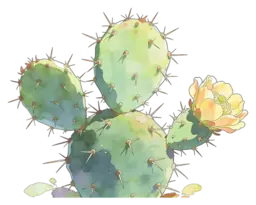
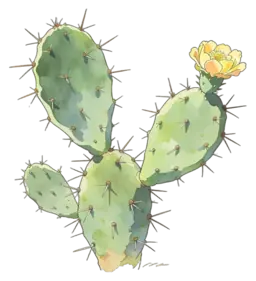
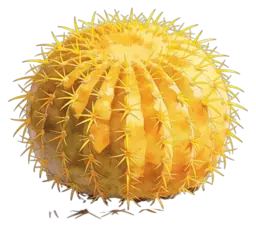
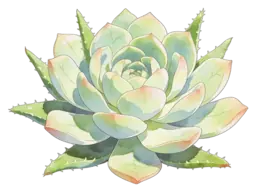
Compare with similar varieties
| Variety | Sowing | Harvest | Days | Spacing | Difficulty |
|---|---|---|---|---|---|
| Jamaica prickly pear | Mar–May | May–Aug | — | 60 cm | Easy |
| Drooping prickly pear (Opuntia monacantha) | Mar–May | — | — | 80 cm | Easy |
| Bunny ears cactus (Opuntia microdasys) | — | — | — | 40 cm | Easy |
| Santa Rita prickly pear (purple prickly pear) | — | — | — | 60 cm | Easy |
| Road kill cactus (Consolea rubescens) | Mar–May | — | — | 100 cm | Moderate |