Credits and licences
- #1 — vueltaalhuerto illustration
- #2 — vueltaalhuerto illustration
- #3 — vueltaalhuerto illustration
- #4 — vueltaalhuerto illustration
- #5 — vueltaalhuerto illustration
- #6 — vueltaalhuerto illustration
- #7 — vueltaalhuerto illustration
- #8 — vueltaalhuerto illustration
- #9 — vueltaalhuerto illustration
- #10 — vueltaalhuerto illustration
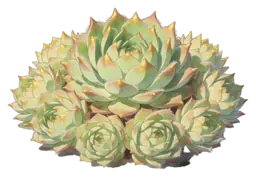
Chinese dunce cap (Orostachys spinosa)
and 1 more names
Sedum spinosumChinese dunce cap (Orostachys spinosa) is sown in seed trays from March to April, and planted out from April to May and in September. It flowers from September to October. Grow it in full sun, 15 cm apart, with little watering. Dates are for a mild temperate climate in the northern hemisphere; the calendar below adjusts them to your zone.
What else to sow in March and April
The Chinese dunce cap (Orostachys spinosa) is a small, very cold-hardy succulent that forms tight rosettes, up to about 10 cm across, of fleshy greyish-green leaves each ending in a tiny whitish spine. Over time it forms colonies of daughter rosettes, joined to the mother by short stolons. Each rosette is monocarpic: it flowers only once, in late summer or autumn, with a conical spike of small pinkish-white flowers, and then dies; the offsets take its place, so the clump does not disappear. It is slow-growing (it takes five to ten years to reach its final size) and suits rock gardens, stone walls, green roofs and shallow pots. It withstands hard frosts but does not tolerate persistent damp: in the wet climate of northern Spain it is best grown under cover or in a very mineral mix. It is not edible and you should not use it as a home remedy.
Family and origin: Stonecrop family (Crassulaceae) · native to Central and eastern Asia (Siberia, Mongolia, China), on screes and rocks · More plants from Central Asia
01In your area
How will it do in your garden?
Year calendar
| Task | J | F | M | A | M | J | J | A | S | O | N | D |
|---|---|---|---|---|---|---|---|---|---|---|---|---|
| Seed trayMar–Apr | no | no | yes | yes | no | no | no | no | no | no | no | no |
| Plant / transplantApr–May, Sep | no | no | no | yes | yes | no | no | no | yes | no | no | no |
| HarvestAug–Oct | no | no | no | no | no | no | no | yes | yes | yes | no | no |
| FloweringSep–Oct | no | no | no | no | no | no | no | no | yes | yes | no | no |
| Divide the clumpApr–May, Sep | no | no | no | yes | yes | no | no | no | yes | no | no | no |
Its life cycle at a glance
Swipe and tap a stage to see its details.
02Care
Care through the year
Sun and aspectFull sun · 8 h of sun · South or south-west, with nothing casting shade at midday
- Too little sun
- Ideal range
- Plenty of sun
South or south-west, with nothing casting shade at midday
Strong sun: Loves full midday sun and high temperatures.
Full sun. It is rated H4 (down to about -10 °C) and advises protecting it from winter rain, which is what damages it in the British climate; other guides say it is hardy to -20 °C or lower. That -20 °C figure is a guide only and applies only when the potting mix is dry; with cold and damp together, count on about -10 °C.
- Common mistakeLack of light makes them stretch and go soft (etiolation).
WateringLet it dry out between waterings · summer: every 5-7 days
- Summerevery 5-7 days0.2 L per plant/week
- Spring / Autumnevery 10-14 days0.1 L per plant/week
- Winteronly in extreme drought (once a month)0 L per plant/week
Let it dry out between waterings: A Mediterranean favourite: better thirsty than overwatered.
Water sparingly: in summer, when the potting mix is completely dry, and not at all in winter, unless it is in a pot under cover. It cannot cope with standing water or with humid air in hot weather: that is what rots it most. Use a very mineral, free-draining mix.
When to water? Push your finger 5 cm into the soil next to the base of the plant:
- Damp: soil sticks to your finger. Do not water yet. It has more than enough; wait for it to dry out more.
- Cool but clean, no mud. Wait another 1-2 days before watering.
- Dry and dusty. Water now, but moderately. Do not overdo it: it prefers thirst to excess.
- TipIt withstands frost and needs no protection, but it must not become waterlogged: in rainy climates it is better sheltered from the rain or in a crevice in a wall.
- TipFigures for cold, watering and timings are a guide only.
- TipWater thoroughly and leave long gaps: better thirsty than overwatered.
- Common mistakeWatering often rots the crown and the roots.
Soil and feedingpH 6–7.5 · Very gritty, free-draining mix
Very gritty, free-draining mix.
30 % multi-purpose compost · 40 % coarse sand · 30 % perlite or pumice.
Very high: standing moisture rots them.
This plant prefers a pH between 6.0 and 7.5 (slightly acidic to slightly alkaline).
- Multi-purpose compost on its own with no drainage: rot sets in quickly.
- Watering the rosette or the leaves marks them and causes rot.
- TipPlant it in a shallow pot or a rock garden with a very free-draining mix (coarse sand, gravel, volcanic grit and a little soil), in full sun.
- TipIt needs hardly any fertiliser.
- TipVery free-draining mix (with sand/perlite) and pots with a drainage hole.
03Harvest
Harvesting and storing
Harvest in Aug–Oct.
04Propagation
Make new plants
It is propagated by dividing off the daughter rosettes, which are separated in spring with part of the stolon and planted in a mineral potting mix; this is the most reliable method and gives plants identical to the mother. It can also be grown from seed: the seeds are very fine, like dust, and are sown on the surface, uncovered, with light and a cool, moist mix; they come up in a few weeks and the seedlings take years to reach a decent size.
Seeds: how to germinate them~21 days
05Uses and health
What it is used for, and with what care
There is no reliable toxicity data for this species. Some Orostachys are used in traditional Asian medicine, but that does not make it safe: do not eat it or use it as a remedy. As a precaution, keep it out of reach of children and pets, which may bite the leaves, and wash your hands after handling it. If you suspect it has been swallowed, in Spain call the Toxicology Information Service (91 562 04 20) or 112, and the vet if it is a pet.
- Properties
- An ornamental rock-garden succulent, with no proven medicinal or food uses.
- Uses
- It is not edible: do not eat it or use it in home-made preparations.
For guidance only; this is not medical treatment and does not replace advice from a doctor or vet.
06Companions and related plants