Credits and licences
- #1 — vueltaalhuerto illustration
- #2 — vueltaalhuerto illustration
- #3 — vueltaalhuerto illustration
- #4 — vueltaalhuerto illustration
- #5 — vueltaalhuerto illustration
- #6 — vueltaalhuerto illustration
- #7 — vueltaalhuerto illustration
- #8 — vueltaalhuerto illustration
- #9 — vueltaalhuerto illustration
Chameleon plant (Houttuynia cordata)
and 3 more names
lizard tail, Houttuynia cordata, Houttuynia 'Chameleon'Chameleon plant (Houttuynia cordata) is planted from March to May and from September to October. It flowers from May to July. Grow it in sun or partial shade, 30 cm apart, with plenty of watering. Dates are for a mild temperate climate in the northern hemisphere; the calendar below adjusts them to your zone.
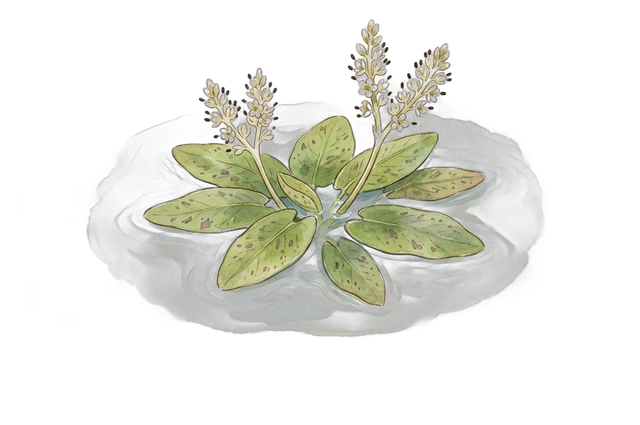
Houttuynia, sold in Spain as 'swamp anemone' and also known as chameleon plant, is a creeping perennial 15 to 50 cm tall that forms dense mats in damp soils and around the edges of ponds. The heart-shaped leaves are bluish green, and in the variegated cultivar 'Chameleon' they are mixed with cream, pink and red; when crushed they give off a strong smell, which reminds some people of fish and others of citrus. Between late spring and summer it produces small greenish-yellow spikes surrounded by four white bracts that look like the petals of an anemone, hence its trade name; it is not a true anemone. It spreads by thin white rhizomes that run through the soil and resprout from any fragment, so it invades easily: it is not listed in the Spanish Catalogue of Invasive Alien Species or on the EU list, but it is best planted in a pot or with a root barrier. In winter it loses its top growth and reshoots in spring. In some Asian countries its leaves are eaten as an aromatic herb.
Family and origin: Lizard's tail family (Saururaceae) · native to East and South-East Asia (from Japan and China to the Himalayas and Vietnam), along stream banks, in wetlands and in cool woodland understorey · More plants from Far East
01In your area
How will it do in your garden?
Year calendar
| Task | J | F | M | A | M | J | J | A | S | O | N | D |
|---|---|---|---|---|---|---|---|---|---|---|---|---|
| Plant / transplantMar–May, Sep–Oct | no | no | yes | yes | yes | no | no | no | yes | yes | no | no |
| FloweringMay–Jul | no | no | no | no | yes | yes | yes | no | no | no | no | no |
| PruningNov–Jan | yes | no | no | no | no | no | no | no | no | no | yes | yes |
| CuttingsMay–Jul | no | no | no | no | yes | yes | yes | no | no | no | no | no |
| Divide the clumpMar–May | no | no | yes | yes | yes | no | no | no | no | no | no | no |
Its life cycle at a glance
Swipe and tap a stage to see its details.
02Planting
Where and how to plant it
Leave 30 cm between plants and 30 cm between rows.
30 cm between plants · 30 cm between rows
Seedlings are planted with the root ball level with the soil.
- Transplanting
- Mar–May, Sep–Oct
- TipIt is ideal for damp, shady areas where other plants will not grow.
- TipIf you want to try the leaves, which in South-East Asia are eaten raw as a strongly flavoured aromatic herb, do so with a small amount and from plants grown without treatments; no medicinal use is attributed to it.
03Care
Care through the year
Sun and aspectSun and shade · 5 h of sun · shade in summer
- Too little sun
- Ideal range
- Plenty of sun
East, or south with light shade during the middle of the day
Moderate sun: Copes with full sun, but give it some shade during heatwaves.
3 to 6 hours of gentle sun is enough; in full sun and with little water the leaves scorch, especially in the hot inland areas of Spain. It withstands hard frosts, down to about -20 °C: it loses its top growth and reshoots from the rhizomes in spring.
WateringVery moist, tolerates waterlogging · summer: keep the soil saturated; in a pot, water daily or keep the saucer full of water
- Summerkeep the soil saturated; in a pot, water daily or keep the saucer full of water1.4 L per plant/week
- Spring / Autumnevery 3-4 days0.6 L per plant/week
- Winteronly if the potting mix dries out0.2 L per plant/week
Very moist, tolerates waterlogging: Saturated or nearly saturated soil. Still watch out for fungal disease.
It needs soil that is always moist or waterlogged: it thrives at the edge of a pond or in a pot without drainage holes, with the potting mix covered by no more than about 5 cm of water. If the soil dries out, the leaves wilt immediately and scorch. It also tolerates moist garden soils, but then it spreads more slowly.
This is a plant for waterlogged soil or pond margins: the finger test does not help, because the soil must stay wet all the time. Make sure the mud never dries out and, if it grows in a pond, that the water covers the base as the profile says; in summer, top up what evaporates.
Soil and feedingpH 5.5–7.5 · Free-draining, airy mix
Free-draining, airy mix.
40 % topsoil · 30 % coarse sand or perlite · 30 % well-rotted compost (less compost for Mediterranean herbs).
High: almost all prefer being thirsty to being wet.
This plant prefers a pH between 5.5 and 7.5 (slightly acidic to slightly alkaline).
- Mediterranean herbs in very rich, heavily watered soil: they grow a lot but lose their aroma.
- A pot without a drainage hole: the roots rot within weeks.
- TipPlant it in a pot or inside an aquatic planting basket, or with a barrier sunk 30 cm deep, because in damp soil it spreads everywhere and is very hard to get rid of.
PruningWhen: Nov–Jan
Pruning time for this plant: Nov–Jan.
- TipPinch out the tips often so it branches and does not run to seed so soon.
Common mistakes and tips
- TipCut back the dead stems after the first frosts.
- TipThe depth, temperature and calendar figures are approximate.
- Common mistakeLetting them flower early makes the leaves bitter (in leafy herbs).
04Propagation
Make new plants
It is propagated mainly by dividing the rhizomes in spring: each piece with roots and at least one bud gives a new plant. It can also be grown from cuttings of young shoots from the base, 8 to 10 cm long, in spring and summer, which root in water or in very moist potting mix. Any fragment of rhizome left in the soil resprouts, which is why the plant spreads so much. Seed is rarely used in cultivation.
- TipDivide the clump every two or three years, in spring, to limit its spread, and do not throw pieces of rhizome onto an open compost heap or into watercourses or natural areas: every fragment resprouts.
05Uses and health
What it is used for, and with what care
There are no known cases of significant toxicity in people from normal culinary use, but some people notice skin irritation when handling it or discomfort after eating it. There are no reliable data on its effect on dogs and cats, so stop them chewing it. WARNING: it is a very vigorous spreader and is considered invasive in some countries; in Spain it is not listed in the Catalogue of Invasive Alien Species (RD 630/2013) or on the EU list (Reg. 1143/2014), but every piece of rhizome resprouts, so plant it contained and do not throw the remains into watercourses or the countryside.
- Properties
- An ornamental plant for damp areas that provides ground cover and shelter for small animals. It is used in traditional Asian medicine, but there is not enough evidence to recommend any home medicinal use.
- Uses
- In South-East Asia, especially in Vietnam, the young leaves are eaten raw as an aromatic herb, with an intense flavour, somewhat fishy or citrusy. If you want to try them, use only a small amount from plants grown without treatments. Do not use it as a remedy.
For guidance only; this is not medical treatment and does not replace advice from a doctor or vet.
06Companions and related plants