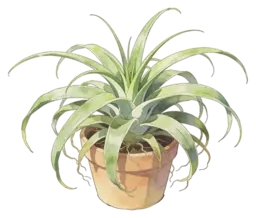
Credits and licences
- #1 — vueltaalhuerto illustration
- #2 — vueltaalhuerto illustration
- #3 — vueltaalhuerto illustration
- #4 — vueltaalhuerto illustration
- #5 — vueltaalhuerto illustration
- #6 — vueltaalhuerto illustration
- #7 — vueltaalhuerto illustration
Catopsis morreniana (green bromeliad)
and 3 more names
epiphytic bromeliad, Catopsis mooreana, Tillandsia morrenianaA compact epiphytic bromeliad forming a rosette about 15 to 20 cm tall, with stiff, smooth, pale yellowish-green leaves covered in a fine whitish waxy coating, which form a central funnel that holds water. In summer it may produce a slender spike of small white flowers, after which the mother rosette forms offsets at its base. It is a small, undemanding plant, widely used in open terrariums and mounted on bark or branches, because it needs little potting mix and absorbs water and nutrients mainly through its leaves and the central funnel. Some shops sell it as 'Catopsis mooreana', a name that is not among the accepted ones; the compact green terrarium bromeliad offered under that name is almost certainly Catopsis morreniana, the species described here. It does not tolerate frost and appreciates warmth, bright light without direct sun, and humid air with good circulation.
Family and origin: Bromeliad family (Bromeliaceae) · native to Mexico and Central America; an epiphyte of humid forests · More plants from Mesoamerica
01In your area
How will it do in your home?
Year calendar
| Task | J | F | M | A | M | J | J | A | S | O | N | D |
|---|---|---|---|---|---|---|---|---|---|---|---|---|
| Divide the clumpApr–Jul | no | no | no | yes | yes | yes | yes | no | no | no | no | no |
Its life cycle at a glance
Swipe and tap a stage to see its details.
02Planting
Planting and transplanting
03Care
Care through the year
Sun and aspectSun and shade · 5 h of sun · shade in summer
- Too little sun
- Ideal range
- Plenty of sun
East, or south with light shade during the middle of the day
Gentle sun: Morning or afternoon sun. Midday summer sun stresses and scorches it.
Bright, indirect light, with some gentle morning sun. Direct midday sun scorches the leaves, and in low light it grows slowly and loses its yellowish-green colour.
- TipTurn the pot every week so it grows evenly towards the light.
WateringLet it dry out between waterings · summer: every 2-3 days
- Summerevery 2-3 days0.6 L per plant/week
- Spring / Autumnevery 4-5 days0.3 L per plant/week
- Winterevery 2-3 weeks0.1 L per plant/week
Let it dry out between waterings: A Mediterranean favourite: better thirsty than overwatered. Mulch: straw or dry plant material cuts watering by 30-50 %.
Keep a little rainwater or distilled water in the central funnel, and replace it every three or four weeks so that it does not go stale; empty it if the temperature drops below 15 °C. The potting mix is only moistened occasionally and should dry out between waterings, because the roots serve mainly for anchorage.
When to water? Push your finger 3 cm into the soil next to the base of the plant:
- Damp: soil sticks to your finger. Do not water yet. It has more than enough; wait for it to dry out more.
- Cool but clean, no mud. Wait another 1-2 days before watering.
- Dry and dusty. Water now, but moderately. Do not overdo it: it prefers thirst to excess.
- TipIn a closed terrarium, pay attention to ventilation, because stagnant water rots the rosette.
- TipThe dates, minimum temperature and watering are only a guide.
- TipAdjust watering to the light and the season: in winter almost all of them need much less water.
- Common mistakeOverwatering is the number one killer: let it dry out as the species requires.
Potting mix and feedingpH 5–6.5 · Multi-purpose compost lightened with perlite
Multi-purpose compost lightened with perlite.
70 % multi-purpose compost · 20 % perlite · 10 % coir.
High: always a pot with a drainage hole and a shallow saucer.
This plant prefers a pH between 5.0 and 6.5 (acidic to neutral).
- Repot every 2-3 years into a pot a finger's width wider, not much more.
- A handful of worm castings a year keeps the potting mix alive.
- Reusing old potting mix without refreshing it compacts and rots the roots.
- No drainage in the pot = waterlogged roots = dead plant.
04Propagation
Make new plants
It is propagated from offsets, which appear at the base of the mother plant during or after flowering. Separate them when they are between a third and half the size of the mother, using a clean, sharp knife and keeping a few small roots, and plant them in a coarse mix of bark and perlite or tie them to a piece of bark. Seed exists, but it is very slow and not used in home growing. An offset takes one to two years to reach flowering size.
05Uses and health
What it is used for, and with what care
There are no specific data on the toxicity of this species to people, dogs and cats. Bromeliads are generally considered low risk, but as a precaution do not eat it and stop children and pets from chewing the leaves. If a significant amount is swallowed, consult a doctor or a vet.
- Properties
- It is a small, decorative bromeliad of a very bright yellowish green, which suits open terrariums and bark mounts with little maintenance.
- Uses
- It is not grown for food and is not used in cooking, infusions or home remedies.
For guidance only; this is not medical treatment and does not replace advice from a doctor or vet.
06Companions and related plants