
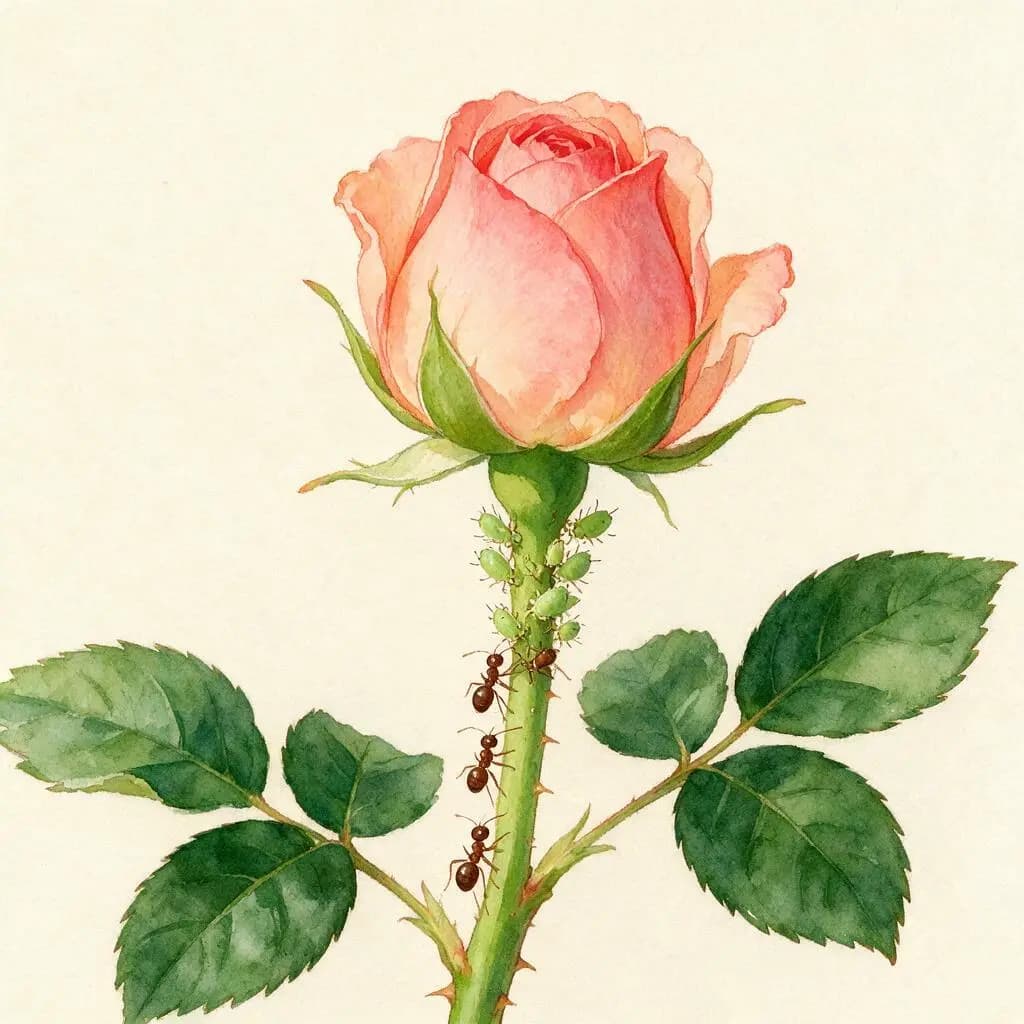
Ants
Also known as: ants, garden ants, black garden ant, ant nest, aphid-farming ants
Ants do not eat the plant directly, but they ‘farm’ aphids and scale insects for their honeydew and protect them from predators. Their presence usually points to a sap-sucking pest. The first step is to look for aphids or scale insects and control them.
Its best ally
Wall lizard
A natural predator that helps to keep this pest under control. Tap to see how to attract it.

How to recognise it at every stage
Shares your gardenThey like your aphids' honeydew: they look after them and defend them.
Life cycle: Complete metamorphosis inside the nest: egg, larva, pupa (sometimes in a cocoon) and adult. The colony lives for many years; in summer, after a storm, winged ants fly out to found new colonies.
Tap a stage to see it full size. The photos are AI reference images checked against real photographs; stages without a reliable photo are shown as text only.
Life-stage calendar
| Jan | Feb | Mar | Apr | May | Jun | Jul | Aug | Sep | Oct | Nov | Dec | |
|---|---|---|---|---|---|---|---|---|---|---|---|---|
| Eggs | ||||||||||||
| Larvae | ||||||||||||
| Pupae ('ant eggs') | ||||||||||||
| Workers and winged ants | ||||||||||||
| Ant nest |
Approximate months for mainland Spain; in cold areas they start later and in warm areas they last longer. Garden creatures this month
- 1Keep an eye on it
Eggs
· 0.5 mmTiny white grains in clumps.
- Where to find it
- Inside the nest.
- When: Mar–Sep
- What to do
- No need to disturb the nest.
- 2Keep an eye on it
Larvae
Small white legless grubs, curved.
- Where to find it
- Inside the nest, cared for by the workers.
- When: Mar–Sep
- What to do
- Nothing.
- 3Keep an eye on it
Pupae ('ant eggs')
· 3-5 mmWhite-yellow cocoons like grains of rice, which the workers rush away if you lift a stone.
- Where to find it
- Under stones and pots warmed by the sun.
- When: Apr–Sep
- What to do
- Put the stone back in place.
- 4Protect your plants
Workers and winged ants
· 3-5 mm (winged, up to 1 cm)Black or brown workers in a line; in summer, winged ants all coming out at once.
- Where to find it
- Climbing stems and trunks towards aphids and scale insects.
- When: Mar–Oct
- What to do
- Put sticky or cotton bands on trunks so they cannot climb to the aphids. In the soil they also aerate the earth and eat other insects.
- Often confused with
- Termites. Whitish, with no clear waist, and they live inside wood. Rare in the garden.
Nests, egg clutches and shelters
- Keep an eye on it
Ant nest
Little heaps of fine soil in cracks, along paving edges or at the foot of plants.
- Where to find it
- In dry sunny soils, under stones and pots.
- When: all year
- What to do
- If it is in a pot or next to a seedling, water thoroughly several days in a row: they usually move.
Often confused with
- Termites. Whitish, with no clear waist, and they live inside wood. Rare in the garden.
How to recognise it (symptoms)
- Trails of ants running up and down the stem
- Colonies of aphids or scale insects protected by them
- Ant nests raised next to the base of the plant
- Ants carrying off small seeds from the sowing row
Crops affected
What favours it
- Hot, dry summers
- Light soils, which drain quickly and warm up sooner
- Honeydew (from aphids, scale insects), which attracts them
Prevention
- Control aphids and scale insects: without food, the ants will leave
- Put a band of tree glue around the trunks of fruit trees
- Prune branches that touch the ground or a wall, because they act as bridges for ants
Organic treatment
Always start here: these remedies are kind to the garden, the soil and pollinators.
- First: look on the plant for the aphids or scale insects that are attracting them and treat those (water jet, potassium soap); without honeydew, the ants usually move on
- A band of tree glue on fruit trees, to stop them climbing up
- Diatomaceous earth in a very fine, dry layer along the ant trails, wearing a mask and on a still day; it loses effectiveness when damp and also affects beneficial insects
- If they set up home in a seed tray, a heavy watering of the nest usually makes them move elsewhere
Don't confuse it with…
Ants are sometimes blamed for damage that is actually caused by aphids or scale insects. Check the undersides of the leaves before treating. Do not use borax baits: they are toxic to pets and children and can contaminate the soil.
In-depth guide — ants in the vegetable garden
Ants do not usually eat the plant, but they protect aphids, scale insects and citrus blackfly in exchange for honeydew. Breaking that alliance is the key to controlling the real pest.
Warning sign
Columns of ants climbing the trunk, especially on citrus, fruit trees and tomatoes. Look for shiny honeydew on the nearby leaves.
Barrier on the trunk
- A band of tree glue, renewed when it fills up with dust or ants.
- On pots, a ring of double-sided tape around the pot; replace it when it gets covered in dust.
- Stop branches touching the ground or a wall: they are bridges.
Controlling the sap-sucker
Treat the aphids, scale insects or citrus blackfly using the methods in their profiles. Without honeydew, the ant colony usually abandons the plant.
Baits only if necessary
If there is a persistent ant nest next to the house, use a specific ant bait inside a closed bait station, away from edible crops, following the label and out of the reach of children and pets. Do not use home-made borax baits.
There is no need to get rid of every ant in the garden: only those protecting pests on your crops.
Use plant protection products responsibly, even organic ones. Always read and follow the label, the doses and the harvest interval, and never treat plants in flower or while bees are flying, in order to protect pollinators. If in doubt, put prevention and organic methods first.

In the plant catalogue you'll see what to plant, how and when: a well-tended plant resists pests much better.