
Hedgehogs: shelter and passages between fences
Each night, a hedgehog covers a kilometre or more looking for slugs, snails, beetles and caterpillars. What it needs most is to be able to pass from one garden to another and a quiet shelter to sleep and to hibernate.
- Difficulty: easy
- Gap in the fence: 13 × 13 cm, at ground level
- Profile: Hedgehog
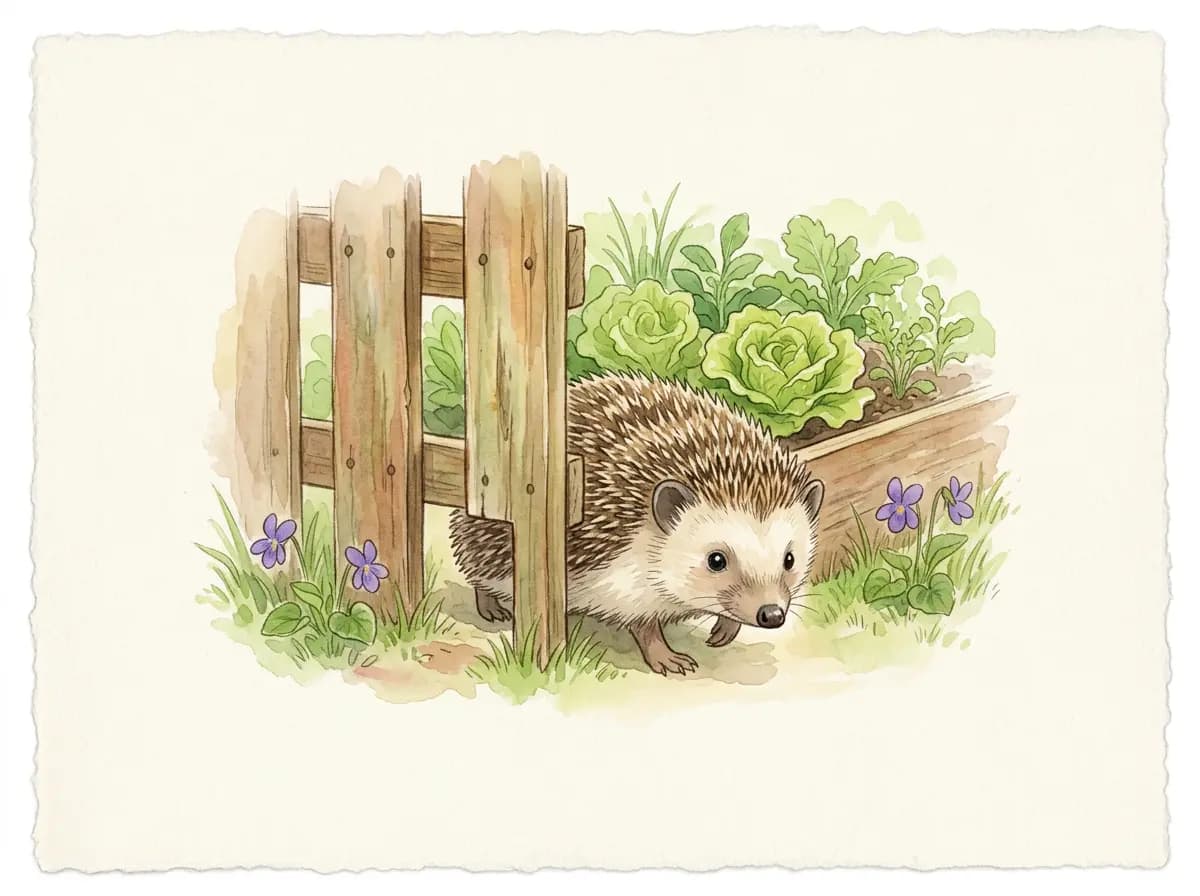
What it helps with
- They eat slugs, snails, beetles, larvae and caterpillars.
- A hedgehog can travel through several gardens each night.
- They need a dry, quiet shelter for the winter.
Materials
- A hand saw or jigsaw for the gap in the fence
- For the shelter: see the build “Hedgehog shelter”
- Dry leaves, branches, straw and a pile of logs for a natural shelter
- A shallow dish of water (never milk)
Measurements
- Gap in the fence
- 13 × 13 cm, at ground level
- Shelter
- chamber of about 40 × 40 cm and 25–30 cm high; entrance tunnel of 13 × 13 cm and 30–40 cm
- Natural pile
- a corner of about 1 × 1 m of leaves, branches and logs
Step by step
1. Open a passage in the fence
Cut a gap of 13 × 13 cm at ground level (in wooden or mesh fences, or under a gate) or ask your neighbours to make one. This is the most important step: without a passage, the hedgehog cannot reach you.

2. Make a shelter
Build the hedgehog house from our guide “Hedgehog shelter” or leave a pile of dry leaves, branches and logs in a quiet corner, under a hedge, without disturbing it.

3. Put out a dish of water
A shallow dish with fresh water in summer. Never milk or bread, which make them ill.

4. Look after the dangers
Cover wells, drains and pools with a ramp, pick up loose netting, check the brush pile before burning or using the brush cutter, and avoid slug bait.

How to recognise it at every stage
Garden allyGarden ally: at night it eats slugs, snails and beetles.
Life cycle: Mammal: the young are born blind with soft spines in a nest of leaves, suckle for about six weeks and become independent at two months. They hibernate from November to March in cold areas.
Tap a stage to see it full size. The photos are AI reference images checked against real photographs; stages without a reliable photo are shown as text only.
Life-stage calendar
| Jan | Feb | Mar | Apr | May | Jun | Jul | Aug | Sep | Oct | Nov | Dec | |
|---|---|---|---|---|---|---|---|---|---|---|---|---|
| Hoglets | ||||||||||||
| Adult | ||||||||||||
| Leaf nest |
Approximate months for mainland Spain; in cold areas they start later and in warm areas they last longer. Garden creatures this month
- 1Protect it
Hoglets
· 6-15 cmSmall hedgehogs with pale spines that leave the nest at dusk following their mother.
- Where to find it
- In hedges, leaf piles and under sheds.
- When: May–Sep
- What to do
- If you see young on their own by day, watch from a distance; if hours go by without the mother, call a wildlife rescue centre.
- 2Protect it
Adult
· 20-30 cmBody covered in brown spines with pale tips, pointed snout; it rolls into a ball if frightened.
- Where to find it
- At night roaming the garden; by day asleep in hedges and leaf piles.
- When: Mar–Nov
- What to do
- Protect it (protected species): leave 13 cm gaps in fences, a dish of water (never milk) and no slug killers.
- Often confused with
- North African hedgehog. Paler, with a spine-free parting on the head, on the Mediterranean coast and the Canary Islands. Also an ally.
Nests, egg clutches and shelters
- Protect it
Leaf nest
A compact heap of dry leaves and grass under a hedge, logs or a shed.
- Where to find it
- In quiet, dry corners of the garden.
- When: all year
- What to do
- Do not burn or move heaps of leaves or branches without looking first, especially from November to March.
Often confused with
- North African hedgehog. Paler, with a spine-free parting on the head, on the Mediterranean coast and the Canary Islands. Also an ally.
Where and when to put it
- Passage in the fence: at any time; best before spring.
- Shelter: at the end of summer or autumn, before hibernation (roughly November to March).
- A quiet corner with partial shade, away from walkways and from pets.
Maintenance
- Do not open the shelter in winter. If you have to look, do it in September–October, carefully.
- Change the leaves when they clump together, in autumn.
- Keep the gap in the fence clear of weeds.
- Check the pile of leaves before burning, pruning or strimming.
If you see a hedgehog wandering by day, injured, or very small and alone, it is almost certainly unwell: call your region’s wildlife rescue centre instead of feeding it yourself.
Common mistakes
What comes up most often, so you can avoid it from the start.
Closing in the garden with a fence with no passage at all.
A hedgehog needs to travel through several gardens each night to find food and a mate. If the fence has no 13 × 13 cm gap at ground level, it cannot get into your garden.
Using slug bait.
The hedgehog eats the poisoned slugs and sometimes the pellets themselves, and is poisoned. It is one of the reasons there are fewer hedgehogs.
Giving them milk or bread.
They do not digest lactose well and milk gives them diarrhoea that can be serious; bread fills them without feeding them. If you want to help, leave only water in a shallow dish.
Leaving nets, mesh or plastic threads on the ground.
Hedgehogs put their heads or legs through, get tangled as they try to get out and can die trapped. Pick up the nets or raise them to 30 cm off the ground.
Moving or opening a shelter in winter.
If the hedgehog is hibernating and you wake it, it uses up the fat it needs to reach spring and may die. Check it only in September or October.
Burning a brush pile without checking it first.
Hedgehogs love those piles to sleep and spend the winter. Turn it over by hand or move it just before burning it.
More information on the site
Sources
The measurements are a synthesis of these conservation guides; where each author gives different figures, they appear as a range.