

Peacock
Aglais io
Also: peacock butterfly, European peacock
Pollinator. Its caterpillars live on nettles.
Unmistakable thanks to the four large blue eyespots on its red wings. It overwinters as an adult hidden in sheds or crevices and is one of the first to fly at the end of winter. Its black, spiny caterpillars live in groups on nettles.
What to do: Protect it
Leave a patch of nettles in the sun: it is their nursery. If one comes into the house in autumn, move it to a cool shed.
Flight months
- Wingspan
- 5-6 cm
- Generations
- One or two a year; overwinters as an adult.
- Where it lives
- Northern half of Spain and the mountains; rarer in the south.
How long each stage lasts
- Egg
- 1-2 weeks
- Caterpillar
- 3-4 weeks
- Chrysalis
- 2 weeks
- Adult
- up to 10 months (overwinters)
How it transforms
Mature caterpillars disperse and hang head-down to form a greenish or brown chrysalis with golden dots.
The caterpillar, stage by stage
- Young: in a group inside a silk web on the nettle.
- Large: black with tiny white dots and branched black spines, still in a group.
Food plants (for the caterpillar)

Nectar plants (for the adult)
 Buddleia (butterfly bush)A vigorous shrub with highly fragrant flower spikes that attract butterflies and bees all summer long.
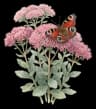 Sedum (stonecrop)An upright succulent clump with fleshy grey-green leaves and large heads of pink star-shaped flowers that…
 ThistlesA large thistle with purple flowers and green leaves veined with white, almost like marble.
 LavenderA Mediterranean aromatic shrub with blue-violet spikes much loved by bees, indispensable in dry gardens and…
How to recognise it at every stage
PollinatorPollinator. Its caterpillars live on nettles.
Life cycle: Complete metamorphosis: egg (1-2 weeks), caterpillars in a group (3-4 weeks), chrysalis (2 weeks) and butterfly, which overwinters hidden away. One or two generations a year.
Tap a stage to see it full size. The photos are AI reference images checked against real photographs; stages without a reliable photo are shown as text only.
Life-stage calendar
| Jan | Feb | Mar | Apr | May | Jun | Jul | Aug | Sep | Oct | Nov | Dec | |
|---|---|---|---|---|---|---|---|---|---|---|---|---|
| Eggs | ||||||||||||
| Caterpillars in a group | ||||||||||||
| Chrysalis | ||||||||||||
| Butterfly | ||||||||||||
| Caterpillar web on the nettle |
Approximate months for mainland Spain; in cold areas they start later and in warm areas they last longer. Garden creatures this month
- 1Protect it
Eggs
· 0.8 mmLarge clusters (hundreds) of ribbed green eggs.
- Where to find it
- On the underside of nettle leaves.
- When: Apr–Jul
- What to do
- Leave them on the nettle.
- 2Protect it
Caterpillars in a group
· Up to 4 cmBlack with tiny white dots and black spines, in a group inside a silk web.
- Where to find it
- On nettles in the sun.
- When: May–Aug
- What to do
- Protect them: do not mow that patch of nettles until they have gone.
- Often confused with
- Caterpillars of other nymphalid butterflies. The small tortoiseshell's (Aglais urticae) has yellow stripes; the red admiral's lives alone in a folded leaf.
- 3Protect it
Chrysalis
· 2.5 cmGreenish or brown with golden dots, hanging head-down.
- Where to find it
- On stems and under leaves near the nettles.
- When: Jun–Aug
- What to do
- Do not touch it.
- 4Protect it
Butterfly
· 5-6 cmDeep red with four large blue eyespots; underneath, almost black like a dead leaf.
- Where to find it
- On buddleia and thistles; in winter, asleep in sheds and crevices.
- When: Feb–May, Jul–Oct
- What to do
- If it comes into the house in autumn, move it to a cool shed.
Nests, egg clutches and shelters
- Protect it
Caterpillar web on the nettle
A silky web at the top of the nettles with dozens of black caterpillars inside.
- Where to find it
- In sunny patches of nettles.
- When: May–Jul
- What to do
- They are not intruders: they are future peacock butterflies.
Often confused with
- Caterpillars of other nymphalid butterflies. The small tortoiseshell's (Aglais urticae) has yellow stripes; the red admiral's lives alone in a folded leaf.