
Duckweed (Lemna) and azolla for ducks, chickens and fish
Duckweed (Lemna minor) and azolla are small floating plants that double their mass in a few days, with plenty of protein. They serve as fresh food for ducks, chickens and fish.
- Difficulty: easy
- Lemna minor · Azolla filiculoides
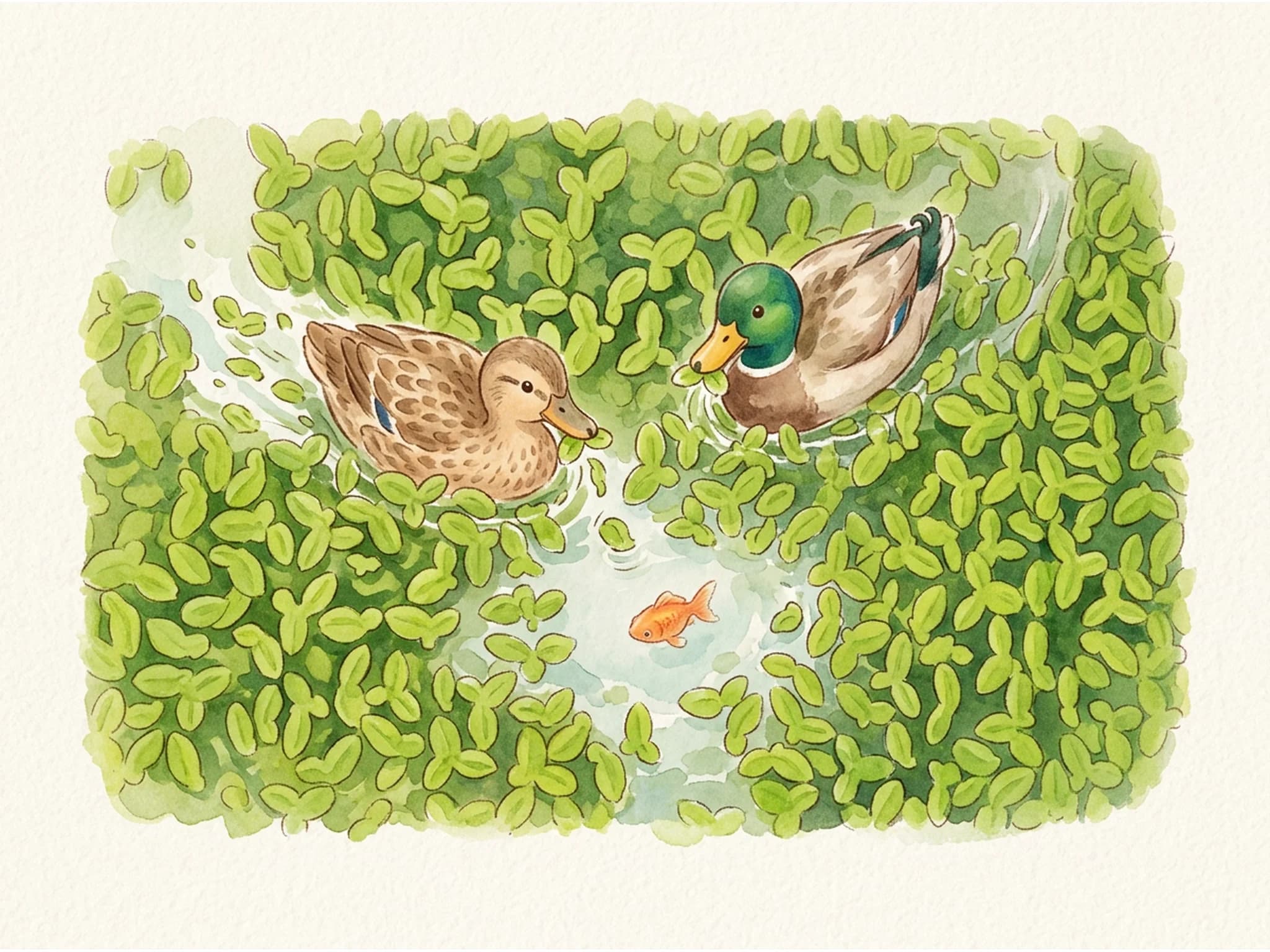
Which animals it suits and how much to give
- Ducks
- Fresh, as much as they want: up to 10–20% of the ration by fresh weight (indicative).
- Chickens
- A drained handful per hen per day (about 30–50 g); they accept less than ducks.
- Quail
- 5–10 g drained per quail per day, mixed with the feed.
- Pond fish
- As much as they want, without covering more than 30% of the pond surface.
- Rabbits and hedgehogs
- There is no basis for recommending it: avoid it.
Use duckweed and not azolla: azolla is invasive and, if it reaches a ditch or a river, it covers the water and smothers the life underneath.
Indicative doses: a supplement to a complete feed. See the table for all the animals.
Materials
- Tub or trough of 100 × 60 × 30 cm (about 100 L) with water
- A handful of duckweed (Lemna minor) from an aquarium shop or water-plant nursery
- Strainer or fine-mesh net
- Gentle fertiliser: a little soak water from mature compost or diluted duck droppings
- Mesh or lid to keep out mosquitoes and stop birds eating the whole crop at once
- A site far from streams, ditches and natural waters
Set-up measurements
- Tub
- 1000 × 600 × 300 mm
- Water level
- 200 mm (20 cm)
- Temperature
- 15–30 °C (best 20–28 °C); it stalls in frost
- pH
- 6.5–7.5
- Maximum cover
- A single layer: if it piles up, the bottom layer rots
- Light
- Partial sun: 4–6 h a day; in full summer sun, a little shade
Diagram drawn by a program with the same measurements as the table. The temperature and humidity figures are indicative.
Step by step
- 1
Choose the site
In partial shade, away from the edge of rivers, ditches and gullies. Put it in a yard, a greenhouse or on a terrace.

- 2
Fill the tub
Fill with water to 20 cm and leave it to stand for 24 h so the chlorine evaporates. Rainwater is best.

- 3
Sow
Spread a handful of Lemna minor over the surface (covering 10% of the surface at most to begin with).

- 4
Fertilise gently
Each week add a little mature-compost water or a splash of diluted duck manure. Without nutrients it yellows; with too much, algae appear.

- 5
Harvest
Every 2–3 days, scoop half the surface with the strainer. Always leave at least half so it regenerates.

- 6
Drain and feed
Drain it for 10 minutes before giving it to the animals. For ducks you can tip it straight into their pond or tub.

Cycle and timings
| Stage | Duration | What happens |
|---|---|---|
| Doubling | 2–4 days in good conditions | It multiplies by vegetative budding: each little frond produces another. |
| Harvest | Every 2–3 days | Half the surface is collected. |
| Rest | Winter | It forms buds that sink (turions) and regrow in spring. |
Maintenance
- Remove yellow or brown fronds and any duckweed that piles up.
- Top up the water that evaporates with rainwater or water left to stand.
- Change a third of the water each month.
- In winter, in cold areas, move a handful to a jar of water on a windowsill, to restart in spring.
Common problems
Smells, mites, mould, leaks and others: why they happen and how to fix them.
Swamp smell
Why it happens: Cover in several layers or excess nutrients.
What to do: Harvest more, remove the bottom layer and change a third of the water.
Green algae in the water
Why it happens: Too much light and nutrients.
What to do: More shade, more cover and less fertiliser.
Mosquitoes
Why it happens: Still water without cover.
What to do: Cover with 1 mm mesh, keep the whole surface covered and renew the water.
Yellow fronds
Why it happens: Lack of nutrients or too much heat.
What to do: Add a splash of compost water and give it shade.
Leaks
Why it happens: Cracked tub.
What to do: Change the container; do not top it up with chlorinated tap water.
Yield
- A 1 × 0.6 m tub can give between 100 and 300 g of fresh duckweed every 2–3 days in summer (indicative figure; it depends on fertiliser and sun).
- Dried duckweed reaches 25–40% protein, but fresh it is 90–95% water, so it works as a supplement, not a substitute for feed.
Safety and hygiene
- Wash your hands with soap after touching the colony or the substrate.
- Do not collect duckweed from natural waters or other people’s ponds to give to your animals: it can carry parasites, toxic algae or heavy metals.
- Watch standing water around small children: a tub of water is a drowning risk if it is not covered.
More information on the site
Sources
Figures synthesised from these sources; where each author gives different values, they appear as a range or as “indicative”.
- Leng, Stambolie and Bell (1995): Duckweed, a potential high-protein feed resource for domestic animals and fish (FAO/Livestock Research for Rural Development)
- Cherryl et al. (2014) and reviews on Azolla as feed for poultry, ducks, pigs and fish (open-access scientific literature)
- MITECO: invasive alien species (in Spanish)