
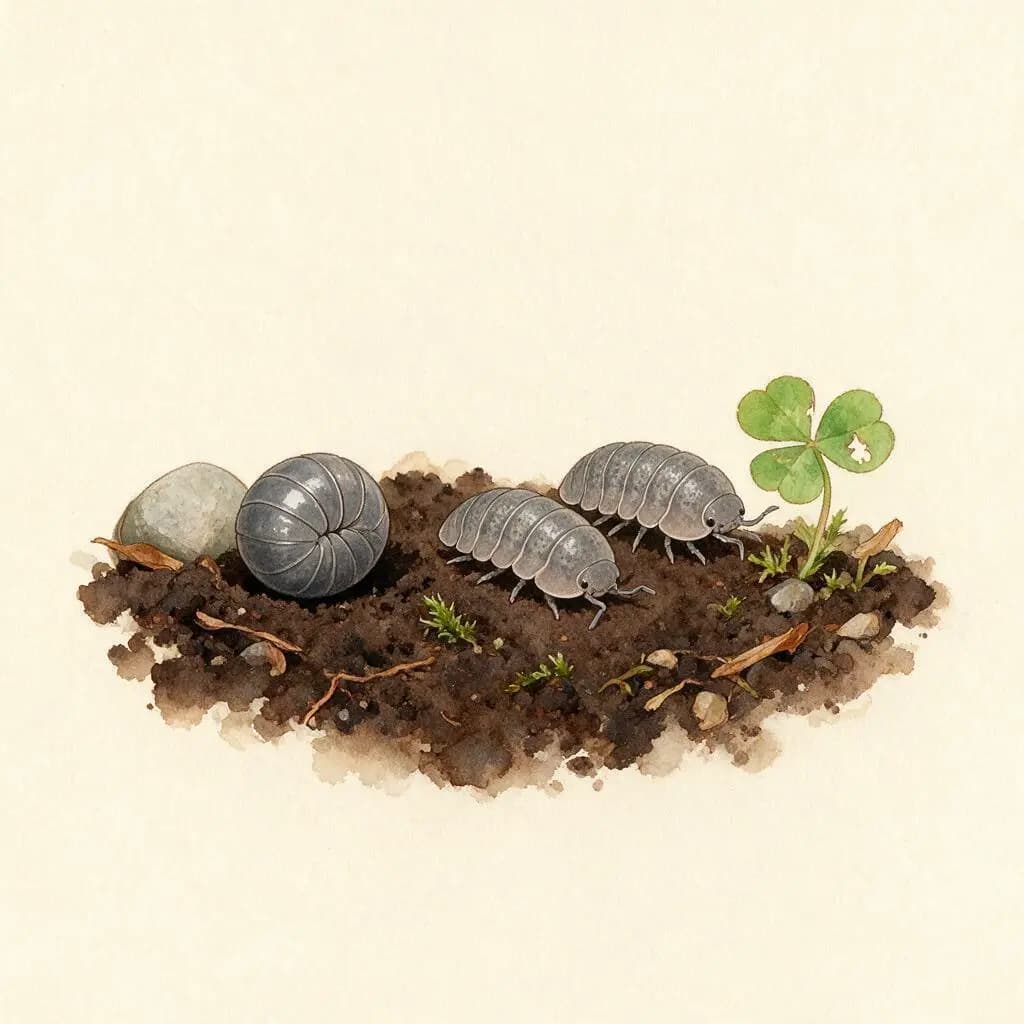
Woodlouse
Armadillidium vulgare, Porcellio scaber
Also called: pill bug, roly-poly, Armadillidium, slater, common woodlouse
Although they look like insects, they are land crustaceans. They eat dead plant matter, leaf litter and woody remains: they are key players in breaking down and recycling in the soil. They are only a nuisance if their numbers soar in very damp seedbeds.

How to recognise it at every stage
Garden allySoil ally: it recycles dead leaves and remains into compost.
Life cycle: It is a crustacean, with no metamorphosis: the female carries the eggs in a pouch under her body (marsupium) and white young come out of it and moult many times. They live two or three years.
Tap a stage to see it full size. The photos are AI reference images checked against real photographs; stages without a reliable photo are shown as text only.
Life-stage calendar
| Jan | Feb | Mar | Apr | May | Jun | Jul | Aug | Sep | Oct | Nov | Dec | |
|---|---|---|---|---|---|---|---|---|---|---|---|---|
| Marsupium with eggs | ||||||||||||
| Young | ||||||||||||
| Adult |
Approximate months for mainland Spain; in cold areas they start later and in warm areas they last longer. Garden creatures this month
- 1Protect it
Marsupium with eggs
A whitish pouch under the female's body, between the legs.
- Where to find it
- Under stones, pots and damp leaf litter.
- When: Apr–Aug
- What to do
- Leave her in place.
- 2Protect it
Young
· 1-3 mmTiny woodlice, white or transparent, that darken with each moult.
- Where to find it
- Next to the mother, under damp debris.
- When: May–Sep
- What to do
- Nothing: they are decomposers.
- 3Keep an eye on it
Adult
· 1-1.8 cmGrey or brown, with a shell in plates and seven pairs of legs. The pill bug (Armadillidium) rolls up completely.
- Where to find it
- Under stones, pots, mulch and in the compost.
- When: all year
- What to do
- It almost always eats debris. If it nibbles seedlings or strawberries in a very damp corner, air that area and pull the mulch back from the seedlings.
- Often confused with
- Plant scale insects (mealybugs). The "plant" scale insect is a soft, mealy insect stuck to stems; the woodlouse is a crustacean with a shell that walks on the ground. See profile
- Rolled-up millipede. The millipede has a great many legs and curls into a spiral, not a ball.
Often confused with
- Plant scale insects (mealybugs). The "plant" scale insect is a soft, mealy insect stuck to stems; the woodlouse is a crustacean with a shell that walks on the ground. See profile
- Rolled-up millipede. The millipede has a great many legs and curls into a spiral, not a ball.
What it eats
- Leaf litter and rotting wood
- Fallen fruit and vegetable scraps
- Decomposing compost
How to attract this ally to your garden
- Mulch with straw or leaf litter, boards and stones: shelter and food.
- An open compost bin, where they can work on the organic matter.
What to avoid so you do not harm it by accident
- Only treat if they attack very tender seedlings in large numbers; in that case, ventilating the seedbed and cutting the humidity is enough.
- Insecticides: it is not a pest, so there is no need.
How to recognise it
8-15 mm, slate-grey segmented body. Pill bugs roll into a perfect ball when touched; woodlice flatten out.
Risk to people: None.
Many allies are protected by Spanish law: do not capture or keep in captivity toads, hedgehogs, bats or native reptiles. Attract them, watch them and thank them from a distance. Rules in other countries differ: check your local regulations.

Allies do better if the garden is varied. Learn to identify each visitor and to prevent problems with good habits.