
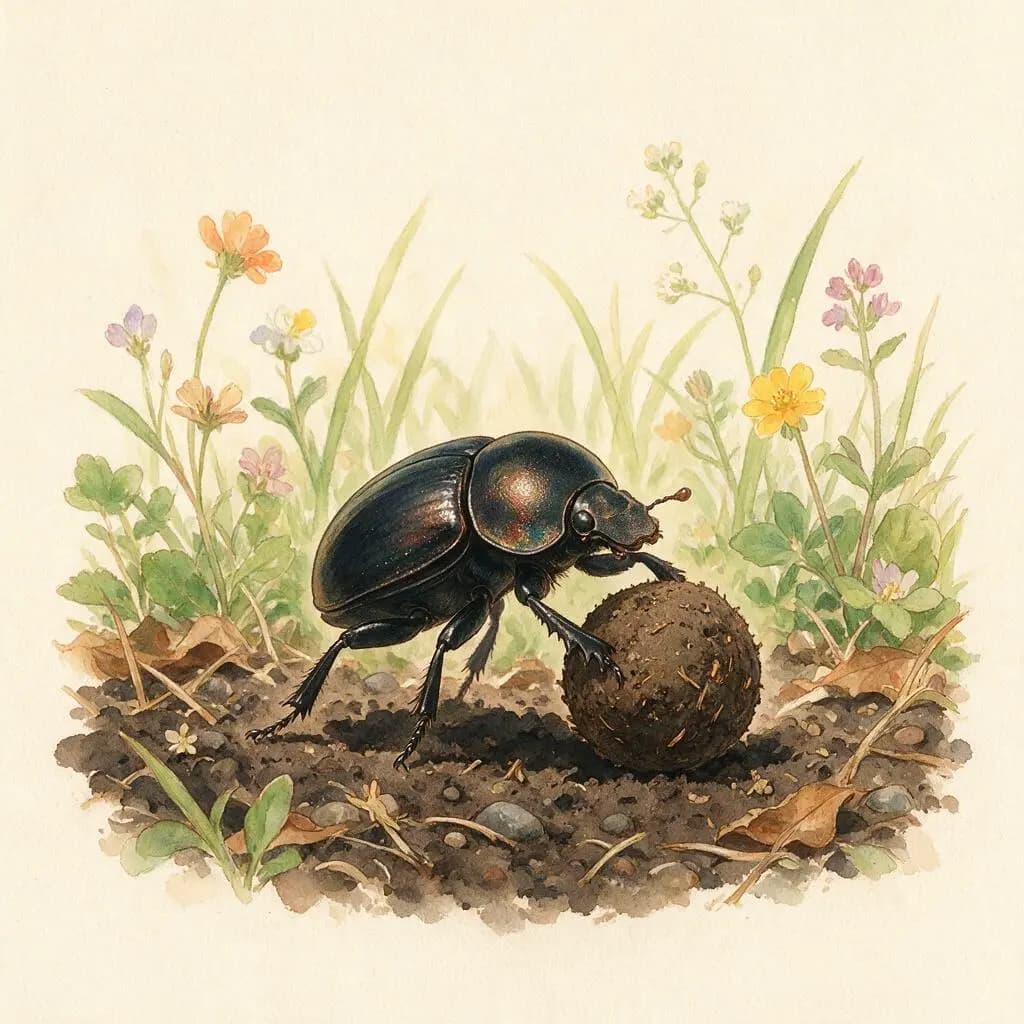
Dung beetle
Scarabaeus laticollis, Geotrupes
Also called: dung beetle, Scarabaeus, black beetle, scarab beetle, earth-boring dung beetle
Dung-eating beetles that bury manure and remains in the soil. They aerate, fertilise and keep fly numbers down by clearing droppings from the surroundings. They contribute to nutrient recycling in the countryside.

How to recognise it at every stage
Garden allySoil ally: it buries dung and turns it into fertiliser.
Life cycle: Complete metamorphosis underground: the female lays an egg inside a buried ball or pear of dung; the larva grows inside eating it, pupates there and the adult emerges. One generation a year.
Tap a stage to see it full size. The photos are AI reference images checked against real photographs; stages without a reliable photo are shown as text only.
Life-stage calendar
| Jan | Feb | Mar | Apr | May | Jun | Jul | Aug | Sep | Oct | Nov | Dec | |
|---|---|---|---|---|---|---|---|---|---|---|---|---|
| Dung ball with egg | ||||||||||||
| Larva | ||||||||||||
| Pupa | ||||||||||||
| Adult |
Approximate months for mainland Spain; in cold areas they start later and in warm areas they last longer. Garden creatures this month
- 1Protect it
Dung ball with egg
· 3-5 cm the ballA buried ball or pear of dung, with an egg inside.
- Where to find it
- Underground, near the dung of grazing animals.
- When: Apr–Jun
- What to do
- Avoid deworming livestock with products that kill dung beetles (ivermectins) if there is an alternative.
- 2Protect it
Larva
· Up to 4 cmWhite, C-shaped, with a hump on its back.
- Where to find it
- Inside its dung ball, underground.
- When: May–Aug
- What to do
- If you dig it up, cover it again.
- Often confused with
- White grub (cockchafer larva). Also white and C-shaped, but it lives loose among the roots, not inside a ball of dung. See profile
- 3Protect it
Pupa
White or cream, with the legs folded, inside the hardened ball.
- Where to find it
- Underground.
- When: Jul–Sep
- What to do
- It cannot be seen.
- 4Protect it
Adult
· 1.5-3 cmA robust black beetle, with toothed front legs; some push balls of dung backwards.
- Where to find it
- In horse, sheep or cow dung and on dirt tracks.
- When: Mar–Oct
- What to do
- Protect it: if you have fresh manure, leave some of it on the ground.
Often confused with
- White grub (cockchafer larva). Also white and C-shaped, but it lives loose among the roots, not inside a ball of dung. See profile
What it eats
- Fresh dung (cow, sheep, horse, goat)
- Decomposing organic matter
How it helps in the garden
How to attract this ally to your garden
- The presence of grazing animals: without dung, there are no dung beetles.
- Ask the farmer whether they deworm with avermectins (ivermectin): its residues come out in the droppings and kill these beetles and other soil insects.
What to avoid so you do not harm it by accident
- Systemic parasite treatments in animals grazing near the garden: the residues come out in the dung and kill the dung beetles that bury it. Ask the vet about other options.
- Clearing away all the dung straight away: leave them some, it is their food.
How to recognise it
1-3 cm, shiny black or metallic. Scarabaeus make rolling balls of dung; Geotrupes dig vertical tunnels under the dung.
Risk to people: None.
Many allies are protected by Spanish law: do not capture or keep in captivity toads, hedgehogs, bats or native reptiles. Attract them, watch them and thank them from a distance. Rules in other countries differ: check your local regulations.

Allies do better if the garden is varied. Learn to identify each visitor and to prevent problems with good habits.