
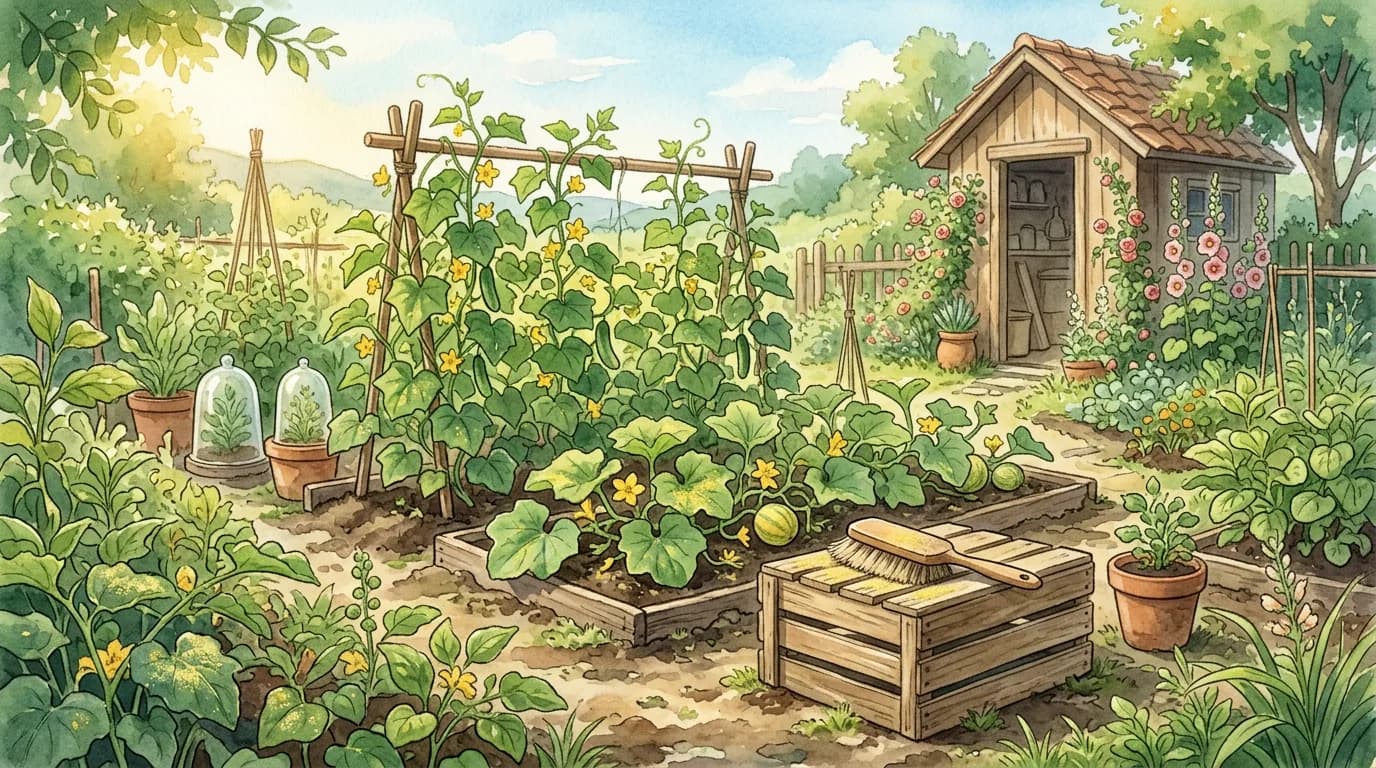
Sulphur against powdery mildew
Wettable or dusting sulphur, the most effective organic treatment against powdery mildew, with a temperature limit and sensitive plants.
Well established. Sulphur is the benchmark fungicide against powdery mildew in conventional and organic farming, with decades of trials. Its effectiveness depends on temperature and it can damage sensitive plants.
Before you start, read the precautions
You will need
- wettable sulphur
- dusting sulphur
- water
- spray bottle
- duster
When to use it
At the first appearance of white spots or preventively when it is moderately hot with humid nights. Avoid applying above 28–30 °C (82–86 °F).
Step by step
1Buy a wettable or dusting sulphur product authorised for gardens/organic and read the label. Wearing gloves and a mask, measure the dose.

2To spray, mix 2.5–3 g (0.09–0.11 oz) of wettable sulphur per litre of water and stir well. For dust, sprinkle a very thin layer with a duster.
3Apply late in the afternoon, with the temperature below 28 °C (82 °F) and no wind. Wet both sides of the leaf.

4Repeat after 10–15 days up to 3–4 times per season and check the result with a magnifying glass a few days later.

Dose
Always follow your product label. Indicative reference from wettable sulphur labels: 250–300 g (8.8–10.6 oz) per 100 litres (about 26.4 US gal) of water (2.5–3 g/L) on cucurbits, maximum 4 applications per season. As a dust, a very thin layer.
Which plants
Courgette, cucumber, melon, watermelon, vine, rose, pome fruit trees, tomato. With care on sensitive pumpkin and melon; avoid on very young crops.
Plants mentioned in this remedy
 Courgette 'Nero di Milano'A cylindrical, very dark green courgette, productive and early, the classic bush type for continuous picking.
 Cucumber 'Marketmore'The 'Marketmore' cucumber is a classic salad cucumber resistant to several diseases.
 Piel de Sapo melonPiel de Sapo is the classic Spanish melon, one that keeps for a long time.
 Watermelon 'Crimson Sweet'A large watermelon with a green rind striped in dark green and very sweet red flesh.
 Italia table grapeA white grape with large, oval berries and a mild muscat flavour.
 Rugosa roseA very hardy rose with distinctive wrinkled leaves, extraordinarily resistant to cold, salt and disease.
 Tomato 'Marmande'Marmande tomato, flattened and ribbed, a good size for salads.
 Butternut squashButternut squash: elongated, sweet and long-keeping.
Precautions
- Do not use sulphur near or above 32 °C (90 °F), and less so on raspberry and strawberry; as a precaution do not apply it above 28–30 °C (82–86 °F), in the middle hours of the day or during a heatwave.
- Some varieties of melon, pumpkin and courgette are sensitive to sulphur: test first on a few leaves.
- Do not mix it or apply it close (at least 2 weeks before or after; some labels ask for more) to treatments with mineral or vegetable oils.
- It irritates eyes, nose and throat: use a mask, goggles and gloves. It is of low toxicity to bees but respect the flowering.
- Respect the safety interval and wash the harvest.
Why it works
Sulphur acts by contact and in the vapour phase, interfering with the respiration of the fungus's spores and mycelium. At higher temperatures it volatilises more, but above about 30 °C (86 °F) it becomes toxic to plants.
Sources
- University of California Integrated Pest Management (ornamentals): sulphur should not be used near or above 90 °F (32 °C), nor in the 2 weeks before or after an oil; it can damage some cucurbits (search summary)
- Dose of 250–300 g/100 L: taken from wettable sulphur labels (SAG Chile and manufacturers), not from a trial; no direct link