
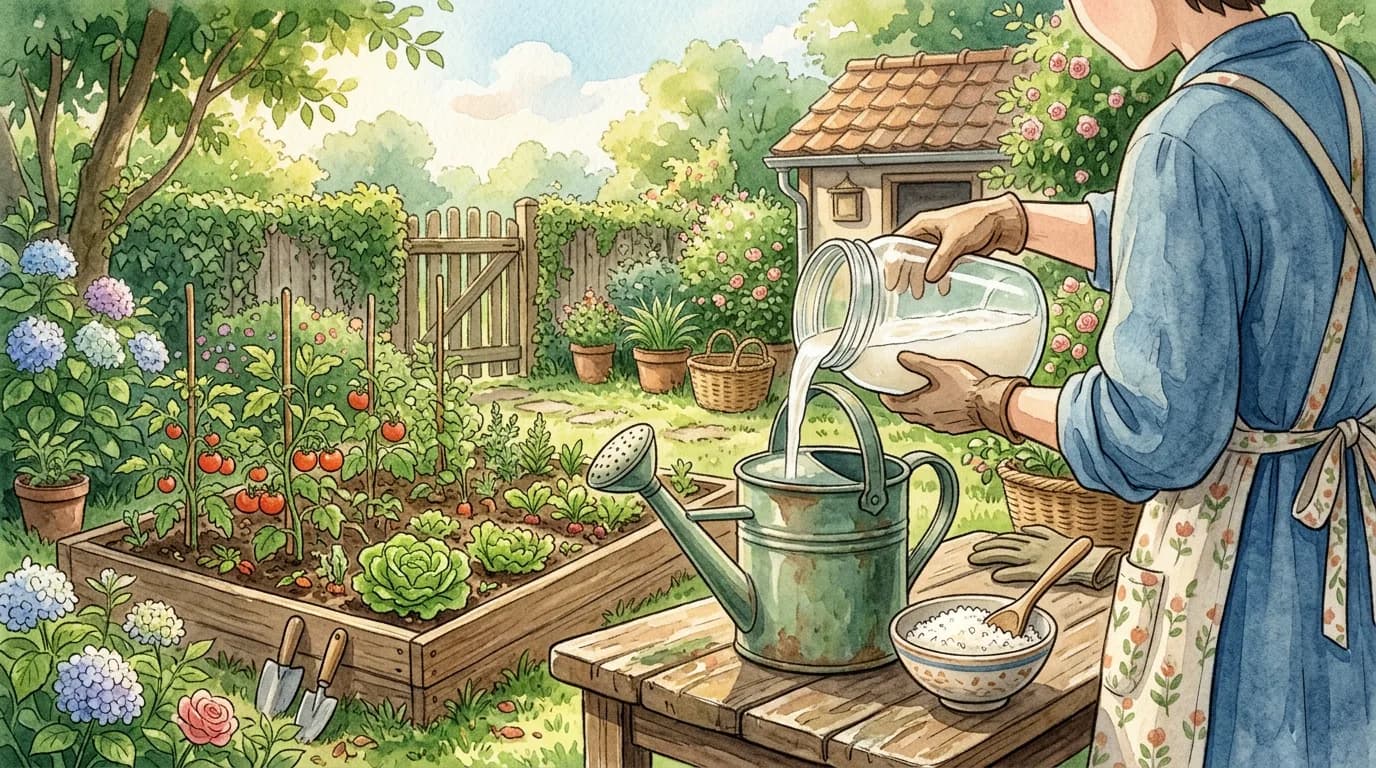
Is rice water any use as fertiliser?
Rice rinsing water supplies few nutrients; fermented it can stimulate micro-organisms, but its effect is modest.
Use with care. There are laboratory studies with fermented rice water on leaf vegetables with growth improvements, but mixed with other fertilisers and with controlled doses. At home the contribution is small and variable.
Before you start, read the precautions
You will need
- rice rinsing water
- water
- watering can
When to use it
As an occasional watering for houseplants or leaf vegetables, if you have no other fertiliser. Do not expect a strong effect.
Step by step
1Rinse unsalted rice in clean water and collect the cloudy water (cooking water with salt will not do).
2Use it the same day, diluted 1:1 with water, or leave it to ferment 1–3 days covered with cloth in a warm place.
3Water the growing medium, not the leaves, once a week at most.
Dose
As a guide, with no validated dose for home use: one part of rice water to one of water, once a week at most, applied onto the growing medium.
Which plants
Leaf vegetables, herbs and houseplants. Avoid on cacti and succulents.
Precautions
- Never use salted cooking water: salinity and harm to roots.
- Fermentation smells bad and attracts flies; do not leave it more than 3 days.
- In excess, organic matter in a pot can favour fungus gnats and fungi.
- It does not replace fertiliser: it supplies very little N, P and K.
Why it works
Rice water contains starch and traces of nutrients that feed soil micro-organisms; when it ferments, bacteria appear that can help the roots. The direct effect as a fertiliser is limited.
Sources
- Agronomy 2022, 12(9): 2220, rice rinsing water (fresh and fermented for 3 days) on choy sum over three cycles; only a search summary was consulted
- Follow-up study (PubMed Central): fermented rice rinsing water with and without NPK fertiliser over three field cycles; search summary