

Garlic steeping as an insect repellent
A strong-smelling liquid that discourages aphids, whitefly and mites; a repellent effect, not a quick-acting one.
Works in practice. Many gardeners use it, but there is little research on its effectiveness and garlic can repel and harm bees and other useful insects. A review of homemade preparations found variable effectiveness and almost always lower than commercial insecticides.
Before you start, read the precautions
You will need
- garlic
- water
- spray bottle
- scissors
When to use it
At the first sight of colonies of aphids, whitefly or mites, or as gentle prevention on young plants. Always at dusk. If what you want is to hold back fungi, see the profile “Garlic infusion as a preventive antifungal”: it is a different preparation and a different dose.
Step by step
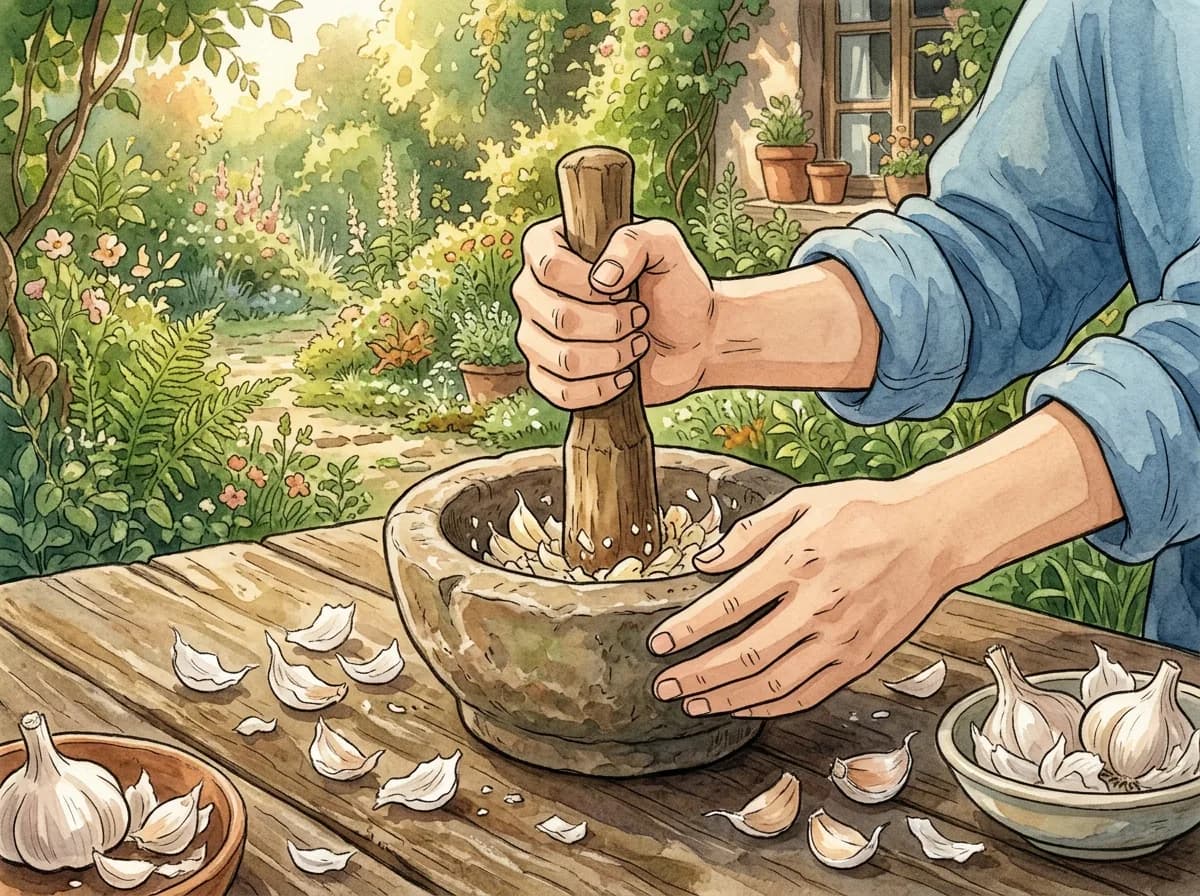
1Peel a head of garlic (about 50 g, 1.8 oz) and crush the cloves in a mortar to break the cells and release the allicin.
2Cover with 1 litre (about 1.1 quarts) of water without chlorine (rain or left to stand 24 h), cover with a cloth and leave to steep for 24 hours in the shade.

3Strain through a fine cloth, pour it into a spray bottle and apply onto the undersides of the leaves at dusk. Repeat after 5–7 days if needed.

Dose
As a guide (there is no dose validated in trials): 50 g (1.8 oz) of garlic per litre of water; start by diluting by half and only increase if there is no damage. Maximum 2–3 applications in a row, with 5–7 days between. Use it the same day or keep it 2–3 days at most.
Which plants
Works on tomato, pepper, aubergine, roses and fruit trees visited by aphids or whitefly. Avoid newly emerged seedlings and plants with very thin or hairy leaves.
Plants mentioned in this remedy
 ajoLas Pedroñeras purple garlic, with a purple, very aromatic bulb: the benchmark garlic of La Mancha, in…
 Tomato 'Marmande'Marmande tomato, flattened and ribbed, a good size for salads.
 Sweet pepper 'California Wonder'California Wonder pepper, a blocky bell type with thick flesh, for stuffing or eating fresh.
 Long black aubergineAn aubergine with glossy black fruit, for warm climates.
Precautions
- Do not spray open flowers or when there are bees: it can repel them and harm useful insects.
- Test first on 2–3 leaves and wait 24 h; on sensitive plants (young beans, seedlings) it can scorch.
- Do not apply it in full sun or above 30 °C (86 °F).
- It smells strong: avoid spraying near where you will eat or near washing on the line.
Why it works
The sulphur compounds of garlic (allicin and derivatives) have a smell and taste that repel many sap-sucking insects, and at high doses they can irritate them. It is a repelling effect and not a quick-acting one, which is why it needs repeating.
Sources
- University of Florida IFAS Extension (Institute of Food and Agricultural Sciences, Nassau County): little research on the effectiveness of garlic as an insecticide and risk to bees and beneficial insects (gives no recipe or dose)
- Review “Efficacy of homemade botanical insecticides based on traditional knowledge” (garlic, chilli and others): variable effectiveness and often lower than commercial insecticides