
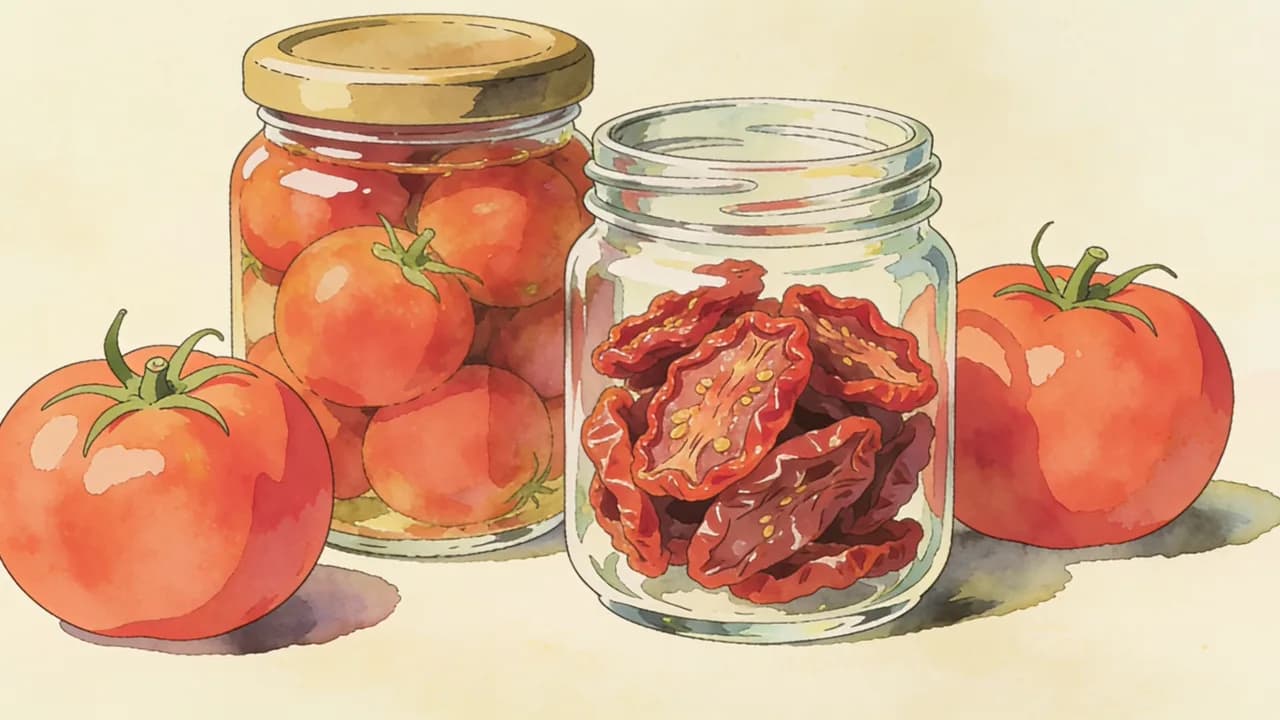
Hot-pack canning (boiling water bath)
Canning tomatoes in jars (boiling water bath)
Tomato is close to the acidity limit considered safe for canning in a water bath. That is why it must always be acidified with bottled lemon juice, citric acid or 5% vinegar: this makes it harder for Clostridium botulinum, the bacterium that produces botulism in oxygen-free environments, to grow. Here, the water bath means submerging the closed jars in boiling water for the correct time. It is not the same as a kitchen pressure cooker or a multicooker; for low-acid vegetables you need a calibrated pressure canner. This guide is only for acidified tomato.
When to use it
When you have a big tomato harvest and want sauce or crushed tomatoes for months. If the sauce contains onion, pepper, garlic or oil, the acidity drops and acidifying is no longer enough: don't can it for the pantry, and freeze it.
What you will need
- Preserving jars with a new lid (important)
- Tall pan for the water bath (with the jars covered by 3 cm, 1.2 in of water)
- Tongs or a jar lifter for taking out the hot jars
- Cloth
Works well with
General process
- 1Sterilise the jars by boiling them for 10 minutes or putting them in the oven for 20 minutes at 120 °C (248 °F).
- 2Prepare the crushed tomato or sauce, without onion or oil.
- 3ALWAYS acidify before closing, adding the acid to the empty jar. For a jar of about 500 ml (16.9 fl oz), one of these options is enough (bottled lemon juice is the most recommended): 1 tablespoon of bottled lemon juice, or 1/4 teaspoon of citric acid, or 2 tablespoons of 5% vinegar (the latter leaves more flavour). For a 1 L (about 1.1 quarts) jar, double it. Fresh lemon is not suitable, because its acidity is not consistent.
- 4Fill the jars with the tomato while still hot, leaving 1.5-2 cm (0.6–0.8 in) of space at the top.
- 5Close tightly and place the jars in the pan on a cloth, with other cloths between them so they don't knock together as they boil.
- 6Cover with water and count the time from when it is boiling hard: 35 minutes for 500 ml (16.9 fl oz) jars and 45 minutes for 1 L (about 1.1 quarts) jars. At altitude water boils at a lower temperature, so lengthen the time: 5 minutes more between 300 and 900 m (2952.7 ft) of altitude, 10 more between 900 and 1800 m (5905.4 ft) and 15 more above that (Madrid, at about 650 m, 2132.5 ft, already needs those 5 minutes).
- 7Turn off the heat, wait 5 minutes and take the jars out with the tongs. Leave them on a cloth, without moving them, for 12-24 hours.
- 8Check the vacuum: the lid should be pulled down and firm.
Worked example: Crushed tomato in jars for the whole year
Ingredients
- 3 kg (6.6 lb) ripe tomatoes
- 1 teaspoon of salt per litre of tomato (optional)
- 1 tablespoon of bottled lemon juice per 500 ml (16.9 fl oz) jar (2 tablespoons if the jar is 1 L, about 1.1 quarts)
Steps
- Blanch the tomatoes for 30 seconds, peel and chop them.
- Crush them and add the salt.
- Cook them over a low heat for 20 minutes so they lose the excess water.
- Put the lemon juice in each empty jar and fill it with the hot tomato.
- Close and apply the water bath: 35 minutes (500 ml, 16.9 fl oz) or 45 minutes (1 L, about 1.1 quarts), plus any extra time that applies if you live at altitude.
- Leave them to cool for 12-24 hours, check the vacuum and label with the date.
Food safety (important)
- Without proper acidifying, jarred tomato is not safe in the pantry. Use the amounts given.
- Use healthy, firm tomatoes. Very overripe, bruised or rotten ones, and those from vines that died from frost, are less acidic and not suitable for preserving.
- If a jar doesn't form a vacuum (the lid moves), keep it in the fridge and eat it within a few days, or throw it away.
- If there is an odd smell, cloudy liquid, bubbles or a swollen lid, don't eat it or taste it. Botulism is rare, but very serious.
- Don't use a kitchen pressure cooker as if it were a pressure canner.
Common mistakes
- If you don't sterilise the jars and lids properly, moulds or bacteria can get in and the preserve spoils within a few days.
- Filling the jar to the brim: without headspace the vacuum doesn't form properly.
- Not labelling with the date: after a year you no longer know what each jar is.
Golden rule: if in doubt, throw it out. A suspicious jar is worth less than food poisoning. Once you have mastered one method, you will see the pantry fill itself and you will eat from your garden all year round.
Explore all the methods
Pickles, fermenting, jams, boiling water bath, oils, drying and freezing.