
Fermentation
Sauerkraut and fermented vegetables
Lactic fermentation is an ancient, simple technique: just salt (2–3% of the weight), vegetables and time. Lactic bacteria (such as Lactobacillus) acidify the medium and make it more stable. The risk is low if you keep everything submerged, use the right amount of salt and follow good hygiene practices; it is not zero. If you see coloured mould (green, blue, black, pink), notice a rotten smell or the jar swells, throw the contents away.
When to use it
Cabbages, carrots and radishes work very well. It is ideal for winter, when you miss fresh, crunchy vegetables.
What you will need
- Large wide-mouthed glass jar, or a fermenting jar with an airlock
- Non-iodised salt (sea salt or Himalayan salt)
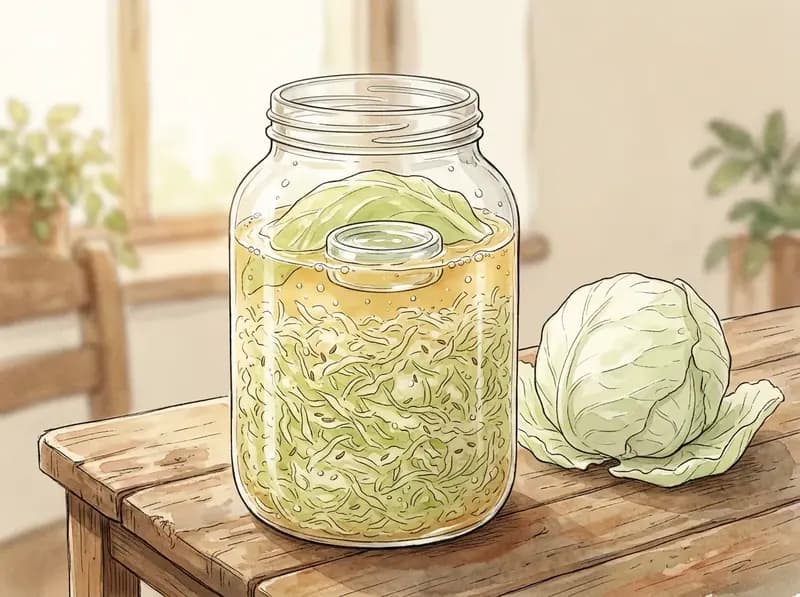
- A weight to keep the vegetables submerged (a well-washed stone, a small plate or a bag of brine)
- Cloth or loose lid (the gases must be able to escape)
Works well with
General process
- 1Cut the vegetables finely.
- 2Massage them with salt (2-3% of the weight; for example, 20 g, 0.7 oz per kilo of vegetables) until they release water.
- 3Fill the jar, packing it down well, until the vegetables are covered by their own liquid.
- 4Add a weight so that EVERYTHING stays below the liquid.
- 5Cover loosely (or with an airlock) and leave at 18-22 °C (64–72 °F), out of the sun, for 1 to 4 weeks: the warmer it is, the faster it ferments.
- 6Taste the vegetables from day 5 with a clean utensil. When it is sour enough for your taste, close the jar and put it in the fridge.
Worked example: Classic cabbage sauerkraut
Ingredients
- 1 white cabbage (~1 kg, 2.2 lb)
- 20 g (0.7 oz) non-iodised sea salt
- Optional: 1 teaspoon of caraway or cumin seeds
Steps
- Discard the damaged outer leaves and set aside 1-2 whole leaves.
- Cut the cabbage into very thin strips.
- Mix the cabbage in a large bowl with the salt and massage it for 5-10 minutes, until it releases plenty of liquid.
- Add the caraway, if using.
- Fill the jar, packing it down in layers.
- Place the reserved leaves on top, as a vegetable lid.
- Put a weight on top so that everything stays submerged.
- Cover without tightening and leave the jar at 18-22 °C (64–72 °F) for 2-4 weeks.
- Taste from day 5. When it is to your liking, close the jar and keep it in the fridge.
Food safety (important)
- The vegetables must ALWAYS be under the liquid: that way no oxygen reaches them and no mould forms.
- A smooth white film (kahm) on the surface is harmless: remove it and the sauerkraut underneath is fine. Don't confuse it with mould, which is fuzzy and coloured.
- Blue, green, black or pink mould: throw out the whole jar.
- A rotten smell (different from the sour, cabbagey smell typical of fermentation): throw it away.
Common mistakes
- With too little salt the fermentation fails and the vegetables rot: stick to the proportion in the recipe and weigh the salt.
- With too much salt the useful bacteria stop working and the vegetables end up tough and too salty.
- A completely airtight lid builds up pressure and can burst the jar. Use an airlock or a loose lid.
Golden rule: if in doubt, throw it out. A suspicious jar is worth less than food poisoning. Once you have mastered one method, you will see the pantry fill itself and you will eat from your garden all year round.
Explore all the methods
Pickles, fermenting, jams, boiling water bath, oils, drying and freezing.