
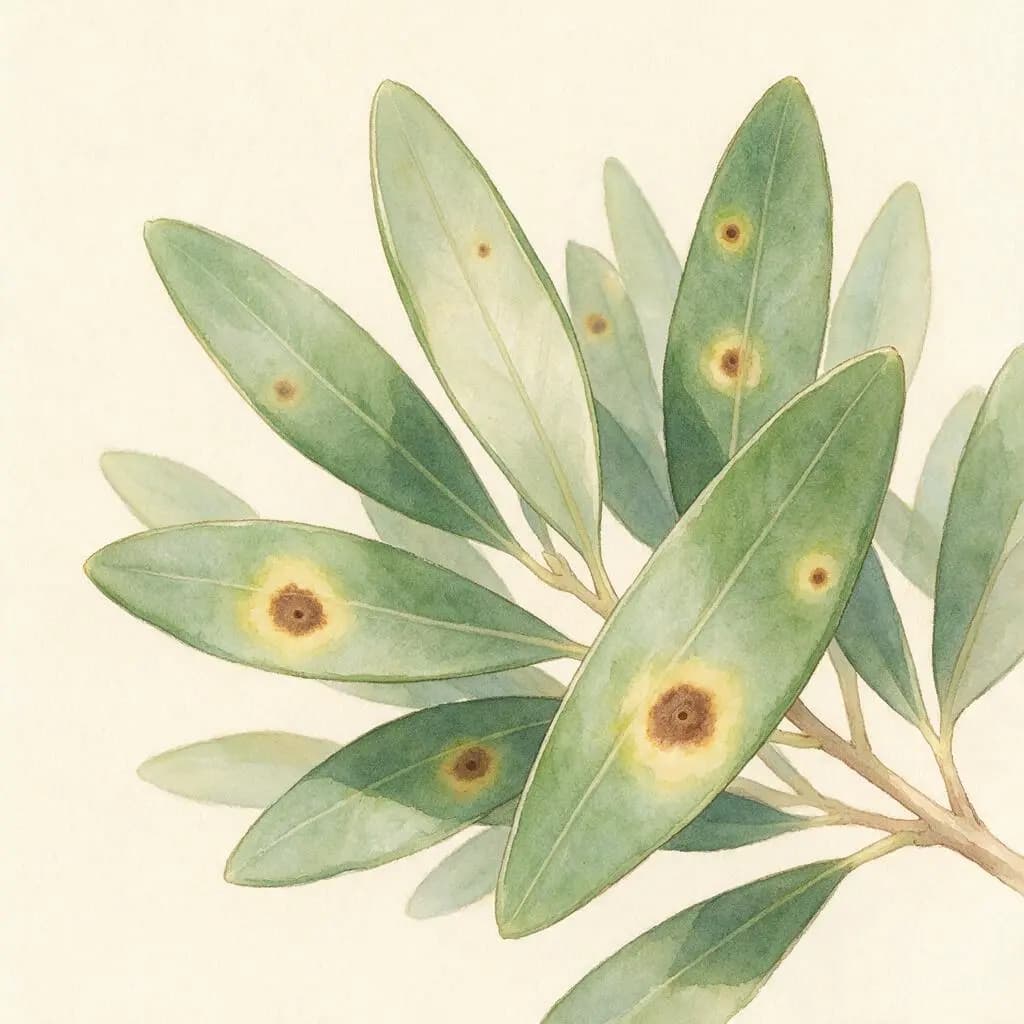
Olive peacock spot
Also known as: olive peacock spot, peacock spot, olive leaf spot, bird's eye spot, Spilocaea oleaginea, Fusicladium oleagineum
A fungus characteristic of olive trees that forms round, dark spots with a yellow halo (‘peacock eye’ or ‘bird's eye’) on the leaves and causes heavy leaf drop. The first step is to open up the canopy by pruning and treat with copper before the autumn rains or at the end of winter.

How to recognise it (symptoms)
- Round, greenish-brown spots (5 to 10 mm) with a yellow halo
- Leaves that drop en masse, leaving bare branches
- Spots on the fruit and the fruit stalk as well
- A thinned-out canopy by the end of winter
Crops affected

What favours it
- Mild, damp autumns and winters
- Dense, poorly ventilated olive groves, where humidity lingers in the canopy
- Susceptible varieties, such as Picual or Hojiblanca
Prevention
- Thinning cuts every year to ventilate the canopy
- Do not overdo nitrogen fertiliser
- If there is a heavy outbreak, gather the fallen leaves, which harbour the fungus, and put them in the rubbish bin
Organic treatment
Always start here: these remedies are kind to the garden, the soil and pollinators.
- First: open up the canopy by pruning and gather the fallen spotted leaves
- Copper (oxychloride or hydroxide) in two treatments: after harvest and at the end of winter, according to the product label
- Bordeaux mixture after the first autumn rains, if it is a product registered for olives
Don't confuse it with…
With other olive diseases, such as anthracnose or soapy olive. Peacock spot has the characteristic yellow halo around the spot.
In-depth guide — olive peacock spot
Spilocaea oleaginea causes spots on the leaves and leaf drop in winter. Ventilating the canopy and a preventive treatment in autumn greatly reduce pressure from the fungus.
Pruning for air flow
Open up the centre of the canopy to let light in and allow the foliage to dry after rain. Remove branches that cross and rub.
Leaf hygiene
- Gather spotted fallen leaves and remove the leaf litter from the olive grove.
- Avoid sprinkler irrigation over the leaves in autumn.
- Do not over-feed susceptible varieties with nitrogen.
Preventive treatment
Copper or another registered fungicide in autumn, after the first rains, and at the end of winter, before bud break, if there was heavy leaf drop the previous year. Respect the rate on the label.
Varieties and microclimate
Picual and Hojiblanca are more susceptible in damp areas. In a home garden, choose a sunny position and avoid valleys where mist collects.
Use plant protection products responsibly, even organic ones. Always read and follow the label, the doses and the harvest interval, and never treat plants in flower or while bees are flying, in order to protect pollinators. If in doubt, put prevention and organic methods first.

In the plant catalogue you'll see what to plant, how and when: a well-tended plant resists pests much better.